
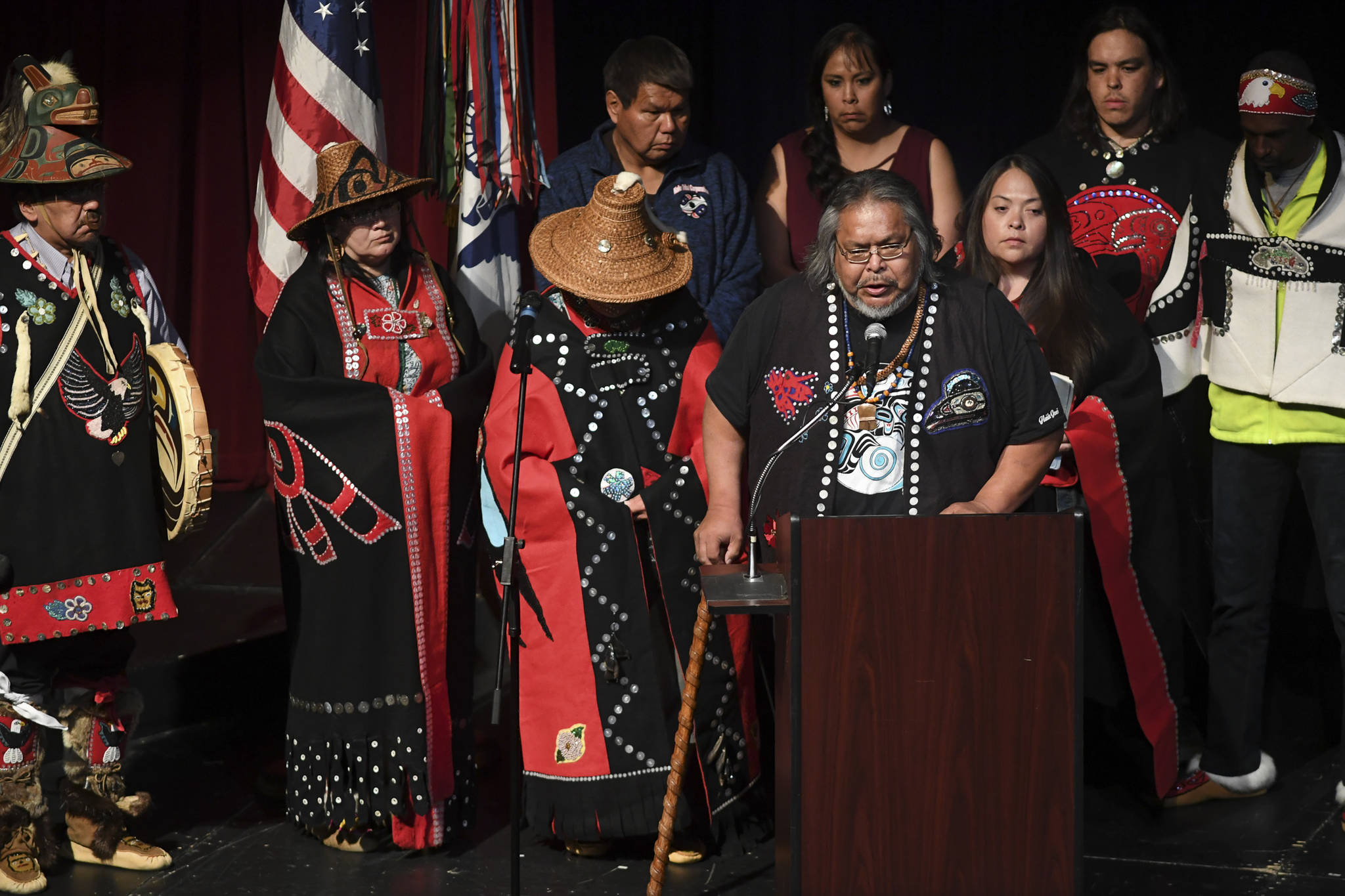
By Joel Jackson
In a My Turn published on Oct. 2, former Governor Frank Murkowski described two sovereign, federally-recognized Tribes as ‘environmental groups’ in a tirade against what he perceives to be outside interests styming all development in our state. I represent one of those tribes, the Organized Village of Kake.
[Environmental groups should disclose funding sources]
My tribal nation provides many services for our citizens, including social services, general assistance, a food bank, funding for higher education, substance abuse support, a teen center, historic preservation efforts, repatriation of our cultural artifacts and monitoring and inventorying our natural resources. Stewardship of the natural resources in our traditional territory is an important function of our Tribe, as the bounty provided by these lands and waters is the reason that the Tlingit, Haida and Tsimshian peoples and our cultures have thrived in this region for over 10,000 years.
No one is more interested in the future prosperity of these lands than the Indigenous first peoples of Alaska, including myself and the members of my tribe. Our lands and waters provide us with our food, our cultural resources, the ability to practice our way of life. Healthy old-growth forests are integral to the future of our community and our peoples; take it from me, a former logger, who participated in the timber boom around Kake. Now, I am surrounded by the long-lasting effects of this short-sighted industrial activity. The paychecks and jobs have dried up, but the forest, our deer and moose populations, and our salmon streams have not yet recovered from this era. Since we have seen first-hand the destruction of the resources and habitat that our community depends on, we seek to protect what is left.
The Organized Village of Kake is not interested in short-term profit, exploiting what we have to create gains for the next 10-50 years; we are planning for the next 10,000 years of prosperity.
That is why OVK is investing in protecting our lands, our old-growth forests and our clean waters: we know that the survival of our community is tied to the Earth’s ability to regenerate and adapt. We are not alone in this realization: OVK works with a wide variety of partners, including other tribal governments, Native corporations, nonprofits, local businesses — including two small-scale sawmills in Kake — and conservation organizations to create cultural, ecological and economic prosperity for our communities and region. On the other hand, when industrial scale clearcutting takes place on the Tongass, the economic value of this development does not make it back to the communities it affects. This type of logging doesn’t create jobs for our village; and the negative impacts to our forest far outweigh any immediate economic value that is derived according to Western capitalist systems.
Where Mr. Murkowski and I can agree is that too little of what we produce is consumed within Alaska. OVK is actively working to change this: we think that our residents should be the first to enjoy, draw economic value from, and consume our State’s resources. That is why OVK purchases the lumber for our historic cannery restoration project from our local mills in Kake. We cannot support the wholescale export of our round longs to Asia; our forest does not regenerate at a rate that allows it to be competitive on a global market. What we can do is support local businesses, including the small-scale mills in Kake that keep economic benefits circulating in the community and region.
Just as Mr. Murkowski partners with the timber and mining industries to advocate for their vision of Alaska, OVK partners with organizations that have a like-minded vision for our future. Our partnership does not mean that we are an ‘environmental organization’; it means that there is a growing movement of Alaskans who realize that we cannot continue to subsidize timber, mining, oil and gas companies to export our resources abroad, and that industrial development cannot continue to disproportionately impact our rural communities’ way of life. While we may share similar goals, we are not a part of any of these organizations: we are tribal people, and we will always advocate for the interests of our communities. Irresponsible, short-sighted projects like the repeal of the Roadless Rule will not lead to sustainable economic development and growth; it will primarily benefit special timber and mining interests that depend on extracting our resources and sending them out of state. The Roadless Rule is not to blame for the economic infeasibility of many projects in Southeast Alaska, and repeating this lie for years on end will not make it true.
The Organized Village of Kake will stand up for the protection of our way of life now and well into the future. Our state is not a ‘natural resource warehouse’ for corrupt politicians and multinational corporations to freely exploit at the expense of our local peoples. Over the past two years we have seen our leaders repeatedly ignore public will and the Tribes, municipalities, fishermen, visitor industry, and citizens speaking in defense of these lands. Now, it is time for Alaskans to hold our leaders accountable for their actions.
• Joel Dáxhajóon Jackson of the Kàach.àdi clan, a child of the Tsaagweidi clan, and is a lifelong resident of Kake. He currently serves as the council president of the federally recognized tribe, the Organized Village of Kake. He has been on the tribal council for almost 30 years. He was formerly employed as a road-builder for the Kake Tribal Corporation for 22 years, the chief of police for Kake for three years, and as a commercial fisherman. Columns, My Turns and Letters to the Editor represent the view of the author, not the view of the Juneau Empire. Have something to say? Here’s how to submit a My Turn or letter.
