
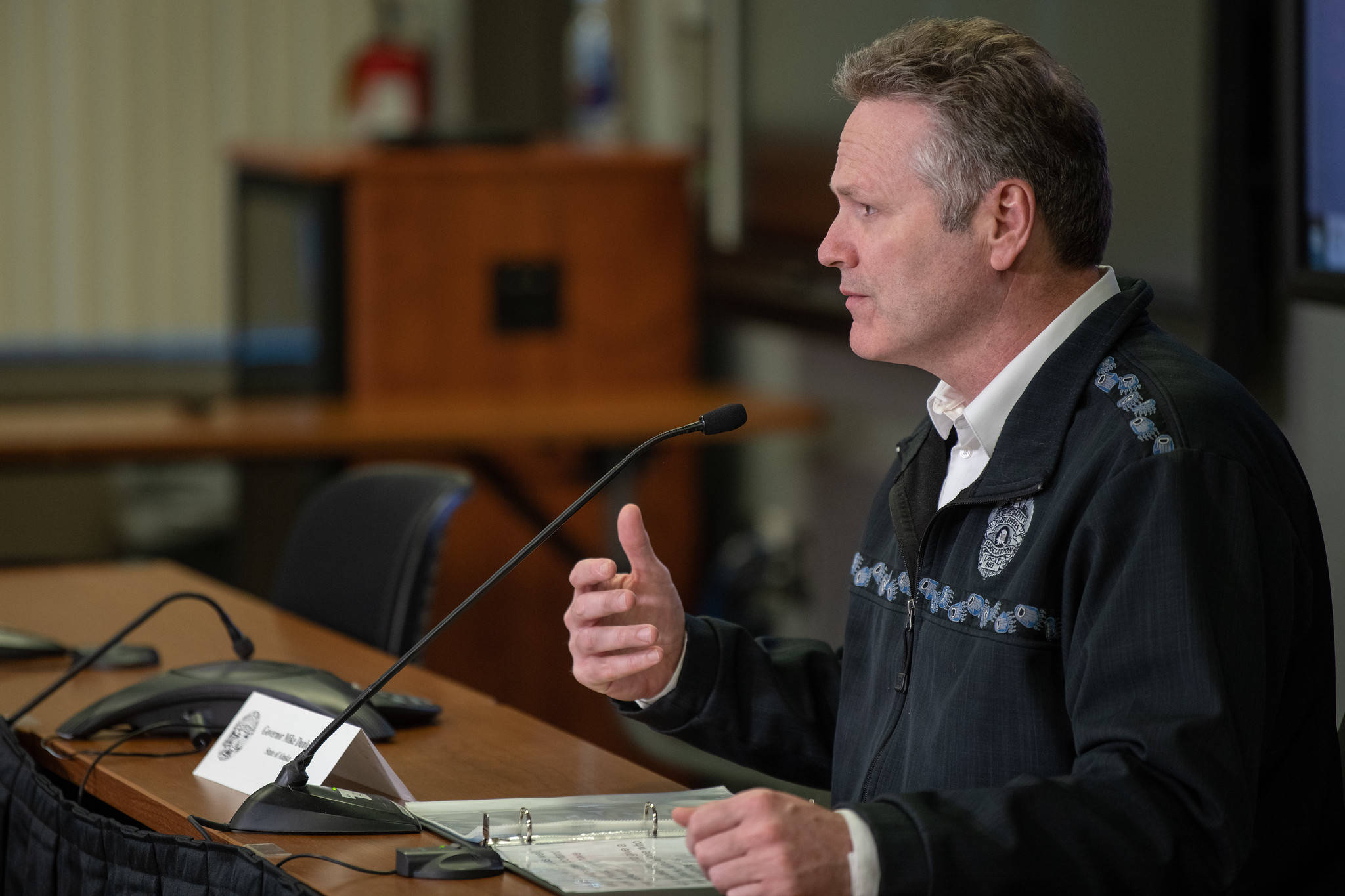
Gov. Mike Dunleavy has handled the COVID-19 pandemic better than many of his counterparts across the country. One reason is he trusted the experts in the medical profession. Another was following the lead of local officials in Anchorage, Ketchikan and Juneau.
But in addressing Alaska’s financial crisis, he’s only trusted economists who agree on the path he’s chosen — balancing the budget by limiting state spending to existing revenue.
Even before the economy was dragged to a standstill, that policy goal was never realistic. The problem is oil taxes make up way too much of our existing revenue. And as the pandemic revealed once more, the price of oil is too volatile for it to be the basis of sustainable state spending plan.
Last August, Dunleavy claimed that as a candidate for governor he believed the budget could be balanced primarily through “a series of costs savings, efficiencies and targeted reforms.” That was because “the price of oil was trending at nearly $85 per barrel.”
He also said we could “no longer afford to deplete our savings and hope for higher revenues.” But a sustainable plan based on $85 meant the price of oil must remain reasonably close to that. And we don’t have to go too far back in time to see why that false hope turned into a $400 million spending veto.
When he declared his candidacy in July 2017, oil was selling for $49 per barrel. For the next 14 months it averaged $66. It was over $80 after that, but only for three weeks.
Before all that, it had to rise from a January 2016 low of $26. After falling six months from high of $144, that’s where it bottomed out during Great Recession of 2008. And we’re back at rock bottom again today.
“No other state is so dependent on a single industry for revenues to support state and local government” economist Scott Goldsmith wrote in March 2010. A year later, he suggested that once the Permanent Fund annual earnings were big enough, they could “eventually replace a substantial share of oil revenues from state lands.”
That also meant reducing the size of the Permanent Fund Dividend.
As a candidate in 2014, Bill Walker opposed that idea and raising taxes. But when faced with the oil price bust in 2015, he proposed a revenue plan that included tapping the Permanent Fund’s earnings along with spending reductions, modest tax increases, and oil and gas tax credit reform.
“Not a single one of these actions is easy or popular” he wrote the following summer. “But doing nothing is far worse.”
Walker understood spending cuts alone wouldn’t solve the problem. Because laying off “every state worker paid with unrestricted general funds” would still leave a $1 billion deficit.
That hasn’t changed.
David Teal, who retired after serving as Alaska Legislature’s chief budget analyst for 22 years, delivered the same message to them again last summer.
However, the expertise of economists like Goldsmith and Teal never interested Dunleavy. In 2016, he was a member Senate majority that opted for the “far worse” option. When they relented and used money from the Permanent Fund’s earnings the following year, Dunleavy quit the caucus.
He’s been on his own highway ever since. And along the way he watched the state’s budget reserves go from $10 billion to $1.4 billion.
Now he’s anxious to reopen Alaska’s economy, which is understandable. But Princess Cruises and Holland America aren’t coming this summer. The others will likely cancel too. And oil prices won’t suddenly rebound.
The state’s economic uncertainty doesn’t end there. “What is unsettling about this crisis is that it doesn’t fit our preconceived notions of how the world works,” Robert. J. Samuelson wrote in the Washington Post this week. “The expectation that after the present recession we should have a standard recovery is based on our past experience. It’s not inevitable.”
The uncomfortable ironies this has created for Dunleavy are becoming obvious.
The private sector won’t pull us out this hole without a lot of help from the very government which he’s been trying to cut to the bone. And because that pursuit helped deplete the state’s budget reserves, he needs a bailout from the debt-ridden federal government.
• Rich Moniak is a Juneau resident and retired civil engineer with more than 25 years of experience working in the public sector. Columns, My Turns and Letters to the Editor represent the view of the author, not the view of the Juneau Empire.
