
Opinion: You can help the bears we love

Bears are in trouble now. They are being drawn into our neighborhoods by easy meals of garbage

  • By Laurie Craig
  • Friday, September 4, 2020 12:18pm
  • Opinion
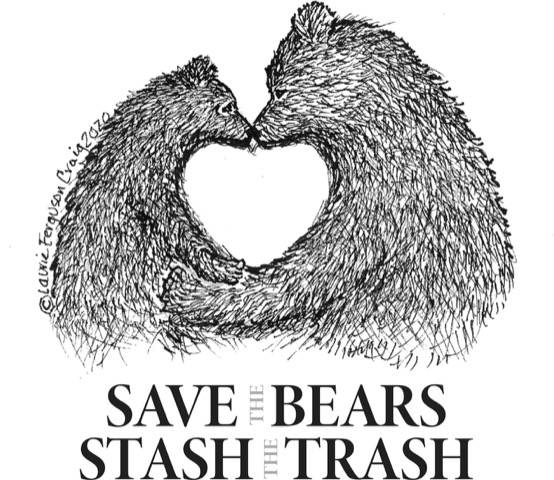
Laurie Craig is an artist, naturalist, and retired Forest Service park ranger who worked at Mendenhall Glacier Visitor Center from 2004-2018. She encourages people to keep this image in mind as a reminder that bears’ survival can be aided by human behavior.

Laurie Craig is an artist, naturalist, and retired Forest Service park ranger who worked at Mendenhall Glacier Visitor Center from 2004-2018. She encourages people to keep this image in mind as a reminder that bears’ survival can be aided by human behavior.

By Laurie Craig

As a park ranger at Mendenhall Glacier Visitor Center, I spent years teaching thousands of people to ethically watch and love bears. Together, we safely observed mother bears tenderly nurse and play with their cubs. We watched the bears nap in trees and catch bright red salmon in Steep Creek. We watched bears live wild lives. Although I retired two years ago, my concern for bears and people continues.

Keeping human food away from bears at the glacier was always, and continues to be, key to bear and human safety. This is true in Juneau’s neighborhoods, as well.

Bears are in trouble now. They are being drawn into our neighborhoods by easy meals of garbage. A few simple steps can save their lives. A bear is most hungry in autumn — their last chance to build fat reserves for hibernation.

Helping is easy: rinse, freeze hold.

At home, rinse out food containers before putting them into your trash or recycling bins. Freeze smelly items to reduce their attraction to bears and other wildlife. Hold trash cans in a secure structure until 4 a.m. on the morning of trash pickup. Clean and frozen trash won’t give off as much scent, which means it’s less of a hassle to store inside.

Use a bear-resistant trash can. Most trash cans in Juneau are not bear resistant. This week, I joined the Juneau Bear Committee to affix yellow stickers to cans that are not bear resistant to help reduce confusion for customers.

Our trash hauler, Alaska Waste, offers bear resistant cans for an additional fee of about $7 per month. More bear resistant cans are due to arrive soon. Call the company at 780-7800 for details and to get on the first-come, first-served list for one of the new arrivals. Or, add your name to next year’s waiting list so enough cans will be ordered for 2021. Currently, 100 neighbors are on the 2020 waiting list.

[Group works to remind there is no such thing as bear-proof]

Replace broken cans. If your can — especially a bear-resistant can — is broken, call the waste hauler to replace it. That notification is the homeowner’s responsibility. Cans can be replaced free once a year by the company, so if yours is shabby, get a new one.

Dumpsters are especially important because they contain so much trash. Apartment and condo tenants should follow the same rinse, freeze and hold procedures. Learn how to operate and secure the dumpsters, reinforce the lids, and keep out bears. It is the landlord’s responsibility to make sure that dumpsters function properly.

Remove food and wrappers from the car. Keep the doors locked at all times to prevent bears from opening the vehicle and climbing in.

Years ago, when 20 bears were killed because of trash, outraged Juneau residents demanded the city take action. The Urban Bear Ordinance was created to provide incentive and enforcement. The first step is education; the next step is citations and costly fines. Call Juneau Police at 586-0600 to contact Community Service Officers if a neighborhood is in need of help.

Alaska Department of Fish and Game also has regulations to prevent people negligently or intentionally giving human food to bears.

Sadly, bears have paid for our carelessness with their lives. Nine bears were killed this year; four were relocated. The problems continue and more bears will die if we don’t clean up our trash and eliminate attractants.

Bears live long lives and rely on wild foods. Several familiar bears are 20-plus years old. They are the matriarchs, the clan mothers, of wild bears. GPS collar data from some bears show they spend a small amount of time seeking trash, and mostly live in the woods. They should not be condemned as “garbage bears.” They are good bears lured into bad places. The forest provides bears’ natural foods, but in lean years like this, they search for easy meals like trash. Bear scat reveals they ate plastic and human garbage.

For years, we have loved watching bears, following their lives and rejoicing at their annual return. Now we need to save bears. Please post the image embedded with this article in your kitchen to remind your family that bears’ survival is in our hands.

• Laurie Craig is an artist, naturalist, and retired Forest Service park ranger who worked at Mendenhall Glacier Visitor Center from 2004-2018. Columns, My Turns and Letters to the Editor represent the view of the author, not the view of the Juneau Empire. Have something to say? Here’s how to submit a My Turn or letter.

More in Opinion

Web
Have something to say?

Here’s how to add your voice to the conversation.

David Guttenfelder/The New York Times
FILE — Federal agents arrest a protester during an active immigration enforcement operation in a Minneapolis neighborhood, Jan. 13, 2026. The chief federal judge in Minnesota excoriated Immigration and Customs Enforcement on Wednesday, Jan. 28, saying it had violated nearly 100 court orders stemming from its aggressive crackdown in the state and had disobeyed more judicial directives in January alone than “some federal agencies have violated in their entire existence.”
OPINION: When silence signals consent

Masked ICE enforcement and the failure of Alaska’s congressional leadership.

Northern sea ice, such as this surrounding the community of Kivalina, has declined dramatically in area and thickness over the last few decades. Photo courtesy Ned Rozell
20 years of Arctic report cards

Twenty years have passed since scientists released the first version of the… Continue reading

Dr. Karissa Niehoff
OPINION: Protecting the purpose

Why funding schools must include student activities.

A sign reading, "Help Save These Historic Homes" is posted in front of a residence on Telephone Hill on Friday Nov. 21, 2025. (Mari Kanagy / Juneau Empire)
OPINION: The Telephone Hill cost is staggering

The Assembly approved $5.5 million to raze Telephone Hill as part of… Continue reading

Win Gruening (courtesy)
OPINION: Eaglecrest’s opportunity to achieve financial independence, if the city allows it

It’s a well-known saying that “timing is everything.” Certainly, this applies to… Continue reading

Gov. Mike Dunleavy gestures during his State of the State address on Jan. 22, 2026. (Photo by Corinne Smith/Alaska Beacon)
OPINION: It’s time to end Alaska’s fiscal experiment

For decades, Alaska has operated under a fiscal and budgeting system unlike… Continue reading

Atticus Hempel stands in a row of his shared garden. (photo by Ari Romberg)
My Turn: What’s your burger worth?

Atticus Hempel reflects on gardening, fishing, hunting, and foraging for food for in Gustavus.

At the Elvey Building, home of UAF’s Geophysical Institute, Carl Benson, far right, and Val Scullion of the GI business office attend a 2014 retirement party with Glenn Shaw. Photo by Ned Rozell
Alaska Science Forum: Carl Benson embodied the far North

Carl Benson’s last winter on Earth featured 32 consecutive days during which… Continue reading

Van Abbott is a long-time resident of Alaska and California. He has held financial management positions in government and private organizations, and is now a full-time opinion writer. He served in the late nineteen-sixties in the Peace Corps as a teacher. (Contributed)
When lying becomes the only qualification

How truth lost its place in the Trump administration.

Jamie Kelter Davis/The New York Times
Masked federal agents arrive to help immigration agents detain immigrants and control protesters in Chicago, June 4, 2025. With the passage of President Trump’s domestic policy law, the Department of Homeland Security is poised to hire thousands of new Immigration and Customs Enforcement (ICE) agents, and double detention space.
OPINION: $85 billion and no answers

How ICE’s expansion threatens law, liberty, and accountability.

Yereth Rosen/Alaska Beacon
The entrance to the Alaska Gasline Development Corp.’s Anchorage office is seen on Aug. 11, 2023. The state-owned AGDC is pushing for a massive project that would ship natural gas south from the North Slope, liquefy it and send it on tankers from Cook Inlet to Asian markets. The AGDC proposal is among many that have been raised since the 1970s to try commercialize the North Slope’s stranded natural gas.
My Turn: Alaskans must proceed with caution on gasline legislation

Alaskans have watched a parade of natural gas pipeline proposals come and… Continue reading