
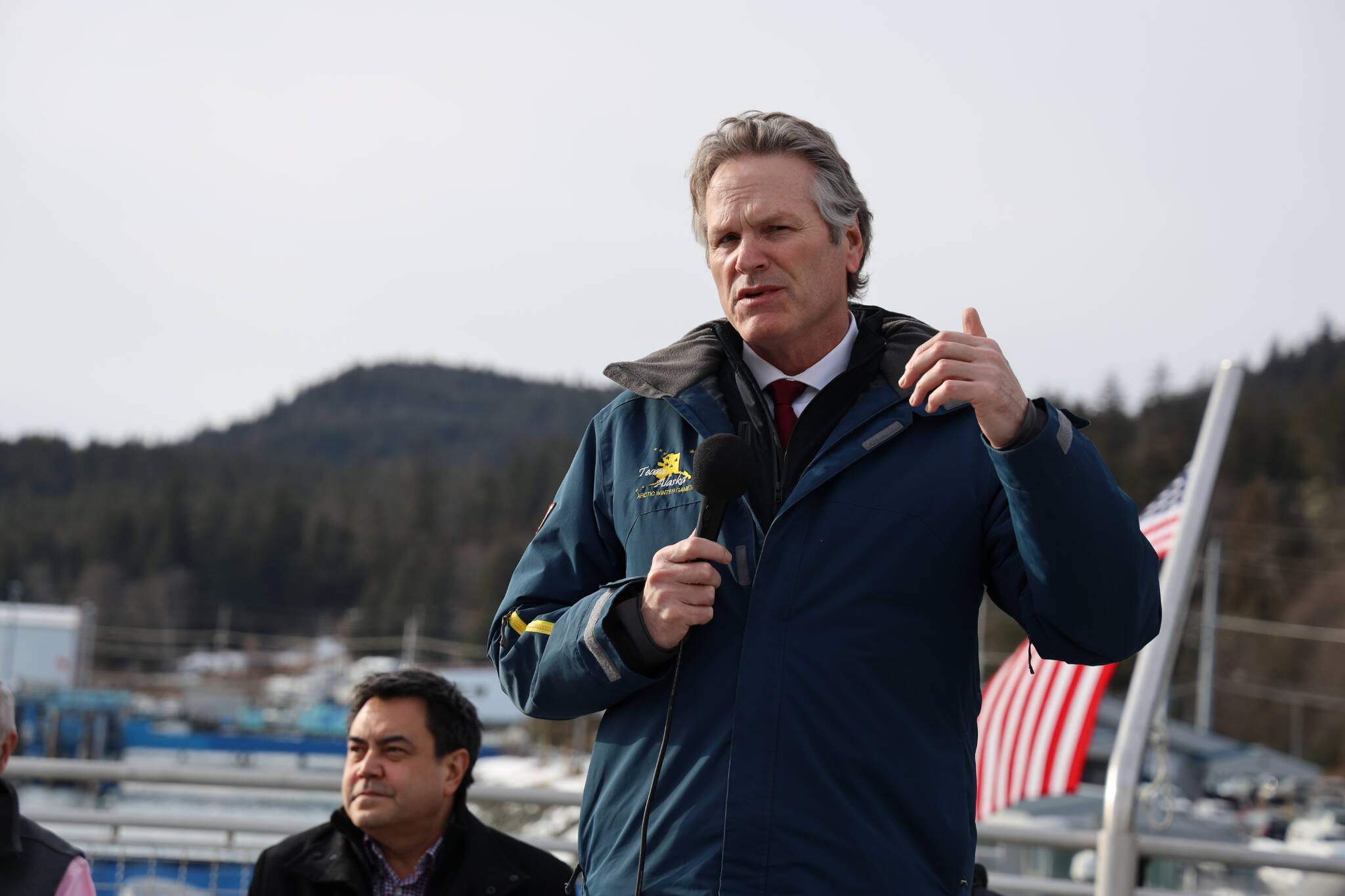
Last week, Gov. Mike Dunleavy and the Acting President & CEO of Goldbelt signed a Memorandum of Understanding for building a new ferry terminal at Cascade Point. But as if the MOU alone proves that the project will improve service, Dunleavy declared we’re “going to see a lot more partnerships” like this, “especially in Southeast Alaska.”
Despite that, not a single Southeast Alaska legislator was present at the ceremony. Instead, our governor from Wasilla was flanked by Ryan Anderson, the commissioner of the state Department of Transportation and Public Facilities who lives in Fairbanks, and Big Lake Rep. Keven McCabe, a Republican.
That’s because this project is less about trying to improve transportation between Juneau, Haines and Skagway than serving Dunleavy’s political ideology.
“There is a lot that government should not do, cannot do, or does not do well” he said in his first state of the state speech. He lumped the Alaska Marine Highway System into that category, as evidenced by the massive agency budget cuts he proposed that year. And his quarter million-dollar “Reshaping” study in which privatizing all or some of the system was analyzed.
As I wrote last month, DOT misrepresented the Request for Proposal for Cascade Point they issued as being the first part of a feasibility study. During my engineering career, I prepared a lot of RFPs for engineering services. The parameters of such a study would need to be defined. And it needs to be listed among the project deliverables. DOT did neither in its Scope of Work. Instead, they defined a timeline for the project to be out for competitive bid by October 2024 and construction completed by December 2026.
At the MOU signing ceremony, Dunleavy called it “a commitment to see this through,” confirming he’s already decided to build it.
He was also wrong last week to claim building a terminal at Cascade Point “has been a long time coming.” That’s true for Goldbelt. They’ve been looking to develop the site and some of its surrounding 1,400 acres for twenty years.
But until just before Dunleavy became governor, DOT was focused on the Juneau Access project. That plan was to build a highway on the west side of Lynn Canal to the Katzehin River where shuttle ferries would connect travelers to Haines and Skagway. Had it moved forward, a terminal at Cascade Point would serve no purpose.
It wasn’t even one of the alternatives evaluated under the Juneau Access. DOT considered extending the road 2.3 miles beyond it to Sawmill Creek with connecting ferry service to Haines and Skagway (Alternative 4B). But they put minimal effort into analyzing that.
The Municipality of Skagway didn’t support the Juneau Access and doesn’t support Cascade Point either. Among the reasons given by their mayor is the opinion by the Alaska Marine Highway Operations Board that the cost/benefit analysis done by DOT is insufficient. He referred to “preliminary modeling” which shows it will have “a positive economic benefit” and requested such information be shared with the public.”
But in December, DOT’s deputy commissioner informed AMHOB that model is nothing more than “numbers and scenarios” run by a working group over the course of a few days. Which is just a little better than the proverbial back-of-the-envelope calculation.
If the administration was interested in doing a real cost/benefit analysis for Cascade Point, they could have contracted with an organization like McKinley Research. In 2020 they acquired the McDowell Group, the state’s largest economic research firm, which published “The Economic Impacts of the Alaska Marine Highway” in 2016. The most significant finding in that report was that the $117 million spent by the state in 2014 to operate the system generated an economic return of $273 million. About 80 percent of that was in Southeast Alaska.
They also concluded that “the impacts of reduced AMHS service will be broad and far-reaching, affecting a diverse range of Alaska residents, businesses, and organizations. The economies of Alaska’s smaller and more isolated coastal communities will be particularly hard hit.”
Four years of the mismanagement and incompetence under Dunleavy proved the McDowell Group was right.
Cascade Point is minor decision compared to that. But like then, Dunleavy thinks he’s smarter than the professionals who analyze the economic impacts of government programs. And he’s not interested in the concerns of citizens from the affected communities and the legislators who represent them.
• Rich Moniak is a Juneau resident and retired civil engineer with more than 25 years of experience working in the public sector. Columns, My Turns and Letters to the Editor represent the view of the author, not the view of the Juneau Empire. Have something to say? Here’s how to submit a My Turn or letter.
