
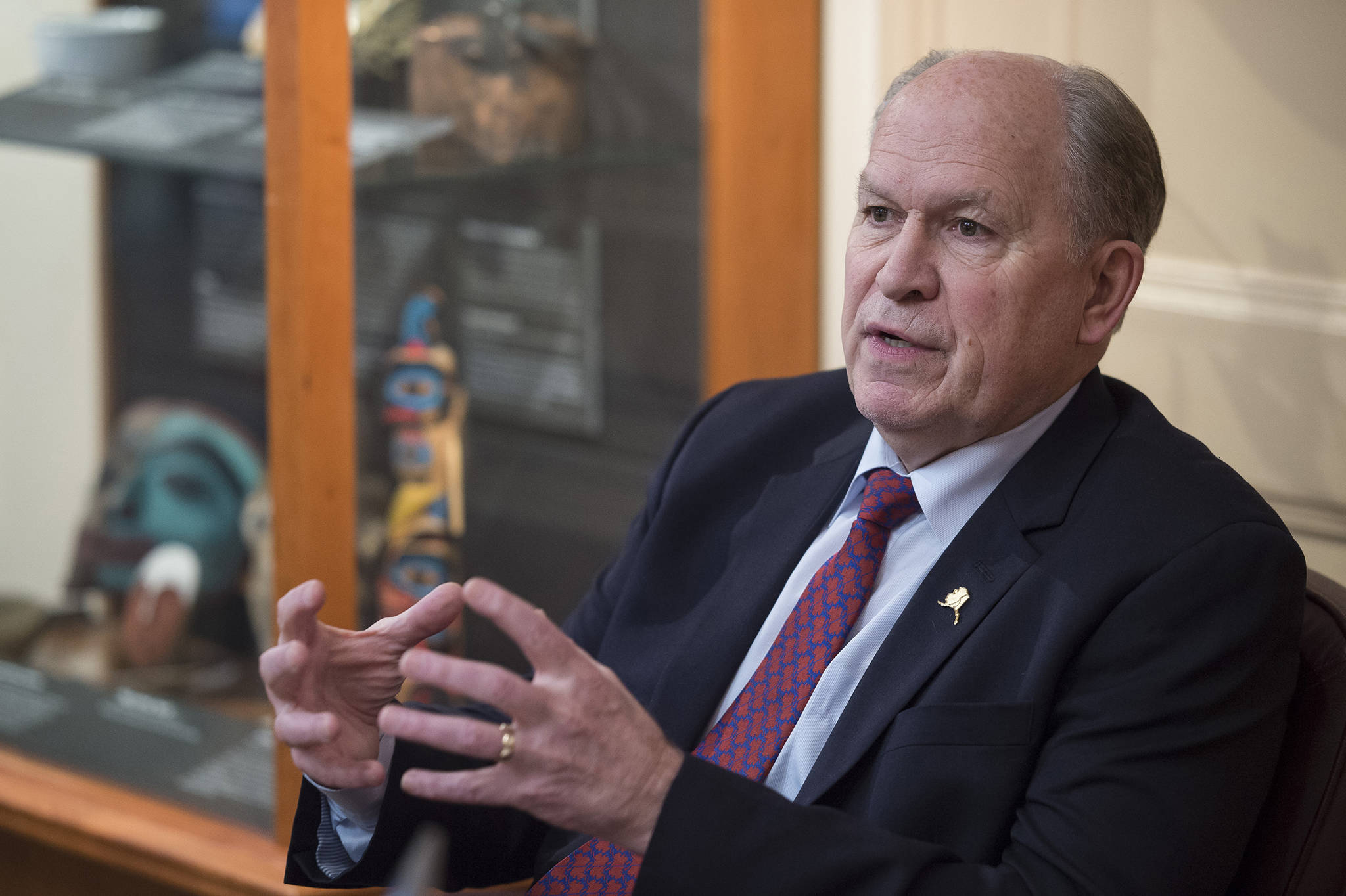
Among Gov. Bill Walker’s many failures — women’s rights, wildlife conservation, public safety, climate change, salmon protection, environment — a fundamental one is his failure to govern openly and transparently.
Alaska statute underscores the need for openness in government: “State government units exist to aid in the conduct of the people’s business; actions of those units should be taken openly and deliberations be conducted openly; the people of the state do not yield their sovereignty to the agencies which serve them; the people, in delegating authority, do not give their public servants the right to decide what is good for the people to know and what is not good for them to know; the people’s right to remain informed shall be protected so that they may retain control over the instruments they have created.”
The Alaska Supreme Court has held that public access to government documents is a “fundamental right;” that the Alaska Public Records Act creates a presumption in favor of disclosure, not concealment; and that exemptions must be construed narrowly.
However, the Walker administration has habitually violated this noble intent by using Public Records Act disclosure exemptions to conceal its decision-making from the Alaska public. This is a dangerous, slippery slope, and should concern all Alaskans.
A recent example is Attorney General Jahna Lindemuth’s Aug. 30 response to a public request regarding Walker’s decision declining a wildlife-protection buffer adjacent to Denali National Park, in which she withheld virtually all internal state emails. The 244-page response kept secret most of the relevant state documents claiming attorney-client, deliberative process and executive communications privilege more than 130 times. There is no legitimate reason to keep such administrative deliberation secret from Alaska citizens.
While these withholding privileges are allowable “to protect the deliberative and mental processes of decision-makers,” they are not required. Generally, a state administration can choose to be as open, or as secretive, as it wishes. Unfortunately, the Walker administration consistently chooses secrecy over openness, leading to public distrust and bad governance.
Another example of Walker’s secrecy is that his fish and game department prohibits its staff from photographing their predator control activities, in order to conceal such inhumane, unethical actions from the public.
One wonders what else the Walker administration is hiding from Alaska citizens, and why. Clearly, Walker needs a short refresher on the need for open government in democracy.
As stated in the Declaration of Independence, democratic governments derive “their just powers from the consent of the governed.” It is a fundamental responsibility of democratic government to provide free and open access to government information, and allow for the advocacy of public interests with such information.
Thomas Jefferson: “Whenever the people are well informed, they can be trusted with their own government.”
James Madison: “A popular government without popular information, or the means of acquiring it, is but a prologue to a farce or a tragedy, or perhaps both.”
U.S. Attorney General Ramsey Clark: “Nothing so diminishes democracy as secrecy. How can we govern ourselves if we know not how we govern? The security of the nation is far more threatened by secrecy than by disclosure.”
While certain types of information are reasonably kept secret (e.g. national defense, trade secrets, etc.), Thomas Emerson notes that:
“As a general proposition, secrecy in a democratic society is a source of illegitimate power … Secrecy in government accompanies evil in government — government wrongs are kept secret because they are evil, and evil is done because it can be kept secret.”
Finally, the Reporters Committee for Freedom of the Press states:
“Government secrecy is widespread and pervasive. … Officials are a tricky bunch and you have to watch them all the time. They will disregard the law, disobey the law, look for loopholes or push for new laws that favor secrecy. Yet the mandates for open government are strong. At its core, participatory democracy decries locked files and closed doors. Good citizens study their governors, challenge the decisions they make and petition or vote for change when change is needed. But no citizen can carry out these responsibilities when government is secret.”
We would be well advised to keep this in mind in choosing our next governor.
• Rick Steiner is a conservation biologist in Anchorage, and former marine conservation professor with the University of Alaska. My Turns and Letters to the Editor represent the view of the author, not the view of the Juneau Empire.
