
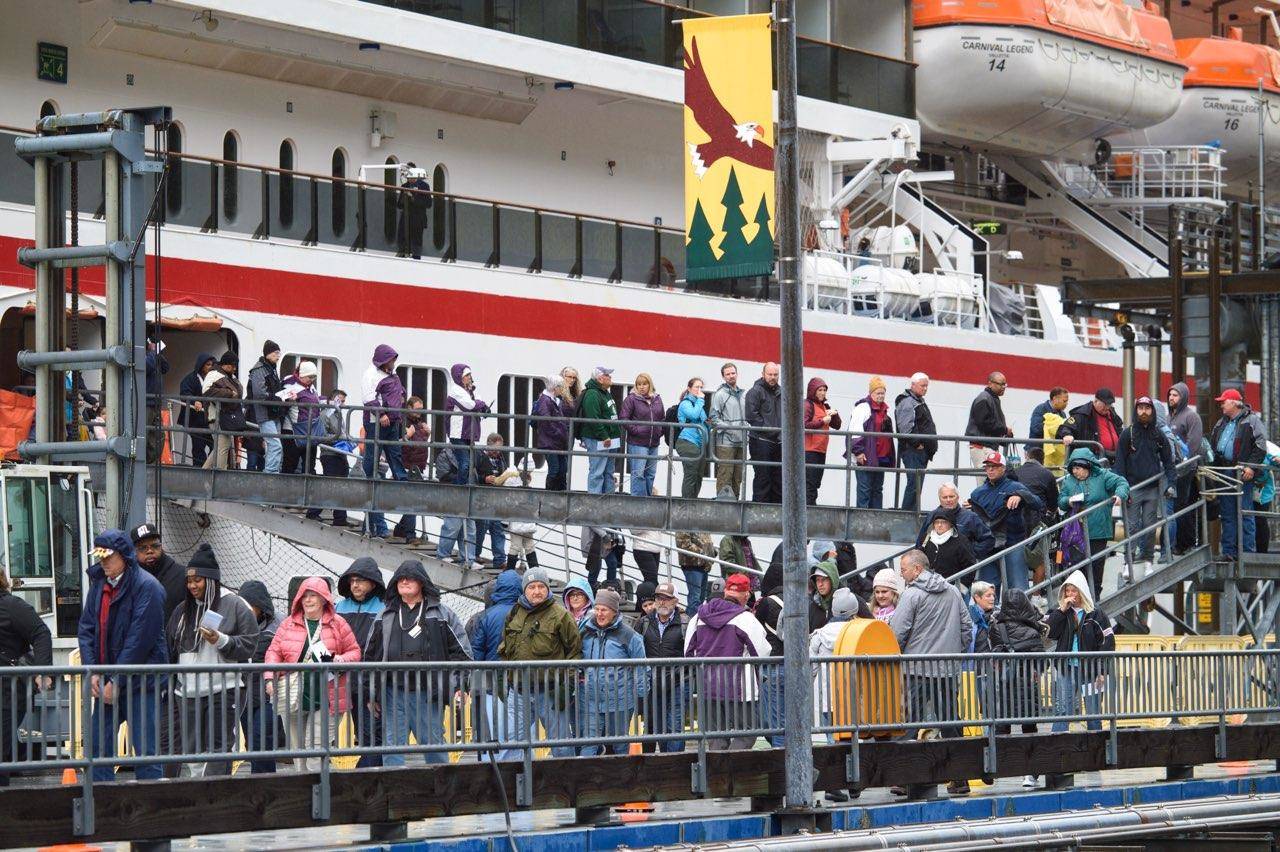
Depending on your perspective, tourism in Juneau is either a marvelous success story or one of such overcrowding that it disrupts the joy of living here. Normally I sympathize with residents who believe the City and Borough of Juneau Assembly should limit the number of cruise ship passengers arriving each day. Other tourist destinations have done it, so why not us?
But as characters in the middle-class success story, we first ought to examine the “thorny questions of ethics and values” posed by the World Travel & Tourism Council.
[How many tourists is too many?]
This summer we’re expecting more than 1.2 million cruise ship visitors. That’s a six-fold increase since 1990.
“The root cause of this surge in tourism is macroeconomic,” Annie Lowrey wrote in a recent Atlantic article about the phenomenon called overtourism. “The middle class is global now, and tens of millions of people have acquired the means to travel over the past few decades.”
But for all its downsides, she argues overtourism is also an opportunity for “more cross-cultural exposure, more investment, more global connection, more democratization of travel, and perhaps more awe and wonder.”
In their study titled “Coping With Success,” McKinsey & Company and the World Travel & Tourism Council describe solutions that would erase those opportunities for more as matter of “value over volume.” And they ask if it’s “reasonable to reduce visitor numbers to a more sustainable level if that action also makes the destination accessible only to the wealthy.”
Such a possibility draws us back to a time when only “wealthy nobles and educated professionals” could afford the luxury of recreational travel. “For them,” Ueli Gyr explains in his 2010 study published by European History Online, “travelling was a demonstrative expression of their social class which communicated power, status, money and leisure.”
Remove the word “nobles” and the rest Gyr’s statement could apply to the middle and upper echelons of today’s middle class. We have the money, education and jobs that give us travel opportunities not available to everyone. And in an America supposedly committed to the self-evident truths declared in our founding history, we have sheepishly acquiesced to the sole surviving law on George Orwell’s Animal Farm.
Orwell is best known for 1984, the second allegory about Soviet Union-style totalitarianism he wrote in the 1940s. But if we’re to keep stock in how his prescient warnings are still relevant today, we must look below the primary metaphors and pay attention to the societal realities that also troubled him. Because Big Brother and the pig named Napoleon couldn’t have become powerful without a class underneath that, in order to improve and sustain their relative comfort and security, tolerated the authoritarian rulers.
[Lavish British ship makes maiden voyage to Alaska]
Animal Farm is a story of a farm animals who overthrow their human master. They write a new governing constitution with “Seven Commandments,” three of which forbid animals from adopting human behavior.
A few years after their revolution, Napoleon and a compliant legion of pigs become comfortable sleeping in beds, wearing clothes and consuming alcohol. Aside from the guard dogs taught to protect the new elite, the rest reluctantly accept the violations. By the end of the story, all they’ve got left is an “imperishable pride” about the heroic battles of the past. The one commandment that wasn’t abolished was amended from “All animals are equal” to include “but some animals are more equal than others.” And they could no longer tell the difference between the pigs living in the farmhouse and their human neighbors.
This is more than a classical tale about corruption at the top echelons of power. The moral depicted by Napoleon becoming what all the animals once despised speaks to the tendency to forget our concern about inequality once we’ve climbed above the disadvantaged rungs of the class ladder.
Given that tourism is seen as an earned privilege by liberals and conservatives alike, it’s an issue where questions of equality might transcend political boundaries. Overcrowded tourist destinations can be troubling here and during our own travels.
And just as the World Travel & Tourism Council tells us they can’t ignore the “thorny” questions that raised for them, we ought to take that as a cue to wonder what other ethical conflicts we tolerate in order to sustain our class comforts.
• Rich Moniak is a Juneau resident and retired civil engineer with more than 25 years of experience working in the public sector. He contributes a weekly “My Turn” to the Juneau Empire. My Turns and Letters to the Editor represent the view of the author, not the view of the Juneau Empire.
