
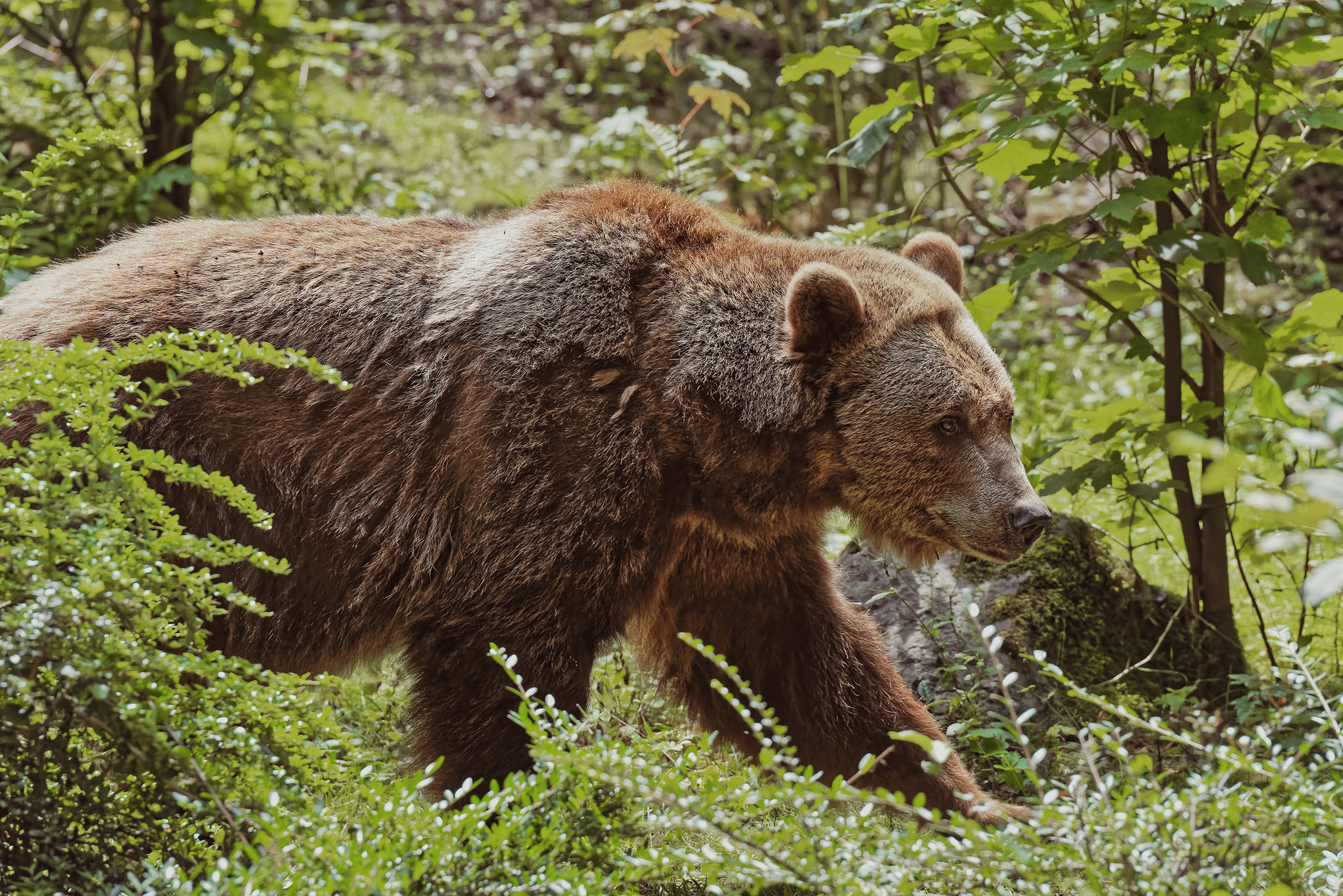
I was a brown bear expert in the Tongass with Alaska Department of Fish and Game for 35 years from 1981 retiring in 2016. I’ve slogged up dozens of bear-infested salmon streams in study areas on Admiralty and Chichagof Islands and along Southeast’s mainland stretching from Misty Fiords National Monument to the south up the coast north to Yakutat Forelands and Malaspina Glacier in the Wrangell-St. Elias National Park Preserve. I’ve captured/immobilized, radio-tagged and radio-tracked over 1,000 bears collecting scientific data and conducted DNA/population estimates. I fitted the first brown bear in the Tongass with a VHF radio-transmitter on Greens Creek on Admiralty Island in 1981.
Brown bears are the second slowest reproducing of the 28 big game species in North America. In the early 1800s, grizzly bears occurred in nearly every state west of the Mississippi River but as a result of human encroachment by 1956, only three states contained marginally sustainable grizzly populations. Historical, ecological and biological evidence across North America are clear that road access, combined with human development/activities within brown bear home ranges, will with certainty lead to fewer brown bears and potentially threaten brown bear populations. More importantly, a brown bear population could easily suffer dramatically if the female component of a population is systematically removed.
Today, six of eight bear species in the world are endangered. To assure cub survival, female bears accompanied with cubs of all eight bear species on the planet require a safe escape location from being killed by male bears/predators. The Tongass old-growth trees adjacent salmon streams are key components for cub survival.
The Forest Service manages the forest on a 100-year harvest rotation. Most brown bear den sites in the Tongass are located in the base of large live or dead standing trees >36” diameter or in natural rock cavities. Clear-cuts have no value to wildlife once the canopy closes in at 12-14 years. Stream buffers along anadromous streams are 500 feet, less on private land.
Brown bear studies in the Tongass are well documented in valleys adjacent to salmon streams encompassing logging roads, clear-cuts and second growth. Here, male brown bears are forced to adjust to the habitat alterations and stay close to salmon streams and dominate the stream. Simultaneously, female brown bears with and without cubs are now also forced to adjust their salmon fishing strategies in the altered landscape within their home range. They now must navigate through clear-cuts and second growth in search of safe escape trees for their cubs far away from male dominated salmon streams.
Consequently, these female brown bears and cubs spend little time on male dominated salmon streams fishing and consuming high protein fat salmon necessary for denning and cub survival. These female brown bears spend more time burning energy navigating through clear-cuts and second growth seeking refuge in standing trees and avoiding males versus fishing. The end result of an altered landscape within a female brown bear’s home range increases cub mortality by males compounded by the fact these female brown bears do not consume adequate salmon for denning and cub survival. In addition, lack of high reliable salmon fat for pregnant female brown bears means smaller litter sizes. Cumulatively, gradually fewer surviving cubs and fewer bears.
To compound threats to brown bear populations in the Tongass, from a brown bears’ perspective, roads evolve into bear trails as a travel route of least resistance. This simultaneously increases bear encounters with man’s activities resulting in exponentially increasing mortality of all demographics of the population.
There are nine distinct DNA brown bear populations in the Tongass, each unique in the world. Reversal of the existing Roadless Rule would have cumulative adverse effects on six of these nine brown bear populations. Perhaps more paramount, climate change is not addressed in reversal of the Roadless Rule, despite the fact it has potential to affect future brown bear populations more adversely than any other human activity.
It is well documented, visitors travel to Alaska with hopes of seeing three animals, bald eagles, whales and brown bears. Wilderness is the symbol of brown bear habitat, and God isn’t making wilderness anymore. Once it’s gone, it’s gone forever.
• LaVern Beier is a former wildlife researcher with Alaska Department of Fish and Game, Division of Wildlife Conservation. He retired after 43 years, from 1973 to 2016. He participated in a variety of wildlife research/management projects throughout the Tongass National Forest. Primarily known as a brown bear expert, his expertise includes the safe capture, immobilizing, radio-tagging/tracking and ecology of Sitka black-tailed deer, mountain goats, wolf, wolverine, elk and black bears. Columns, My Turns and Letters to the Editor represent the view of the author, not the view of the Juneau Empire.
