
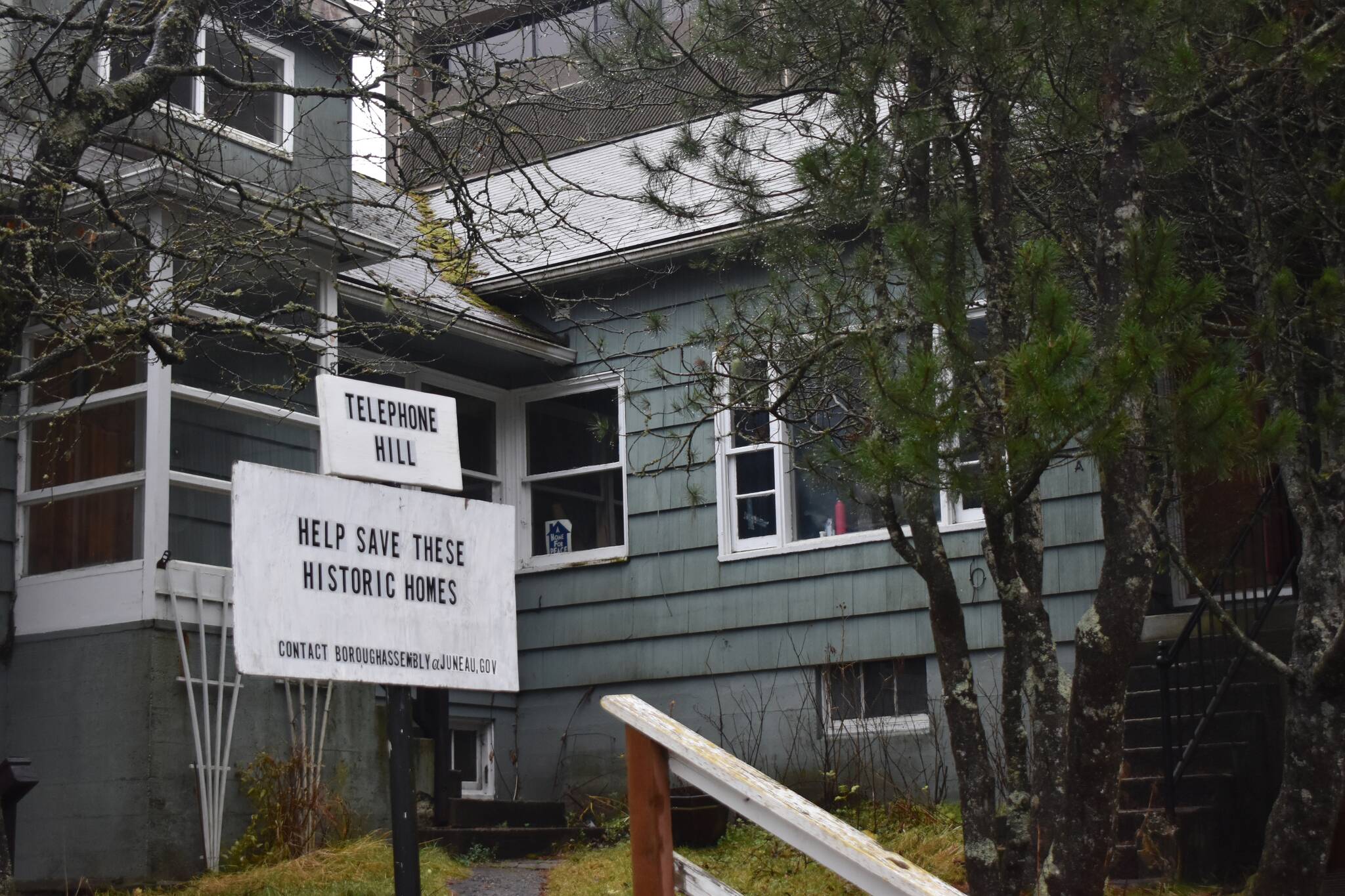
The Assembly approved $5.5 million to raze Telephone Hill as part of the “Telephone Hill Redevelopment Project.” The CBJ Project Summary and the City Manager’s Telephone Hill FAQ state that the project will provide up 155 housing units of which 31 housing units (20% of the total) will be affordable. The City does not have a design or a developer for the project and has not given even an estimate of the total cost to the taxpayer. But we need such an estimate.
Based on the Telephone Hill Market Analysis and other public documents, I estimate that the project will cost the Juneau taxpayers a staggering $42.5 million. That is an average CBJ subsidy of $275,000 per unit. Here are the numbers and then an explanation for them:
• Demolition & site prep: $5.5 million – appropriated, not spent
• Road & utilities: $3.5 million – city will have to pay
• Affordable Housing Fund: $1.55 million – 31 unites at $50,000
• Construction Feasibility Gap: $32 million – market analysis
The grand total: $42.5 million – staggering.
The demolition and site prep will cost an estimated $5.5 million. The demolition is not just knocking down seven houses. It is blasting the Hill and removing tons of rock and gravel and dirt and every single manmade structure : the houses; every water, sewer, light, and electrical structure; the retaining wall; every inch of asphalt. The City estimates this contract will result in the removal of 5030 cubic yards of rock alone. That is the equivalent of 500 commercial dump truckloads of rock.
A new road and utilities – to replace the ones that were just demolished — will cost an estimated $3.5 million. The Assembly did not approve this amount thinking that this cost “may be incurred by a future developer.” That is fantasy. Developers do not usually pay for city streets and utilities in Downtown neighborhoods. The City Manager’s FAQ for the project states that the “City will provide ready-to-build land to maximize developer interest.” A land without access to city streets or utilities is not “ready-to-build land.” Everyone knows the City will be on the hook for this expense.
The Juneau Affordable Housing Fund provides a $50,000 subsidy for construction of affordable housing units. The FAQ states that thirty-one affordable units will be subsidized by CBJ.
As for the Construction Feasibility Gap, first of all, what is it? A construction feasibility gap is the difference between what it costs to build a project and what the completed project is worth on the day it is completed. It is usually a “per unit” number. It is probably the single most important number for a housing development project and determines whether a project is go/no go. If there is a gap and it is not covered by some entity, the project is not bankable and a developer will not do it.
The Telephone Hill Market Analysis at page 41 provides estimates of the feasibility gap per unit. Using construction costs of $550 per square foot, and no parking, the gap per unit is $137,000 per unit or $21 million for the project. No parking for 155 new housing units in Downtown Juneau does not pass the red face test. If modest parking is added, the gap per unit is $209,000 per unit or $32 million for the entire project.
You may ask “Isn’t this just what it costs to build housing in Juneau?” The answer is an unequivocal NO. No other project will start with $5.5 million to demolish existing homes or $3.5 million to rebuild a road and utilities that were just destroyed. And the Telephone Hill site is difficult-to-access and is not flat. CBJ sources indicate that the Telephone Hill site is 1.5 times more expensive to build on than standard sites.
Whether the project costs that a developer will not pay are $42 million or even “merely” half of that, where will that money come from? Not the Feds: the City cannot get a penny of federal funds to build this project because the City will not do a section 106 review to determine if the project would affect historical properties. Not the State: Telephone Hill is ranked #10 on the City’s CIP list for State funds. The City is lucky to get funding for its top three. And, anyway, would we really want to fund Telephone Hill instead of flood control in the Valley (#1), a transfer station for solid waste (#4), reconstruction of the flume (#7), or renovations in the Hospital’s emergency facilities (#8)? CBJ: every dollar for the Telephone Hill project will come from CBJ – from you and me. Every dollar will come from projects and services that will not be funded because the City is spending millions on this project. It will come from other housing efforts, a working ski lift at Eaglecrest, Bartlett Hospital, libraries, or schools.
The City states it needs to cut $10 – 12 million from its budget as a result of the propositions passed by voters in November. Consider taking the CBJ Budget Survey at Juneau.org and tell CBJ to stop the bulldozers on Telephone Hill and immediately save $5.5 million!
Mary Alice McKeen, ottokeen@gmail.com, has lived in Juneau since 1978, is a (mostly retired) attorney, and owner of a downtown business.
