
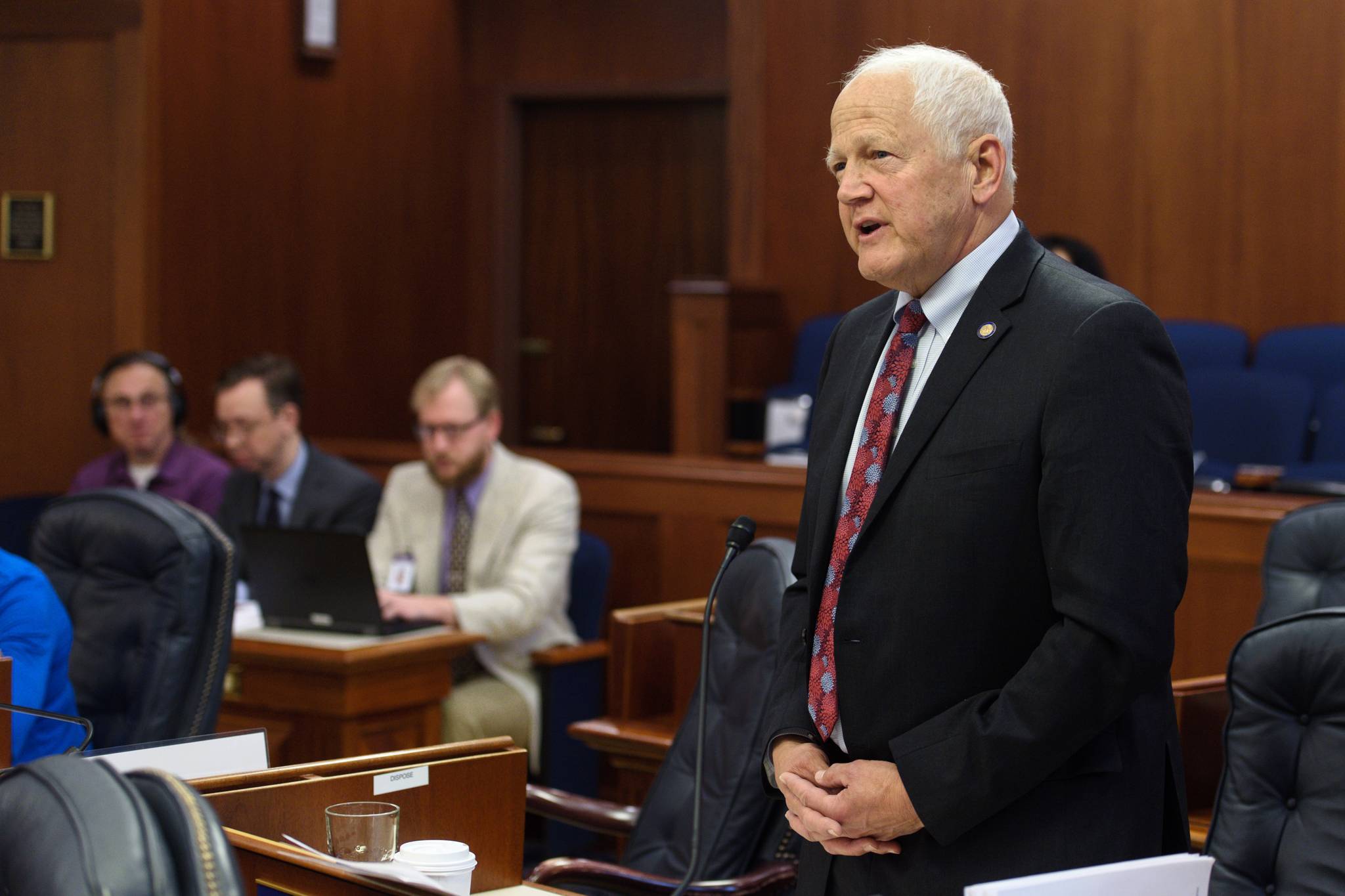
It would be a mistake to suggest that Gov. Mike Dunleavy had no right to select Rep. Laddie Shaw to fill the Anchorage Senate seat vacated by the death of Sen. Chris Birch. But the statute he’s following is both vague and too reliant on tradition. Worse yet, it’s given Dunleavy the power to appoint a legislator friendly to his agenda.
And that “gravely erodes public confidence that their representative in Juneau is there to represent their values.”
That was Dunleavy’s reaction when then-Gov. Bill Walker tried to fill the seat that he vacated in 2017. Randall Kowalke was one of 11 eligible applicants, but not among the three the Republican Party eventually nominated. However, Kowalke’s selection still complied with the law.
Senate Republicans rejected the appointment.
“We believe the people of District E should be given an opportunity to fill the seat with a candidate they support through the traditional process, which is designed to respect the will of the voters,” Senate Majority Leader Peter Micciche, R-Soldotna, explained in a press release.
Even though their rejection happened behind closed doors, it complied with the law too.
[Walker picks former business man for vacant seat]
But it was party officials, not the people, who approved the nominations. And they didn’t speak for the majority of the district’s voters. Only 35 percent were registered Republicans.
In 1987, Gov. Steve Cowper challenged the party’s role in the Senate confirmation process. He filed a lawsuit arguing the entire Senate should have a voice. But he dropped it after the two sides agreed on a compromise appointment.
When Sen. Kim Elton of Juneau resigned in 2009, local Democratic party officials nominated only House Minority Leader Beth Kerttula to replace him. Gov. Sarah Palin tried to appoint Tim Grussendorf, a self-described conservative Democrat with very different values than Kerttula. Senate Democrats rejected him. Palin’s second choice wasn’t Kerttula or the three additional nominations offered by the party. Like 1987 though, the dispute ended with compromise appointment
The selection of Shaw won’t stir up controversy the way any of these three past cases did. But there’s a justifiable suspicion that Dunleavy is putting his PFD agenda ahead of the voters’ concerns.
As I wrote a few weeks ago, the Legislature passed SB 26 in 2018. The law effectively capped the PFD. As a member of the House minority, Birch voted in favor of the bill. That didn’t upset district Republicans enough to vote him out of office. Instead, on his path to winning election to the Senate, 78 percent of them supported him in the primary.
In the Senate, Birch was a steadfast supporter of the smaller PFD who tipped the scales enough to ensure it would pass. In the House though, Shaw voted in line with Dunleavy’s desire to pay the full amount based on the older statute. If he’s confirmed by senate Republicans, the next vote on the matter might need to be broken by Lt. Gov. Kevin Meyer.
That would certainly make Dunleavy happy. But in trying to keep his campaign promise to pay out the full PFD, he may be breaking one made during his State of the State speech in January — to govern by the “simple truth” implied by Article I, Section 2 of the Alaska Constitution.
[Dunleavy delivers State of the State address]
“Government gets all of its authority from the people,” he said.
Because the process of filling legislative vacancies takes the power away from the people and first puts it in the hands of the political parties. It then empowers the governor to put his interests ahead of the voters.
And the check of that power by the Senate is an illusion. Not only because the full body doesn’t confirm. If, for instance, a lone Libertarian party member resigned, the governor could pick any qualified candidate, including a democrat diametrically opposed to libertarian ideals. In that case, or to replace an independent legislator, there is no Senate confirmation vote.
Dunleavy was right when he criticized Walker a year and a half ago. But he and Micciche were wrong about why. The law is undemocratic. The Legislature ought to consider changing it to require local elected officials to submit nominations directly to the full legislature for confirmation. Or give the people the power to choose their new representative in a special election.
• Rich Moniak is a Juneau resident and retired civil engineer with more than 25 years of experience working in the public sector. He contributes a weekly “My Turn” to the Juneau Empire. My Turns and Letters to the Editor represent the view of the author, not the view of the Juneau Empire.
