
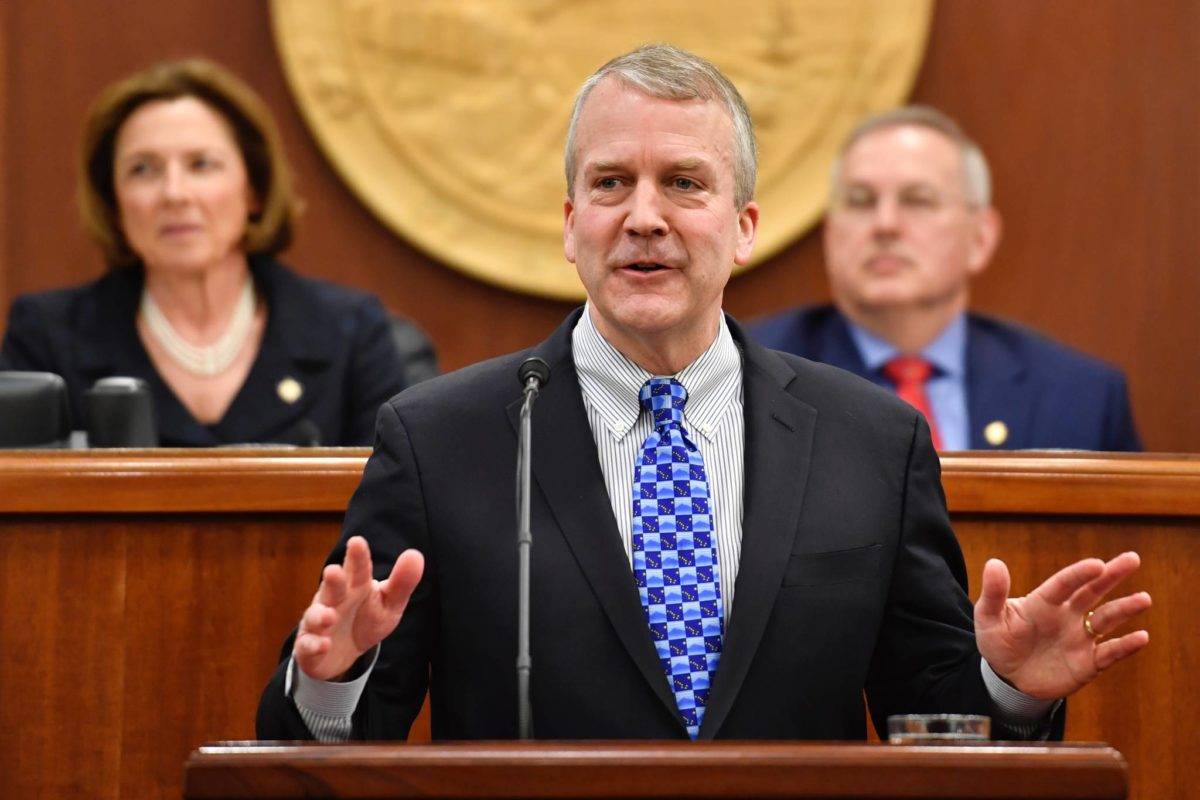
Government has a big role in the future Alaskan economy. Whether intentional or not, that’s the message Sen. Dan Sullivan delivered to the state legislature last week. Hopefully Gov. Mike Dunleavy heard it too. Because it might help him realize that balancing the state budget is about values first, not numbers.
Sullivan teed off with his party’s usual talking points. It’s “because of policies like cutting taxes on middle class families and small businesses, getting rid of job killing regulations and unleashing the promise of American energy production” that the “the U.S. economy in the lower 48 is firing on all cylinders.“ And he’s “optimistic that by continuing to enact good policies at the federal level, and bringing investment dollars home to Alaska, the economic dynamism in job growth” down south “will hopefully be coming our way soon.”
Surprisingly though, he didn’t promote last year’s tax cuts any further. The roll back of regulations wasn’t highlighted much either.
On energy, of course, he could claim a hand in opening the Arctic National Wildlife Refuge to oil exploration. And there are more leases up for grabs.
[Sullivan to introduce legislation that would help victims of sexual assault]
But those are the only new jobs he mentioned that might be created here solely from activity in the private sector. The rest will come courtesy of the American taxpayer and deficit spending. Sullivan began that story by saying he’s helped “secure over $1.3 billion in military construction” during the past three and half years, leading to “hundreds, if not thousands” of good paying Alaskan jobs. And we can expect more because “previous pentagon budgets that cut spending by almost 25 percent” are a thing of the past.
His omission is what’s relevant here. The spending cuts he referred to was fallout from Republican resistance to raising the ceiling on the federal debt. Known as sequestration, they became law when Congress passed the Budget Control Act of 2011. The cuts were automatically triggered because Congress failed to enact deficit reduction legislation.
It’s not the first time this approach to deficit reduction failed. The Graham -Rudman legislation of the 1980s had to be abandoned. Those were also accompanied by Republican refusal to consider new taxes.
The message for Dunleavy here is two-pronged. Government spending boosts employment in the private sector. And reducing it without new revenue is an unrealistic solution to the state’s fiscal deficit.
But the biggest lesson for our new governor came from the recent bipartisan successes Sullivan described.
“For example,” he said “we funded the Child’s Health Insurance Program, known in Alaska as Denali Kid Care, for 10 years. That is longest reauthorization of that important program in history.”
Created in 1997, CHIP was, “was the largest expansion of taxpayer-funded health insurance coverage for U.S. children since Medicaid” was enacted in 1965, according the weekly publication Modern Healthcare. That may sound like another big government program. But it wasn’t Democrats who championed it. It became law while the GOP controlled both the House and Senate.
Sullivan also cited federal budget increases for Community Health Centers (CHCs). “Last year the funding was close to $8 billion” he said. With 170, we have more of them than any other state, serving more than 113,000 Alaskans who would otherwise be medically underserved or uninsured. And Sullivan promised Congress “will continue to fund these vitals centers as well.”
And finally, Sullivan spoke about a “whole new very big market for our fish” he helped create. It came through a provision in the farm bill “that mandates that only domestically landed and processed fish be included in the National School Lunch Program.” To make it happen, Congress removed a loophole that allowed “Russian caught pollock that’s sent to China, injected with phosphates, sent back to the U.S.” and served to American school children “using federal dollars.”
That’s smart legislation. But to the point I’m trying to make, like CHIP and CHCs, the National School Lunch Program wouldn’t exist if Congress tried to make its spending decisions by building its budget from the bottom up.
These programs are an extension of how Sen. Lisa Murkowski views the state’s Power Cost Equalization program and ferry system – responsibilities our government accepts “because of it’s part of who we are.”
That’s values speaking. And Dunleavy won’t succeed as governor by slicing and dicing those into a bottom line.
• Rich Moniak is a Juneau resident and retired civil engineer with more than 25 years of experience working in the public sector. He contributes a weekly “My Turn” to the Juneau Empire. My Turns and Letters to the Editor represent the view of the author, not the view of the Juneau Empire.
