
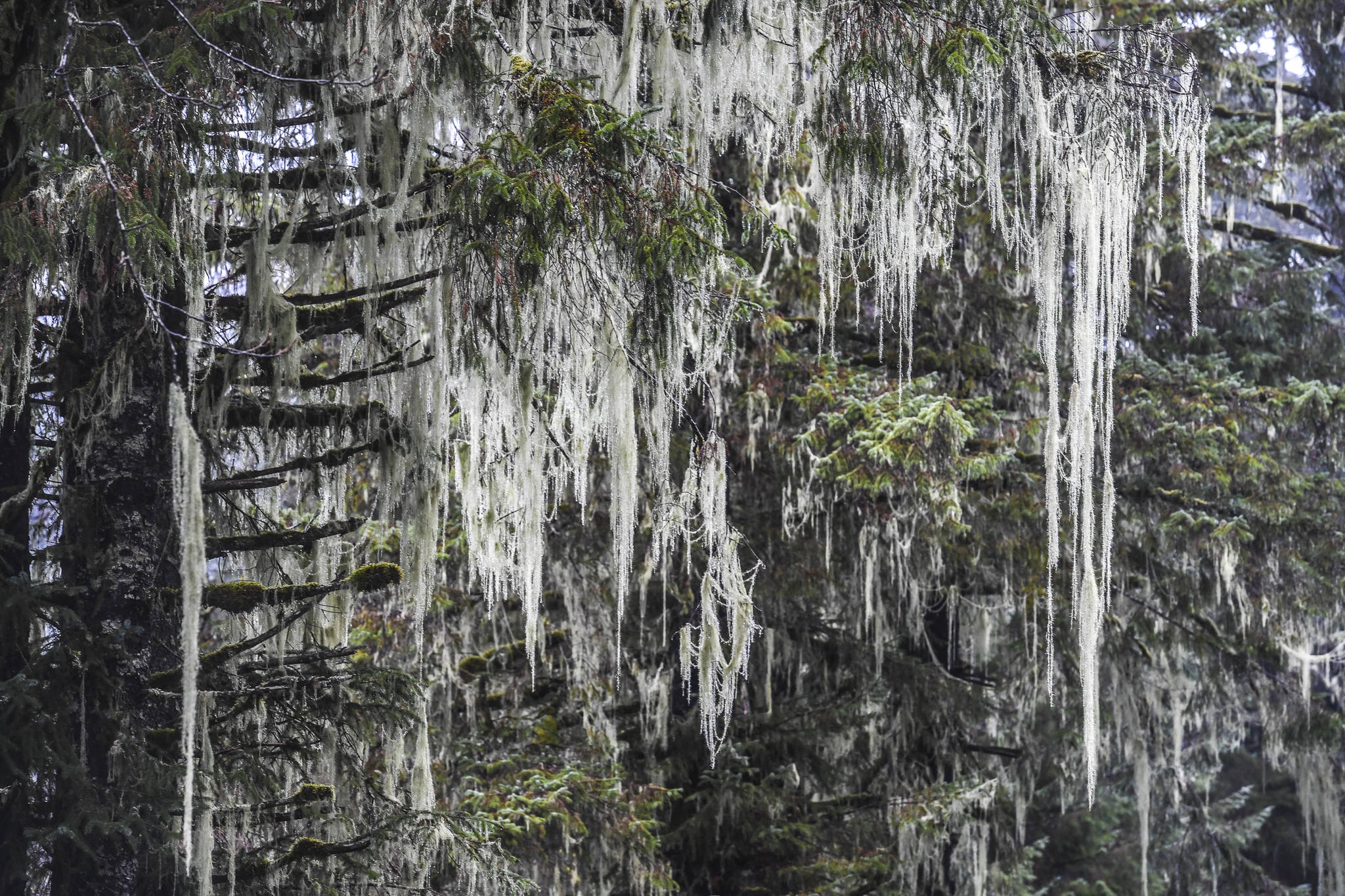
The Tongass National Forest is actually a vast island archipelago.
In Latin, archi is chief, extreme, primitive, early, and pelagos is deep sea, water contrast with land, a vast expanse of open water. Archipelago. Our nation’s largest national forest is one of the world’s largest, wildest and most northern island archipelagos in the world. It is an extreme system in a vast expanse of open water, and every time I fly north to our braided Chilkat River home, I see the islands as a fingerprint the Pleistocene left us at a climate change crime scene. These islands are the Galapagos of the North.
Our Darwin’s finches are the Queen Charlotte goshawks, and the olive-sided flycatchers. The Tongass provides home to 82 endemic, or regionally distinct, animals and plants. Endemism is akin to small communities in Southeast Alaska. Residents adapt to island surroundings, forced to reconcile remote living with limited resources, evolving through time to inhabit maybe one, maybe two, but not all islands on the Tongass. Before long, islands resemble a patchwork quilt of thousands of years of diversity driven by harsh climates, rugged landscapes, water and isolation. Birds on islands sing distinct songs. Wolves eat fish on one island, and sea otters on another. We all must adapt to our home.
Kuiu Island is home to a small population of the Pacific marten, small forest carnivores that search for voles in the understory of old growth cedar. These Pacific marten have disappeared from 95% of their global range to retreat into refuge here.
Spruce grouse on Zarembo Island grow smaller wings and longer tails. They are old, like the grizzly bears that became polar bears and disappeared.
Small, white-in-the-winter, short-tailed weasels (ermine) hold DNA that disconnects them from their nearest relatives by over 40,000 years of island evolution on Taan, or Prince of Wales Island.
These creatures move across forest, marsh, muskeg, on islands that are shaped like sea monsters’ bodies, curved with many lobes and water tracing around the edges.
I spent 20 years crawling on my belly like a marten in the rainforest, chasing weasels in meadows and trapping voles with the tenacity of a road system wolf trapper from Craig. These island fortresses in the vast expanses of open water became laboratories for learning. Pulling from the knowledge I wrought from years in rain gear and rubber boots, I showed other students these islands, these creatures, and islands became classrooms. When I went to visit old cedar stands on Kuiu, rare orchids in a muskeg in Thomas Bay, they were gone. Impermanence is also a part of living on islands. The shore erodes, tides change, deer swim away, cedars die.
These islands, this archipelago, the Tongass, does not fit well within the normal confines of forest management. We are trying to manage thousands of islands as if they are part of the same, continuous place, not individual, ecological systems across a vast expanse of open water. Some islands have more coastline than they have acres of land. It’s complex. In 2006, the Forest Service started to use the word “matrix” to describe the Tongass National Forest islands. In 2008, it used the word “legacy trees” to define standing old-growth trees that would be left as legacies from logging.
In essence, each of these words carves up the islands of the archipelago into ever smaller fragments, like a fine silk cloth that is cut into pieces. The edges fray and nothing is left. Although the Tongass is a large national forest, its smallest islands are rock outcrops in the open ocean with no board feet of timber, yet home to colonies of nesting sea birds. The numbers lie about the forest’s true shape. What does 17 million acres of scattered pieces of 3-acre habitat mean to a grizzly bear? To a spawning silver salmon? To a human being at home on an island? Island extinctions make up half of the planet’s extinctions, and the primary causes are habitat loss and fragmentation. Roadless areas are the last, remaining large tracts of glaciated fjord, forest, muskeg, mountain left on the Alexander Archipelago, fragments of Alaska on the ragged, unraveling edges of our continent.
• Natalie Dawson is executive director of Audubon Alaska, and has spent 18 years as a field biologist, educator and professional bushwacker on Tongass islands. Columns, My Turns and Letters to the Editor represent the view of the author, not the view of the Juneau Empire.
