
K’asheetchlaa Louise Brady
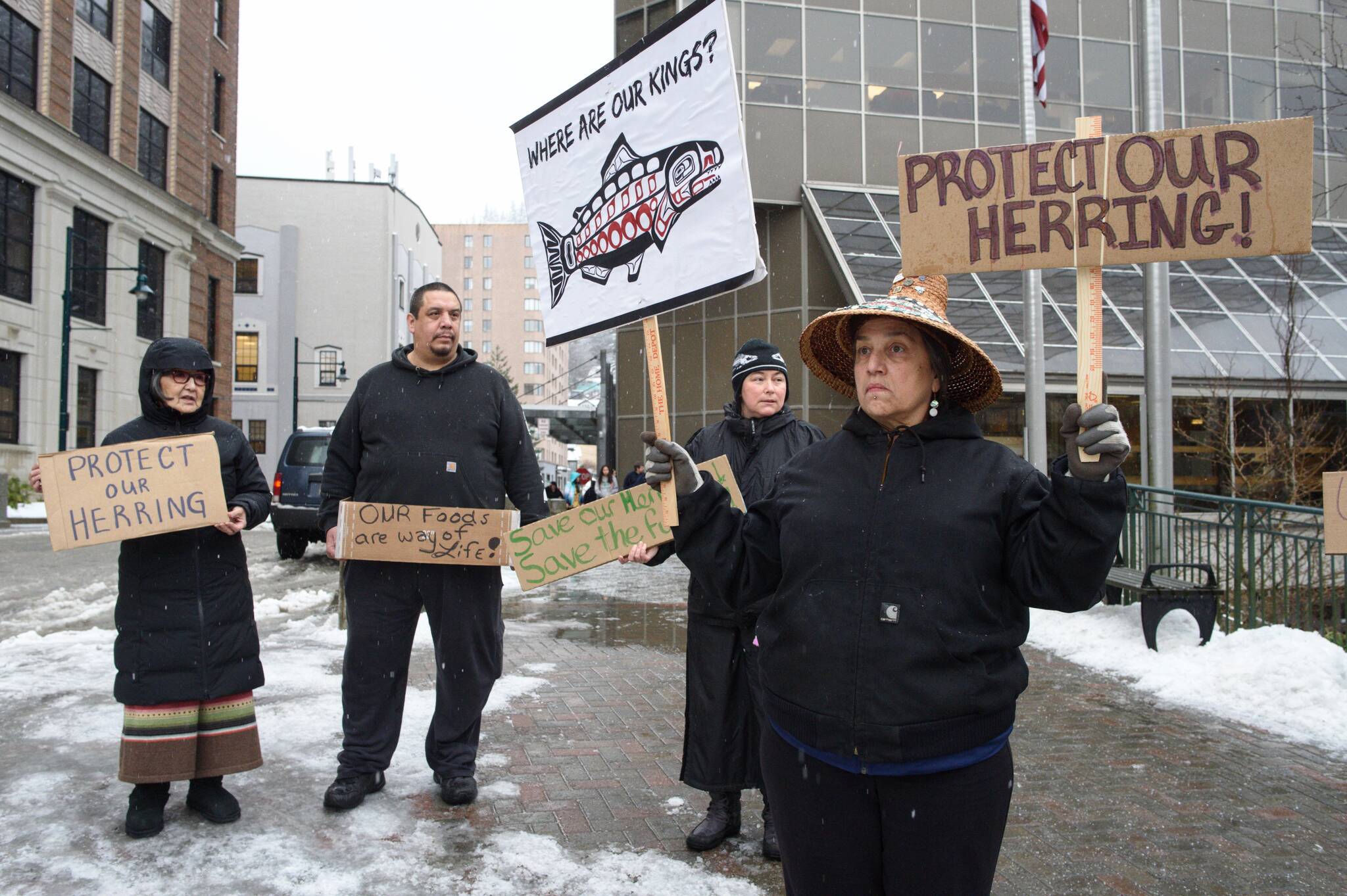
The Board of Fish is meeting to tinker with the Sitka Sound Sac Roe fishery this week. The Sac-Roe industry has long been criticized as a wasteful misuse of the herring; the roe from mature females is exported as a foreign delicacy, but the remaining 90% of the fish are ground into cheap fishmeal, if they’re utilized at all. It’s like hunting a herd of deer only to harvest the liver. Maybe it’s time to start calling the industry what it is — the fishmeal industry. Public sentiment clearly reflects that it is time for this fishery to change — the vast majority of public comments before the Board of Fish this year call for reducing the currently unsustainable herring harvest levels. But despite these criticisms, a biomass assumptions that haven’t been updated since 1997 and a skewed age structure where 69% of the entire population is estimated to be from a single age class, the Alaska Department of Fish and Game has set a Guideline Harvest Level of 45,000 tons, the largest ever.
Sitka Tribe of Alaska has proposed a few modest changes to this management regime: sound proposals that would result in more herring being left in Sitka Sound where they belong, to feed our communities and power our marine ecosystems. These proposals would especially protect the mature, females that guide reliable spawning behavior and keep herring coming back to Sitka year after year. But even if the board adopts all of STA’s proposals, it won’t resolve the fundamental problem with this fishery, which is that culturally, ecologically, economically significant forage fish simply shouldn’t be ground into fish meal.
On the other hand, the Sac-Roe/fishmeal industry has submitted several proposals attempting to limit subsistence access, while ham-handedly trying to remove the guardrails to their own industry at the expense of subsistence users and the larger ecosystem that our communities and other commercial fisheries rely on.
While we hope that the board votes in favor of STA’s proposals and opposes the Sac-Roe/fishmeal industry’s, the state of Alaska must also recognize that this fishery is fundamentally and fatally flawed. Ask the people of Juneau, Ketchikan or Kake where their herring went? In a few decades, ADFG has collapsed once abundant herring populations across Southeast Alaska: Kah Shakes, Lynn Canal, Hoonah Sound, Tenakee Inlet, Auke Bay, West Behm Canal, Ernest Sound, Hobart Bay, Chatham Strait, Seymour Canal, Yakutat Bay, Cat Island, Icy Straits — all gone. Lingít and Haida people successfully stewarded herring in these places for 10,000 years before ADFG inserted themselves in 1959. But the populations ADFG collapsed haven’t recovered; once the herring are gone, they’re gone.
Imagine showing up on someone else’s land and fishing 12 out of 14 herring populations to death, and then having the audacity to tell the original inhabitants of the land that they can’t manage their own fishery. Take a second to imagine what it would feel like if someone raided your freezer, threw 85% of it in the trash, and then corked your last best fishing spot. How would you feel? This is what is happening to subsistence herring users.
The only true solution is moving toward tribal stewardship. The board has the responsibility to vote to reduce the harm being perpetrated against people and ecosystems that depend on herring. But the State must recognize that it can’t solve the fundamental conflict at the heart of the Sac-Roe industry, except by returning control to the rightful stewards of these fish. Until then, there will be conflict, and great risk of continued herring collapse. It’s time to return to an approach with 10,000 years of proven history. Return stewardship of the herring to the people of Sheet’ka Kwaan.
• K’asheetchlaa Louise Brady is Kik’sadi of the Point House, a Herring Lady, and founder of the Herring Protectors. Matt Jackson is a community organizer around climate change and decolonization, and has been organizing with Herring Protectors since 2016.Columns, My Turns and Letters to the Editor represent the view of the author, not the view of the Juneau Empire. Have something to say? Here’s how to submit a My Turn or letter.
