
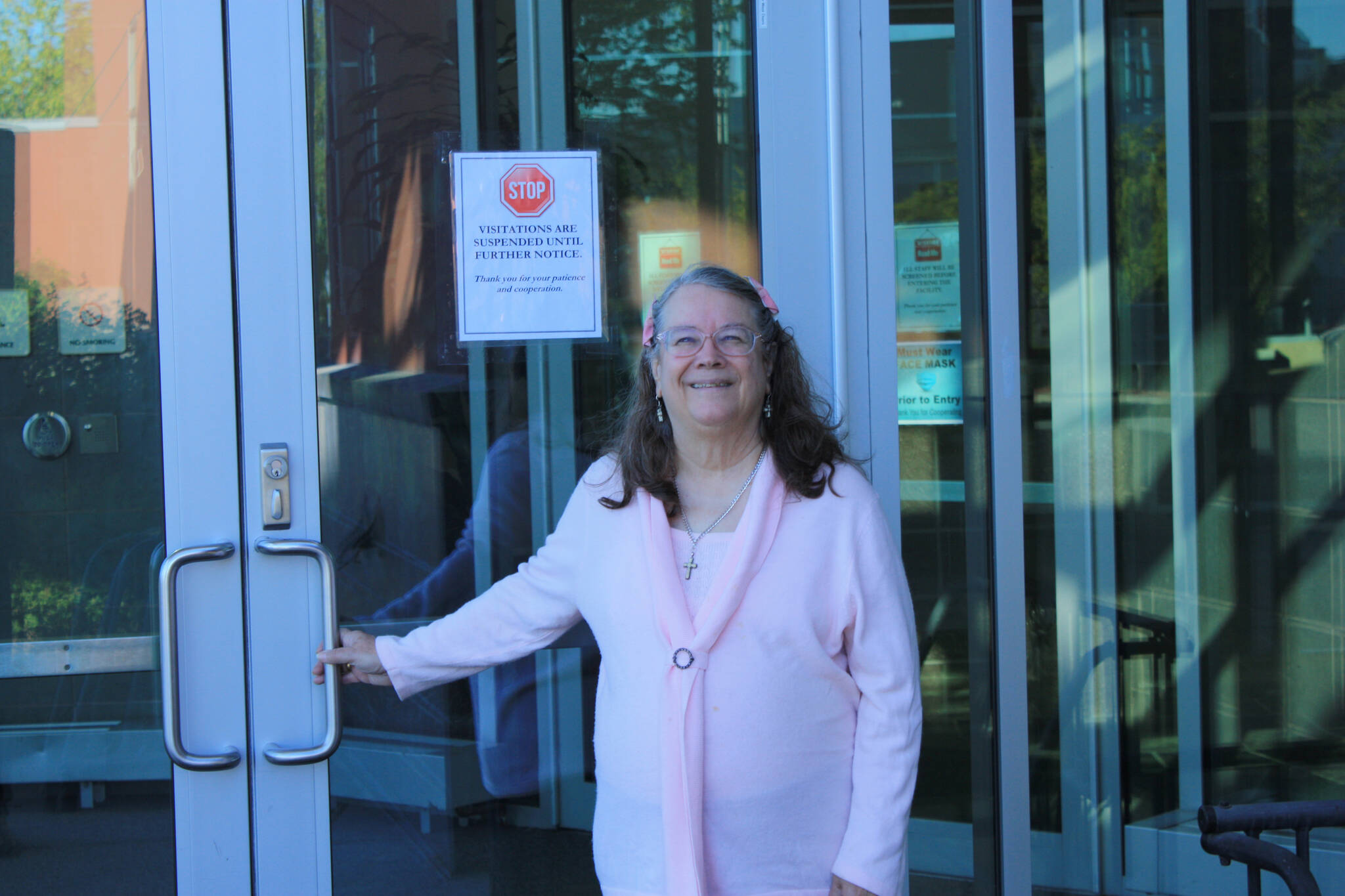
Faith Myers stands at the doors of API. (Courtesy Photo)

Faith Myers stands at the doors of API. (Courtesy Photo)

Opinion: Protecting people with a disability should be a legislative priority

The question still to be answered: “Will mental health care improve?”

  • By Faith J. Myers
  • Wednesday, September 15, 2021 1:43pm
  • Opinion

By Faith J. Myers

The settlement of a 2018 lawsuit brought by the Disability Law Center and others against the state will shape mental health care in Alaska for decades. The question still to be answered: “Will mental health care improve?”

Prior to 2018, the Department of Health and Social Services reduced the number of available beds at the Alaska Psychiatric Institute. Because of the lack of beds, people needing mental health care or a psychiatric evaluation found themselves in jail or a hospital waiting room. Superior Court Judge William F. Morse determined the practice caused “irreparable harm” and ordered the DHSS to create a plan for corrective action. The ripples of that decision are still being felt in 2021.

The lawsuit and the on-going settlement are all about correcting the failures of the state to properly protect and care for people in crisis. The 30-page document released by the DHSS in 2020, titled “Addressing Gaps in the Crisis Psychiatric Response System” is one-sided. The missing voice — psychiatric patients. There is not one mention of creating a partnership between the providers of psychiatric services and the patient. In my opinion, the DHSS is advocating for a system of care that has proven to be a failure.

There will be no measurable improvements in patient recovery and no partnership between providers of psychiatric services and psychiatric patients in Alaska, until psychiatric patients are given fair rights. According to state law AS47.30.847, patients have a right to bring their grievance to an impartial body, but patients are not informed they have that right. Patients are told they have a right to file a grievance, but they are rarely told the process. People entering places like the API involuntarily are often coerced into signing papers to sign themselves in with no representation.

House Bill 172 and Senate Bill 124 are working their way through the Legislature. These bills are a direct result of the lawsuit filed by the Disability Law Center in 2018. According to the bills, private Psychiatric Emergency Service Agencies (PES) over a 5-day period can detain, evaluate an individual and also administer psychotropic drugs. There are two problems with this… First, five days is too long. Second, psychiatric patient rights in law or regulation presently

do not protect a person being detained in a locked emergency services facility.

Additionally, the state has made no provision in the bills for keeping patients safe nor a way to keep statistics of patient complaints or injuries state-wide. There are over 10,000 people each year in Alaska that are taken to acute care psychiatric facilities or units. As of now, the state does not know what happens to patients in private facilities, patient injuries, patient complaints, etc. which makes a patient survey a necessity.

As of now, Alaska has not established adequate laws to protect disabled psychiatric patients. And psychiatric patients often do not have the ability to protect themselves in a meaningful way from treatment caused trauma (sanctuary trauma). There are no independent patient advocates inside of the major psychiatric units to help patients with their complaints during the hours of operation. As a note, in 2017 at the API, 116 patients were injured. Not a single patient was able to bring their complaint to an impartial body, as is their right by state law.

On seven occasions I have been locked in psychiatric facilities or evaluation units. It was the indifference of my treatment and mistreatment that led me to become a mental health advocate. The lawsuit by the Disability Law Center and the decision by Judge Morse gave the state the best opportunity in 40 years to improve mental health care. In my opinion, the opportunity is being wasted by the Legislature.

• Faith J. Myers is the author of the book, “Going Crazy in Alaska: A History of Alaska’s Treatment of Psychiatric Patients.” She has volunteered as a mental health advocate for over 10 years. Columns, My Turns and Letters to the Editor represent the view of the author, not the view of the Juneau Empire. Have something to say? Here’s how to submit a My Turn or letter.

More in Opinion

Web
Have something to say?

Here’s how to add your voice to the conversation.

David Guttenfelder/The New York Times
FILE — Federal agents arrest a protester during an active immigration enforcement operation in a Minneapolis neighborhood, Jan. 13, 2026. The chief federal judge in Minnesota excoriated Immigration and Customs Enforcement on Wednesday, Jan. 28, saying it had violated nearly 100 court orders stemming from its aggressive crackdown in the state and had disobeyed more judicial directives in January alone than “some federal agencies have violated in their entire existence.”
OPINION: When silence signals consent

Masked ICE enforcement and the failure of Alaska’s congressional leadership.

Northern sea ice, such as this surrounding the community of Kivalina, has declined dramatically in area and thickness over the last few decades. Photo courtesy Ned Rozell
20 years of Arctic report cards

Twenty years have passed since scientists released the first version of the… Continue reading

Dr. Karissa Niehoff
OPINION: Protecting the purpose

Why funding schools must include student activities.

A sign reading, "Help Save These Historic Homes" is posted in front of a residence on Telephone Hill on Friday Nov. 21, 2025. (Mari Kanagy / Juneau Empire)
OPINION: The Telephone Hill cost is staggering

The Assembly approved $5.5 million to raze Telephone Hill as part of… Continue reading

Win Gruening (courtesy)
OPINION: Eaglecrest’s opportunity to achieve financial independence, if the city allows it

It’s a well-known saying that “timing is everything.” Certainly, this applies to… Continue reading

Gov. Mike Dunleavy gestures during his State of the State address on Jan. 22, 2026. (Photo by Corinne Smith/Alaska Beacon)
OPINION: It’s time to end Alaska’s fiscal experiment

For decades, Alaska has operated under a fiscal and budgeting system unlike… Continue reading

Atticus Hempel stands in a row of his shared garden. (photo by Ari Romberg)
My Turn: What’s your burger worth?

Atticus Hempel reflects on gardening, fishing, hunting, and foraging for food for in Gustavus.

At the Elvey Building, home of UAF’s Geophysical Institute, Carl Benson, far right, and Val Scullion of the GI business office attend a 2014 retirement party with Glenn Shaw. Photo by Ned Rozell
Alaska Science Forum: Carl Benson embodied the far North

Carl Benson’s last winter on Earth featured 32 consecutive days during which… Continue reading

Van Abbott is a long-time resident of Alaska and California. He has held financial management positions in government and private organizations, and is now a full-time opinion writer. He served in the late nineteen-sixties in the Peace Corps as a teacher. (Contributed)
When lying becomes the only qualification

How truth lost its place in the Trump administration.

Jamie Kelter Davis/The New York Times
Masked federal agents arrive to help immigration agents detain immigrants and control protesters in Chicago, June 4, 2025. With the passage of President Trump’s domestic policy law, the Department of Homeland Security is poised to hire thousands of new Immigration and Customs Enforcement (ICE) agents, and double detention space.
OPINION: $85 billion and no answers

How ICE’s expansion threatens law, liberty, and accountability.

Yereth Rosen/Alaska Beacon
The entrance to the Alaska Gasline Development Corp.’s Anchorage office is seen on Aug. 11, 2023. The state-owned AGDC is pushing for a massive project that would ship natural gas south from the North Slope, liquefy it and send it on tankers from Cook Inlet to Asian markets. The AGDC proposal is among many that have been raised since the 1970s to try commercialize the North Slope’s stranded natural gas.
My Turn: Alaskans must proceed with caution on gasline legislation

Alaskans have watched a parade of natural gas pipeline proposals come and… Continue reading