
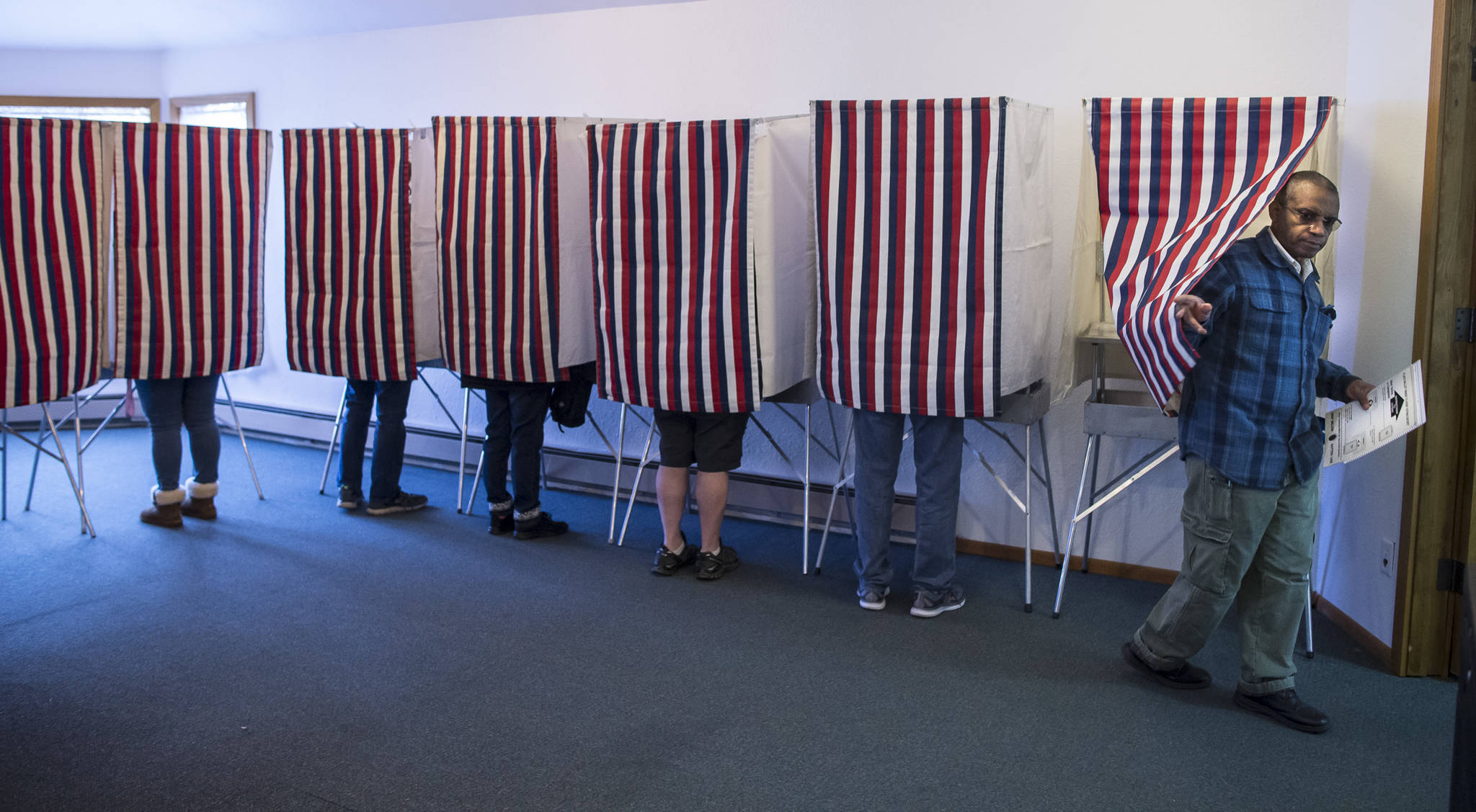
Democrats took control of the U.S. House of Representatives on Tuesday. But the blue wave only rippled into seven eastern states and a few districts scattered across the northern plains and southwest. And the undertow gave Republicans firmer majorities in the Senate and here at home.
In other words, nothing changed dramatically.
In Alaska, Governor-elect Mike Dunleavy will suspend the debate over new revenue, consider restoring the full Permanent Fund Dividend and dream that new oil and mining investments will grow our economy enough to solve the long-term budget crisis. But not fast enough. Which means more cuts to what he’s sure is a “bloated state budget.” All with faithful Republicans like him cheering from the legislative chambers they’ll control.
Translation — fiscal responsibility will remain an Alaska oxymoron in which the citizenry expects the highest level of state government services while enjoying the annual handout on top of the lowest personal tax burden in the country.
Mark Begich thought it would be different. He began his campaign saying he’s never entered a race he couldn’t win. His confidence was boosted after Gov. Bill Walker withdrew a few weeks before the election. And even more afterwards when an Alaska Survey Research Poll showed him leading Dunleavy by three points.
But the political reality was an old story for Alaska Democrats — a near double-digit loss.
The only change we’ll see nationally is the house speaker and committee chair gavels will be in the hands of Democrats. Any serious attempt to enact a more liberal agenda or hold the Trump administration accountable will likely be stopped by the Republican dam in the senate.
So expect more partisan animosity and gridlock. And Congress’ approval to hover near 20 percent, which is where’s it’s been since 2010.
Not so coincidentally, that’s when senate minority leader Mitch McConnell (R-Kentucky) said “the single most important thing we want to achieve is for President Obama to be a one-term president.” Even if he sincerely hoped Obama would meet his party “halfway on some of the biggest issues,” between the lines the message was a never-ending campaign takes precedence over actual governance.
And that suits Trump, who seems most at home when rallying the troops. Expect that to resume in about six months, which is when, based on the past few presidential election cycles, Democratic hopefuls will start stumping for their party’s 2020 nomination.
In the meantime, Trump will tweet enough vitriol to keep his base satisfied he’s upsetting both the left and the establishment Republicans who oppose his presidency.
The worst of what won’t change is the violence. The law and order president, who in his inauguration speech promised “This American carnage stops right here and right now,” won’t find the courage to stand up to the National Rifle Association. Nor will Congress.
So, expect more deranged male shooters — like the ones who killed 11 people at a Pittsburgh synagogue two weeks ago and 12 at a bar in California the night after the election — to open fire on crowds of unsuspecting Americans. And our government to act like more thoughts and prayers is a substitute for sensible gun laws.
Instead of serious legislative debates, we’ll also get partisan posturing on health care, immigration and climate change. And we’ll be stuck there because one side will trust the talking heads of Fox News and Sinclair affiliated stations, while the other turns on MSNBC or CNN.
Trump will amplify that divide by continuing to call the latter “fake news” and the “enemy of the people.” It’ll be effective with his base not just only they love it, but because even his dismal approval rating is twice as high as the confidence Americans of all stripes have in television news and newspapers.
It’ll stay that way as long politically friendly bubbles give both sides refuge. Which is why a prerequisite to solving serious problems is making some sort of peace with voices in the opposition who also seek to restore respect for news media and other vital American institutions.
“Not everyone on the right lost their minds,” writes conservative commentator Charles J. Sykes in the preface to the paperback edition of his book, “How the Right Lost its Mind.” Their lyrics may be different, but after Trump claiming victory on Wednesday, they’re certainly singing the blues too.
• Rich Moniak is a Juneau resident and retired civil engineer with more than 25 years of experience working in the public sector. He contributes a weekly “My Turn” to the Juneau Empire. My Turns and Letters to the Editor represent the view of the author, not the view of the Juneau Empire.
