
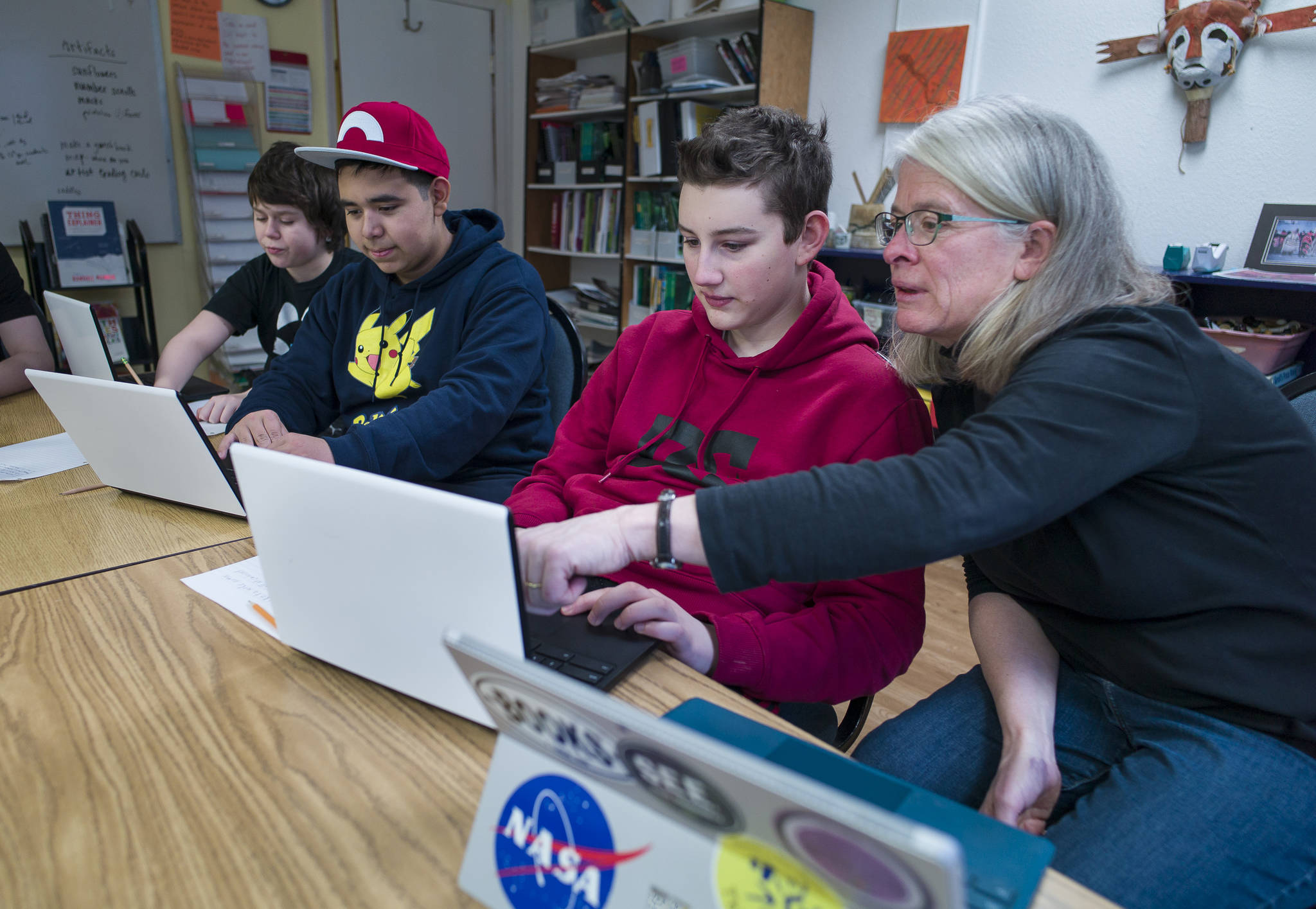
In this Jan. 10, 2018 photo, Math Specialist Brenda Taylor helps eighth graders Fisher Lee, right, and Jorge Cordero, center, and sixth grader Joshua Kessler with their coding project at the Juneau Community Charter School. (Michael Penn | Juneau Empire File)

In this Jan. 10, 2018 photo, Math Specialist Brenda Taylor helps eighth graders Fisher Lee, right, and Jorge Cordero, center, and sixth grader Joshua Kessler with their coding project at the Juneau Community Charter School. (Michael Penn | Juneau Empire File)

Opinion: Our schools are challenged, but thriving

Data doesn’t tell the entire story.

  • By PAMELA GARCIA
  • Thursday, May 9, 2019 7:00am
  • Opinion

I have worked for the Juneau School District for 26 years in a variety of roles: paraprofessional, primary teacher, intermediate teacher, instructional coach and special education teacher.

During this time, I have observed school personnel working to their utmost capacity to provide for the myriad of student needs. Administrators, teachers, special ed staff, specialists, nurses, counselors, librarians, paraprofessionals and office staff are all working hard. We are constantly striving to improve academic, social/emotional and behavioral learning.

So, if we are all working so hard, why does the achievement data not look better, and why do student outcomes appear to vary between our schools? We need to be very cautious when looking at aggregated data as the numbers do not tell the whole story.

Each school in the Juneau School District has a different profile. Some schools house special programs for students with behavioral disorders, communication disorders or autism spectrum disorders, while other schools do not. Some schools have a higher population of English language learners. Some schools have a higher population of students considered to be homeless or at the poverty level.

[Opinion: University of Alaska is fully committed to the student experience]

We have a proclivity to compare schools when looking at data. However, comparing schools is not helpful as they are not similar in their special programs or student populations.

It is important to note that many of our students are doing quite well and showing progress in academic growth. But, teachers are also noticing a growing number of children coming to school less prepared and able to attend to learning. We are faced with managing a classroom of students where a significant number are experiencing varying effects of trauma.

Our student population is a reflection of the greater community. Notice some of our most recent concerns in Juneau: crime, suicide, drug and alcohol addiction, domestic violence, sexual assault and mental health issues. Some adults involved in the above-mentioned issue also have children. And, these children are adversely affected by their caregiver’s difficulties, which often transfers to learning challenges in school.

[Opinion: The solution to every problem isn’t always spending more money]

Most people understand that prenatal drug use can affect brain development, but it is not commonly known that trauma and chronic stress can also stunt the brain’s ability to learn or to self-regulate emotions and behavior. I like to think of Maslow’s Hierarchy of Needs. Children’s physiological, safety, love and belonging needs have to be met before they are able to dedicate more of their attention to learning.

Despite the challenges of trying to meet the intense needs of some of our students, our schools are thriving — thriving with staff and community members who dedicate their hearts and expertise to helping our children meet their potential. Unfortunately, the quantitative data for our academic achievement does not always reflect the positive impact we are making for the social and emotional well-being of our students.

I do not have any political stance or recommendations for solutions. All I know is that real problems are complex. If we want to improve the academic achievement of our children, we need healthier individuals, healthier families and a healthier community.

My hope is to broaden people’s understanding of what is happening in schools in order to decrease misconceptions and the human tendency to draw conclusions when presented with data. Numbers are only the tip of the iceberg; there is the whole human milieu that lies underneath.


• Pamela Garcia is a special education resource teacher for the Juneau School District. My Turns and Letters to the Editor represent the view of the author, not the view of the Juneau Empire.


More in Opinion

Web
Have something to say?

Here’s how to add your voice to the conversation.

Dr. Karissa Niehoff
OPINION: Protecting the purpose

Why funding schools must include student activities.

A sign reading, "Help Save These Historic Homes" is posted in front of a residence on Telephone Hill on Friday Nov. 21, 2025. (Mari Kanagy / Juneau Empire)
OPINION: The Telephone Hill cost is staggering

The Assembly approved $5.5 million to raze Telephone Hill as part of… Continue reading

Win Gruening (courtesy)
OPINION: Eaglecrest’s opportunity to achieve financial independence, if the city allows it

It’s a well-known saying that “timing is everything.” Certainly, this applies to… Continue reading

Gov. Mike Dunleavy gestures during his State of the State address on Jan. 22, 2026. (Photo by Corinne Smith/Alaska Beacon)
OPINION: It’s time to end Alaska’s fiscal experiment

For decades, Alaska has operated under a fiscal and budgeting system unlike… Continue reading

Atticus Hempel stands in a row of his shared garden. (photo by Ari Romberg)
My Turn: What’s your burger worth?

Atticus Hempel reflects on gardening, fishing, hunting, and foraging for food for in Gustavus.

At the Elvey Building, home of UAF’s Geophysical Institute, Carl Benson, far right, and Val Scullion of the GI business office attend a 2014 retirement party with Glenn Shaw. Photo by Ned Rozell
Alaska Science Forum: Carl Benson embodied the far North

Carl Benson’s last winter on Earth featured 32 consecutive days during which… Continue reading

Van Abbott is a long-time resident of Alaska and California. He has held financial management positions in government and private organizations, and is now a full-time opinion writer. He served in the late nineteen-sixties in the Peace Corps as a teacher. (Contributed)
When lying becomes the only qualification

How truth lost its place in the Trump administration.

Jamie Kelter Davis/The New York Times
Masked federal agents arrive to help immigration agents detain immigrants and control protesters in Chicago, June 4, 2025. With the passage of President Trump’s domestic policy law, the Department of Homeland Security is poised to hire thousands of new Immigration and Customs Enforcement (ICE) agents, and double detention space.
OPINION: $85 billion and no answers

How ICE’s expansion threatens law, liberty, and accountability.

Yereth Rosen/Alaska Beacon
The entrance to the Alaska Gasline Development Corp.’s Anchorage office is seen on Aug. 11, 2023. The state-owned AGDC is pushing for a massive project that would ship natural gas south from the North Slope, liquefy it and send it on tankers from Cook Inlet to Asian markets. The AGDC proposal is among many that have been raised since the 1970s to try commercialize the North Slope’s stranded natural gas.
My Turn: Alaskans must proceed with caution on gasline legislation

Alaskans have watched a parade of natural gas pipeline proposals come and… Continue reading

Win Gruening (courtesy)
OPINION: Juneau Assembly members shift priorities in wish list to Legislature

OPINION: Juneau Assembly members shift priorities in wish list to Legislature

Letter to the editor typewriter (web only)
LETTER: Juneau families care deeply about how schools are staffed

Juneau families care deeply about how our schools are staffed, supported, and… Continue reading