
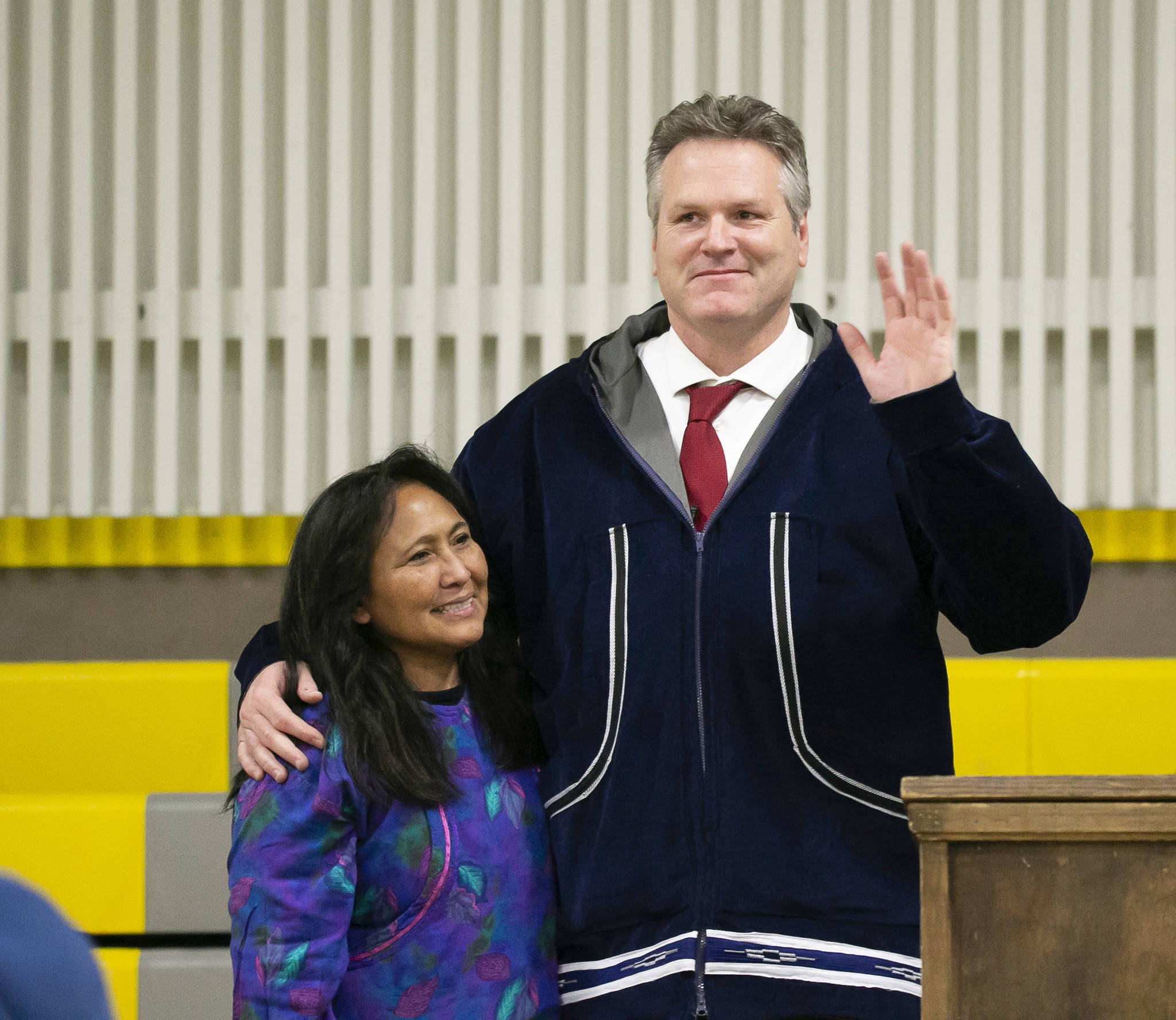
Mike Dunleavy’s inaugural day came in typical Alaska fashion — weather conditions forced him to cancel a ceremony in Noorvik, his wife’s remote hometown village, and instead hold a hastily assembled meeting in Kotzebue where he took his oath of office as Alaska’s 12th governor.
Adapting to weather conditions is a fact of life for all Alaskans. Where I live, in the town of Kodiak, spending the night in the Anchorage airport waiting for your plane to be able to land on our foul-weathered island is essentially a rite of passage. It’s this reality of the Alaskan climate that we are forced to cope with on a daily basis.
This is why I was baffled to hear Dunleavy’s response at his inauguration when asked about how Alaska should deal with climate change: “Alaska is being affected by erosion…so that’s going to be the focus of this administration.” He also mentioned that his “focus is trying to create jobs for our kids and grandkids,” in a statement implying that addressing climate change is somehow antithetical to sustaining a workforce.
Erosion didn’t kill the fish in the Gulf of Alaska in 2016 when the entire area was declared a federal economic disaster due to record-low salmon returns. It didn’t kill the sockeye last summer in the Copper River and Cook Inlet, nor did Chignik endure its worst salmon season ever as a result of eroded hillsides. It was a massive warm patch of water, colloquially termed the Pacific Blob, that was the culprit in creating devastating ocean conditions that killed off nearly an entire generation of multiple fish species.
Regardless of whether Gov. Dunleavy choses to accept the scientific consensus that mankind is accelerating climate change, he should not abdicate his duty to prepare the state for continued catastrophic outcomes of a warming ocean. Gulf communities were caught entirely by surprise when salmon failed to show up, and it is unclear how these towns will cope if future salmon runs remain this volatile. Alaska needs to be prepared for sustained weak salmon returns as “the blob” is now reappearing after a couple of years’ absence.
Past policies have exacerbated the negative impact of poor salmon returns. For example, short-sighted fishery managers have forced an entire generation of fishermen to become over-reliant on salmon fisheries as a result of the privatization of halibut, king crab and groundfisheries. These programs, known as “catch shares,” provided a windfall for many Seattle-based fishing and processing companies, but cost ordinary Alaskans thousands of jobs, eliminated the ability of fishermen to diversify between fisheries and resulted in the outmigration of fishing rights away from fishing towns, thereby weakening the economic resiliency of coastal communities.
The governor needs to understand that, in contrast to his inaugural statements, addressing climate change is necessary to sustain jobs in Alaska. Though he essentially ignored Gulf communities in his campaign (he was the first major gubernatorial candidate to skip the traditional fisheries debate in Kodiak) he cannot dismiss the fact that the seafood industry is Alaska’s largest employer, producing tens of thousands of jobs while generating billions of dollars annually in state exports. It’s also the industry most vulnerable to global warming, as was discovered during the recent salmon disasters. Dunleavy needs to ensure that economic policy and fishery management allows for coastal resiliency in the face of uncertain ocean ecology.
If it was Dunleavy’s desire to focus on a subset of Alaska’s communities, while ignoring Gulf residents, then he should have simply remained a state senator. But instead, he chose to run for governor, and now must assume all of the responsibilities that accompany the state’s highest post. He has a lot to discover about the diversity of issues facing our state and I hope it’s his intention to learn more about the challenges facing the Gulf. It would be as foolish of him to ignore coastal communities and their perilous exposure to climate change as it would have been for him to neglect the weather on his inaugural day and continue blindly into the dense fog toward Noorvik.
• Darren Platt is a commercial fisherman and resident of Kodiak. My Turns and Letters to the Editor represent the view of the author, not the view of the Juneau Empire.
