
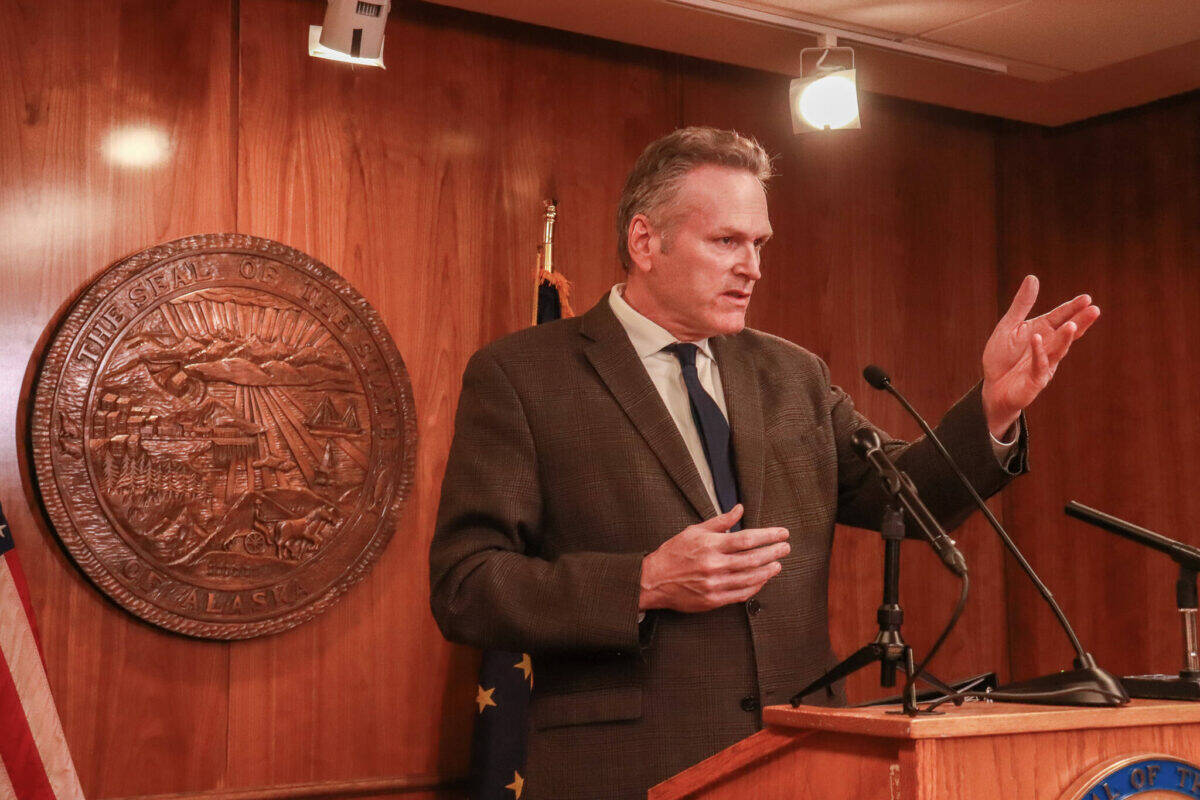
Gov. Mike Dunleavy speaks about his decision to veto House Bill 57 during a press conference at the Alaska State Capitol on Monday, May 19, 2025. (Jasz Garrett / Juneau Empire file photo)

Opinion: Governor deposits a veto to help predatory lenders

  • By Larry Persily
  • Wednesday, July 2, 2025 11:09am
  • Opinion

Thousands of Alaskans get so squeezed on their finances every year that they turn to high-interest payday loans to help cover their bills. That may sound manageable — short-term borrowing with the intent to pay back the debt with the next paycheck — but it digs a deep hole into financial quicksand for many people.

More than 7,000 Alaskans took out payday loans totaling $17.4 million in 2023, according to the state’s Division of Banking and Securities. The loans were small, averaging about $440, but these were not one-time events. Each of those 7,000 borrowers took out an average of 5.5 loans over the year, according to the state’s record keeping.

There are three problems here:

First, people are so desperate for cash to help cover bills or feed their families that they resort to borrowing money that they often cannot afford to repay on time, running up huge interest payments.

Second, the interest rates charged by payday lenders may sound “affordable,” ranging from 15% to 30%, but that’s misleading. There are fees, and that interest is quoted for the one-time life of the short-term loan. If a borrower fails to pay on time, another 15% to 30% interest can get added at every due date. Calculate the interest at an annualized rate, as you would for a car loan, and it can range between 200% and 500%.

The third problem is that while the Alaska Legislature passed a bill to limit the annualized rate to 36%, Gov. Mike Dunleavy vetoed the measure. The 36% annualized cap, though still hefty, was in line with almost 20 other states that want to help consumers but not eliminate the necessary borrowers of last resort.

Dunleavy said he vetoed the legislation because it would have reduced short-term borrowing options for Alaskans, “while creating enforcement challenges for the state.”

Despite the governor’s excuse, the “enforcement challenges” would be no more difficult than what the state already manages for traditional lenders. The legislation would have merely removed payday lenders from a state exemption in lending laws and placed a cap on interest rates and fees.

Industry groups were in full force against the legislation, telling the state’s elected leaders that curtailing payday loan interest rates would stifle “innovation” to serve people with low credit scores. One of the groups even proclaims that in its name: The Innovative Lending Platform Association.

There is nothing innovative about making money off people who have few other options. The governor sided with payday lenders — an out-of-state industry — over Alaskans. He used his veto pen to deposit profits for the lenders at the expense of people struggling to pay their bills.

Larry Persily is a longtime Alaska journalist, with breaks for federal, state and municipal public policy work in Alaska and Washington, D.C. He lives in Anchorage and is publisher of the Wrangell Sentinel weekly newspaper.

More in Opinion

Web
Have something to say?

Here’s how to add your voice to the conversation.

A sign reading, "Help Save These Historic Homes" is posted in front of a residence on Telephone Hill on Friday Nov. 21, 2025. (Mari Kanagy / Juneau Empire)
OPINION: The Telephone Hill cost is staggering

The Assembly approved $5.5 million to raze Telephone Hill as part of… Continue reading

Win Gruening (courtesy)
OPINION: Eaglecrest’s opportunity to achieve financial independence, if the city allows it

It’s a well-known saying that “timing is everything.” Certainly, this applies to… Continue reading

Gov. Mike Dunleavy gestures during his State of the State address on Jan. 22, 2026. (Photo by Corinne Smith/Alaska Beacon)
OPINION: It’s time to end Alaska’s fiscal experiment

For decades, Alaska has operated under a fiscal and budgeting system unlike… Continue reading

Atticus Hempel stands in a row of his shared garden. (photo by Ari Romberg)
My Turn: What’s your burger worth?

Atticus Hempel reflects on gardening, fishing, hunting, and foraging for food for in Gustavus.

At the Elvey Building, home of UAF’s Geophysical Institute, Carl Benson, far right, and Val Scullion of the GI business office attend a 2014 retirement party with Glenn Shaw. Photo by Ned Rozell
Alaska Science Forum: Carl Benson embodied the far North

Carl Benson’s last winter on Earth featured 32 consecutive days during which… Continue reading

Van Abbott is a long-time resident of Alaska and California. He has held financial management positions in government and private organizations, and is now a full-time opinion writer. He served in the late nineteen-sixties in the Peace Corps as a teacher. (Contributed)
When lying becomes the only qualification

How truth lost its place in the Trump administration.

Jamie Kelter Davis/The New York Times
Masked federal agents arrive to help immigration agents detain immigrants and control protesters in Chicago, June 4, 2025. With the passage of President Trump’s domestic policy law, the Department of Homeland Security is poised to hire thousands of new Immigration and Customs Enforcement (ICE) agents, and double detention space.
OPINION: $85 billion and no answers

How ICE’s expansion threatens law, liberty, and accountability.

Yereth Rosen/Alaska Beacon
The entrance to the Alaska Gasline Development Corp.’s Anchorage office is seen on Aug. 11, 2023. The state-owned AGDC is pushing for a massive project that would ship natural gas south from the North Slope, liquefy it and send it on tankers from Cook Inlet to Asian markets. The AGDC proposal is among many that have been raised since the 1970s to try commercialize the North Slope’s stranded natural gas.
My Turn: Alaskans must proceed with caution on gasline legislation

Alaskans have watched a parade of natural gas pipeline proposals come and… Continue reading

Most Read