
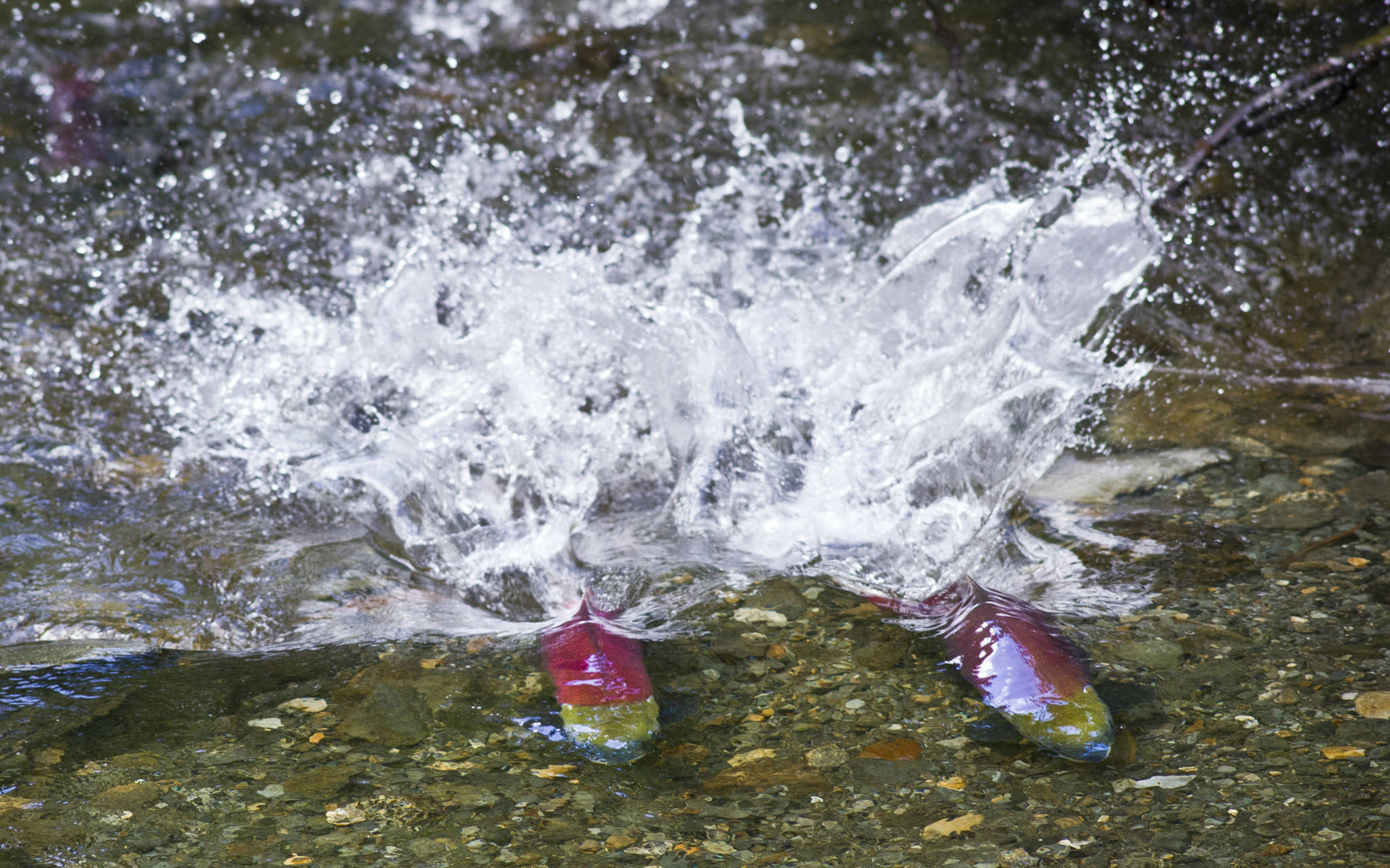
In the 1980s, when the fishing industry was opposing cuts to the Department of Fish and Game, they argued that salmon was Alaska’s first Permanent Fund.
Protecting the budget for salmon management was seen as akin to protecting the principal of the Permanent Fund. Because healthy populations of salmon, whether for commercial, sport or subsistence, is so fundamental to how we define ourselves as Alaskans, it was an easy and effective association to make. Now the principal of Alaska’s first Permanent Fund (salmon) is at risk and there is an opportunity for the second Permanent Fund to address this risk while concurrently improving the fund’s bottom-line.
About a week ago, the Juneau Empire reported on how Alaska’s heat wave is killing salmon across the state. From the Koyukuk River in the Arctic to the Deshka river in the Mat-Su area, pink and chum salmon have been observed in large numbers dying of “heat stress” prior to spawning. In financial terms, the principal of our first Permanent Fund is now being drained away and exposed to the risk of the ongoing climate crisis.
Many credible analyses that demonstrate a significant amount, up to two-thirds, of the world’s known and accessible fossil fuel reserves must remain in the ground if there is to be any chance at all of the world meeting the terms of the Paris accord and avoiding complete climate catastrophe. To push world markets to responsibly move in this direction, countries and thousands of institutions have joined the global campaign to divest from fossil fuels, and instead invest in renewable energy and energy efficiency. The latest major institution to join the divestment movement is Norway’s $1 trillion sovereign wealth fund.
The track record is positive for funds that have switched from fossil fuels to renewable energy in their portfolios, improving their bottom line. The Institute for Energy Economic and Financial Analysis (an independent organization of economists) concludes that: “Future returns from the fossil fuel sector will not replicate past performance making the financial case for fossil fuel divestment strong. Over the past three and five years, respectively, global stock indexes without fossil fuel holdings have outperformed otherwise identical indexes that include fossil fuel companies. Fossil fuel companies once led the economy and world stock markets. They now lag.”
Last year when more than 400 Alaskans signed a petitioned to ask the Alaska Permanent Fund Board to consider climate change and good governance criteria in the management of the fund, the Board responded, “we invest in companies, not causes.”
According to Tim Bradner, a longtime reporter on oil and gas matters, “The Board is worried that anything that smacks of a fossil fuel divestiture policy would be seen as an unfriendly gesture toward the industry at a time when Alaska is courting new investment by companies on the North Slope and the Cook Inlet.” Mr. Bradner’s assessment was confirmed by follow-up statements made by William Moran, Board chair, and Angela Rodell, CEO of the Permanent Fund. In a letter sent to former UA Professor Rick Steiner, they wrote, “We are relying on the continued investment of these [fossil fuel] companies to sustain our oil production and our state’s economy and revenues and the oil royalties that flow to the Permanent Fund.”

Kate Troll (courtesy photo)
Refusing to consider divestment out of loyalty to Alaska’s oil and gas sector certainly sounds like a cause to me. If the state’s economy is the bottom-line for the Board, then again they should consider the impact of Alaska’s salmon. According to the Alaska Salmon Marketing Institute, salmon contribute approximately 32,900 full-time jobs and over $1.7 billion in annual wages.
It’s no longer polar bears on dwindling icebergs serving as Alaska’s canary of the climate crisis. It’s now heat-stressed salmon. Salmon, our backbone of who are and a vital contributor to the state’s economy is facing a serious risk of survival. It’s time for the Alaska Permanent Fund to step up and do its part to protect Alaska’s first permanent fund, salmon. If Norway, an oil and gas country, can move in this direction, so too can Alaska. Our salmon deserve nothing less.
• Kate Troll is a former Juneau Assembly member with 22 years experience in climate and energy, fisheries and coastal management policy. She is the author of “The Great Unconformity: Reflections on Hope in an Imperiled World.” My Turns and Letters to the Editor represent the view of the author, not the view of the Juneau Empire.
