
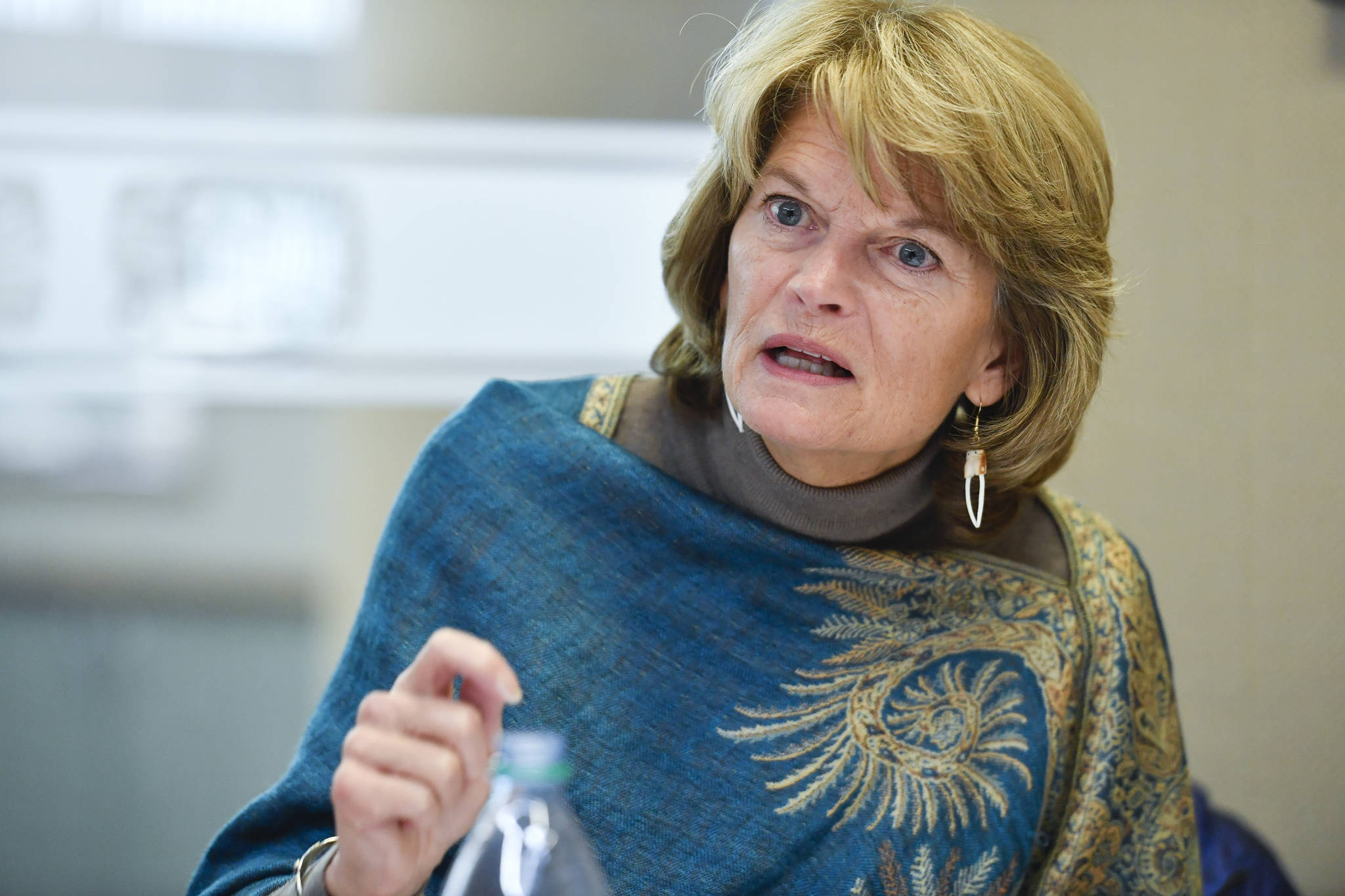
Sen. Lisa Murkowski is once again getting national attention for breaking ranks with the Republican Party. This time it’s over President Donald Trump’s emergency declaration over the southern border. For having “the strength to announce opposition” to it, Washington Post columnist Dana Milbank listed her as one of the few survivors of the critically endangered species of “Principled Republicans.”
I’d expand that to include principled Democrats. And argue we’ve reached this point because the base of both parties also prize loyalty over principle.
The border wall story is a perfect example. Republicans often accused President Barack Obama of usurping congressional authority. In this case, Trump’s emergency declaration is challenging the appropriation power invested in Congress by the Constitution.
[Opinion: Sen. Sullivan’s subtle budget advice]
More than 20 Republican senators had expressed serious reservations over it. Senate Majority Leader Mitch McConnell was one of them.
But after House Democrats passed a resolution denying Trump the emergency use of funds to build the border wall, only Murkowski and Sens. Susan Collins, Thom Tillis, and Rand Paul said they’d vote in favor of it. McConnell, who had acquiesced to Trump before the resolution was passed, appears to have gotten the rest to fall in line and oppose it.
[Murkowski knocks Green New Deal’s impossible timeline]
Now let’s look at how House Speaker Nancy Pelosi and Democrats operate the same way.
Last week the House passed a bill requiring background checks for all firearm sales, including purchases being made from private citizens. The title – Bipartisan Background Checks Act of 2019 – masked its partisan reality. The California Democrat who introduced it had 232 co-sponsors, only five of which were Republicans. Just eight Republicans joined the 232 Democrats who voted to pass it. The nays included two Democrats and 188 Republicans.
What was more bipartisan occurred before it was passed. Republicans submitted a motion that 26 Democrats supported. It would have added language requiring law enforcement officials to notify U.S. Immigration and Customs Enforcement (ICE) if there was evidence the firearm purchase was being made by an illegal immigrant. Pelosi responded with a demand right out of McConnell’s playbook. “Vote no. Just vote no because a vote yes is to give leverage to the other side, to surrender the leverage on the floor of the House.”
[Murkowski critical of Trump’s border wall emergency]
And the voice of the more liberal freshman class, Rep. Alexandria Ocasio-Cortez referred to them as the “moderate wing” of the party. She wasn’t recognizing possible differences in political opinions, but rather deriding them for betraying the party’s liberal base.
To clarify one point, I’m not suggesting any of the Democrats who supported the GOP motion necessarily did so on principle. Most were from swing districts and their only concern may have been jeopardizing chances for re-election.
Regardless, the position taken by Pelosi and Ocasio-Cortez is how Alaska’s Republican Party usually responds to Murkowski whenever she doesn’t back the party line. On the other hand, many Alaska liberals who praise her for such stands later act betrayed when she returns to her more traditional Republican philosophies.
David Brooks describes this kind of politics as a “scarcity mind-set … based upon us/them, friend/enemy, politics is war, life is conflict” with both sides believing “the fantasy that the other half of America can be conquered, and when it disappears we can get everything we want.” The fantasy is in the futility. The conquered opposition won’t cease to exist. It’ll be mobilized to respond, will eventually regain power, and reverse course.
[Empire Exclusive: Read our full conversation with Sen. Murkowski]
The alternative, Brooks suggests, is for moderates like Murkowski to build an agenda around “solidarity, fraternity, conversation” across the divide. It “should magnify our affections for one another” in four areas that bind society — love of our children, work, community and our shared humanity.
“Moderation is not an ideology,” he concludes. “It is a way of being.”
As such, it’s only a temporary state. A so-called political moderate must have the freedom to wander not only across party lines but as far from the center as their principles guide them.
We can continue to live with the tragic irony that a government elected to protect our freedoms and promote responsibility can do neither. Or we can follow Murkowski’s way out. She may never have gained such prominence in another era. But today, more members of Congress and the party bases must learn to embrace the conscientious relationship to higher values that she often exhibits.
• Rich Moniak is a Juneau resident and retired civil engineer with more than 25 years of experience working in the public sector. He contributes a weekly “My Turn” to the Juneau Empire. My Turns and Letters to the Editor represent the view of the author, not the view of the Juneau Empire.
