
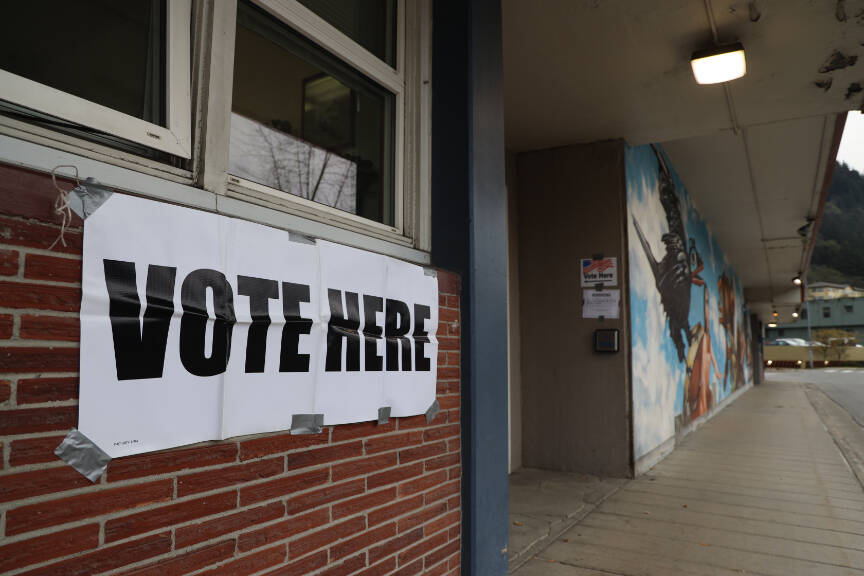
Leading up to Juneau’s Oct. 4 municipal election, arguments for and against several ballot propositions dominated social media, Juneau Empire pages, radio airwaves and yard signs. All candidates on the ballot ran unopposed which focused even more attention on ballot issues.
It’s rare when an Assembly-sponsored bond proposition doesn’t pass muster with the electorate and even more uncommon when a CBJ ordinance is repealed by voters. But it’s possible both of those outcomes may come to pass.
Two of the four ballot issues, Proposition 1 and Proposition 4, were the subject of some controversy. The first authorized issuance of $35 million in general obligation bond debt to partially pay for construction of a new City Hall and the second repealed recently enacted CBJ Code requiring disclosure of prices realized in private real estate transactions.
The first round of election results showed the new City Hall funding losing narrowly and the repeal of real estate disclosure passing narrowly – both by less than 1%. Later vote counts widened those margins considerably. While it’s unlikely that remaining outstanding votes would change the end result, it’s still possible.
Regardless of the final outcome, city leaders need to ask themselves, what happened?
The last several years of COVID relief have effectively masked deficit spending that has proceeded unchecked at City Hall and allowed the Assembly to delay taking the necessary steps that would balance revenues and expenditures. Instead, city leaders have ignored the growing concern of taxpayers over the mounting list of expensive projects being promoted along with the recent steep escalation in commercial and residential property taxes.
Juneau’s economy has also shifted somewhat over the past two years. Voters have found it hard to ignore the number of empty storefronts and vacant commercial office space, not to mention our stagnant population and dwindling school enrollment.
With that as a backdrop, the Assembly and city staff rationale for a brand-new city hall with a $42 million price tag apparently did not reassure voters. The city’s own financial analysis indicated it would take 52 years to break-even and that was based on a lower construction cost and smaller bond amount than presented to voters.
Mandatory real estate disclosure, while not a tax measure or an authorization for expenditures, also failed to resonate with the public. Many voters rejected the Assembly-passed mandatory real estate disclosure because it was viewed as an over-reach and invasion of privacy (Juneau would have been the only city in Alaska with this requirement) coupled with a public distrust of city tax assessment policies. City staff explanations that mandatory disclosure would “equalize” property taxes and make them “more fair” did not convince property owners after many saw their tax bill increase dramatically and may have suffered through a long, contentious, and unsuccessful tax assessment appeal process.
Election results were probably also influenced by the Assembly’s single-minded determination to continue spending public funds on planning for a new ($77 million) civic center that included a grandiose arts and cultural facility component despite a less expensive project being rejected by
voters in 2019. This could explain some voters’ reluctance to approve additional spending elsewhere.
Will this election be a wake-up call for the Juneau Assembly?
Expenditure reductions, facility consolidations or closures, and elimination of sales tax exemptions should top the agenda before consideration of expensive replacements to city buildings serving staff and arts patrons.
Most importantly, economic development should be a high-priority topic at the Juneau Assembly’s next annual retreat on December 11. Years ago, the CBJ out-sourced economic development to the Juneau Economic Development Council which has been generously funded. But, as noted in Mark Lautman’s book, “When the Boomers Bail”, economic development is not simple. Lautman posits that almost everything that economic development specialists have traditionally promoted will be mostly useless in the coming decades. Shifting demographics, the lack of a properly educated workforce and competition to attract qualified talent will challenge even the most prosperous communities.
City leaders can meet this challenge by focusing more on growing the economy and less on growing the budget.
An expanded economy is the key to avoid saddling taxpayers with unnecessary taxes and debt.
• After retiring as the senior vice president in charge of business banking for Key Bank in Alaska, Win Gruening became a regular Opinion Page columnist for the Juneau Empire. He was born and raised in Juneau and graduated from the U.S. Air Force Academy in 1970. He is involved in various local and statewide organizations. Columns, My Turns and Letters to the Editor represent the view of the author, not the view of the Juneau Empire. Have something to say? Here’s how to submit a My Turn or letter.
