Opinion: Begich would tax, Dunleavy, cut. Whoever wins will have to act fast.
Published 6:00 am Monday, November 5, 2018
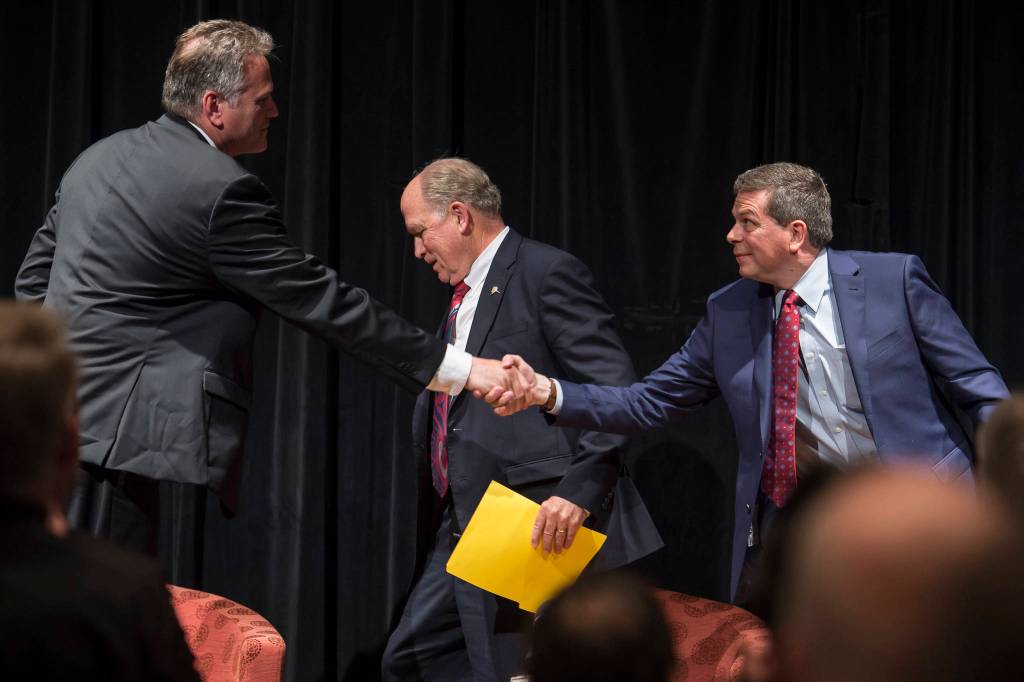
The two major candidates for governor, Mark Begich and Mike Dunleavy, have different philosophies on how to tackle our structural budget deficit.
Begich would draw 4 percent of the market value of the Permanent Fund and dedicate half to dividends and half to education, as well as transfer $14 billion from the Earning Reserve to the principle of the Fund. He also proposes bonding for $3-5 billion for a large capital budget over the next six years and to pay off the loan using a portion of the existing yearly capital budget. Loan payments will be over $200 million for twenty years if we borrow $3 billion, and the divertible capital budget is no more than $100 million, adding about $100 million to the deficit annually. However, his plan has lower dividends and produces approximately $300 million more from the Permanent Fund draw spent on government. Other than those two items, Begich’s fiscal plan is largely focused on the structure of accounts and fund flows and does not have substantial impact on the deficit.
Begich does not want major cuts. He states that if other elements of his fiscal plan are passed, he would adopt additional revenue measures as needed so long as they do not fall disproportionately on the needy. Thus taxation is a primary tool he will use to address the deficit.
Dunleavy is pursuing a different approach. Rather than immediately reducing the dividend and adopting taxes, Dunleavy indicates his plan is designed to rebuild the people’s trust. He intends to do that by reducing the operating budget through spending cuts. He has not identified all the cuts he will make or the total magnitude, instead committing to delve deeply into the effort once in office. Dunleavy is also a proponent of adopting a spending cap to prevent the budget from growing too fast in the future. He also believes in seeking the people’s input through a constitutional amendment or advisory vote to let Alaskans decide how to treat the dividend. If these things happen, then voters will be more open to a discussion around other fiscal options like how to use the Permanent Fund. Finally, Dunleavy is optimistic and determined to spur the development of Alaska’s resources to generate new state revenues.
So where does this leave Alaska? Both plans leave a structural deficit of about $1 billion at $70 per-barrel oil that gets reduced and approaches a balanced budget north of $80 per barrel. Begich intends to address the deficit by focusing on taxes, and Dunleavy by focusing on cuts in the short term and growing Alaska’s resource economy in the long term. Neither has identified many of the details around their proposals, but the deficit is a bit of a moving target, and specifics will develop once the new governor takes office.
However, the governor and Legislature must be prepared to act rapidly. Since oil prices fell in 2014, the structural deficit has been funded by savings. Although the Permanent Fund is now being used to contribute to government, cuts have been modest, and no tax package has been adopted. Consequently, state savings have fallen from over $10 billion when Gov. Bill Walker took office, to just over $2 billion when he will leave. That means at $70 per-barrel oil, we can only fund the deficit for about two years.
Unless we get lucky with high oil prices, we have no option but to act. What I like about this election is the clear choice voters have about what that action looks like. Do we cut or tax?
My personal experience serving in state government has convinced me that cutting first is the right approach, which is why I am supporting Dunleavy. But regardless of who wins, it is important that the next governor be viewed as having a mandate for their approach and that we act rapidly.
• Craig Richards is an attorney in private practice in Anchorage. He is Chairman of the Alaska Permanent Fund Corporation and former Attorney General of the State of Alaska. These views are strictly his own and do not reflect those of his clients or the Alaska Permanent Fund Corporation.