
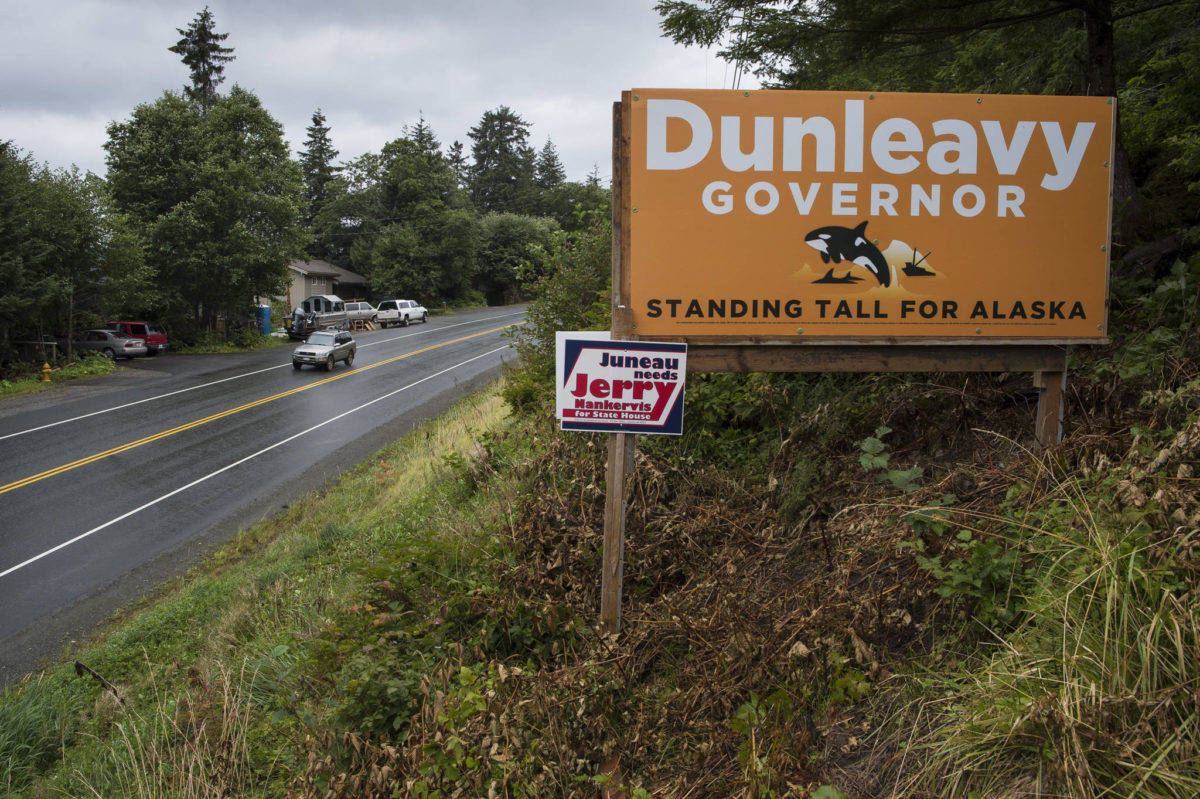
No, the American Civil Liberties Union of Alaska is not fighting to allow billboards along Alaska’s scenic highways.
It’s understandable that many Alaskans may have drawn that conclusion since the news media continues to cast our recent lawsuit against the state of Alaska as challenging what they have erroneously dubbed the “billboard law.” The fact is the statute in dispute covers a great many types of outdoor advertisements, including constitutionally-protected political speech, not just billboards.
But let me assure you that no one at the ACLU of Alaska, either staff or board members, have expressed any interest in allowing large commercial billboards to pop up across our state, nor do we believe that would happen if we win our lawsuit.
Our suit is seeking only to protect Alaskans’ ability to express their political free speech on their own property, which should become clear as we walk through the facts of the case.
Right now, the state of Alaska bans many types of signs, including campaign signs, for 660 feet on either side of their 200-foot right of way along most major roads in Alaska. That means there is a corridor 1520 feet (over five football fields) wide in which people are prohibited from expressing political speech, even on their own property.
Since we filed our lawsuit, attorneys for the state have already conceded that banning political signs outside of the right of way is indefensible. They even proposed that the judge in this case impose an injunction on them to stop them from enforcing the statute on political signs there.
Both the state and the ACLU also agree that the state is fully justified in immediately removing any sign in the public right of way that creates a public safety danger to drivers or pedestrians. This is common sense to everyone.
What is left in dispute is whether Alaskans have a right to place a political sign on their own property inside of a state highway right of way. Many Alaskans may not realize that the state doesn’t necessarily own the area in the right of way, they merely have an agreement with the property owner, called an “easement,” for the state to cross or use part of it for specific purposes.
We believe that under the Constitution’s First Amendment, so long as that owner is placing the sign on their own property and there is no safety risk to the public, then the state has no compelling interest in interfering with free speech.
It is true that the ACLU of Alaska is challenging the constitutionality of the same state statute that restricts large commercial billboards along these roadways. That doesn’t mean, however, that if our suit is successful it will lead to a proliferation of billboards across the state.
We fully expect that our suit will take a year or more to be resolved. This gives the legislature plenty of time in the upcoming legislative session to amend the current statute to both reflect Alaskans’ interest in prohibiting billboards while protecting our political free speech rights.
This is neither a complicated task nor a heavy lift given the overwhelming public support for the billboard ban.
Even if legislators don’t complete this simple task before we get a ruling from the courts, we have every confidence public pressure will force them to immediately afterward. Either way, we don’t foresee large commercial billboards being allowed in Alaska anytime soon.
Many Alaskans have asked us how we can challenge the state’s ability to ban small political signs but not large commercial billboards. Aren’t they both expressing speech?
Yes, both are expressing speech, but U.S. courts have long afforded political speech far more protections than commercial speech.
Limiting commercial speech might create a hardship for that business and their customers, but liming political speech poses the far direr threat of stifling public discourse and free expression that are fundamental necessities for our democratic system. That is why the ACLU of Alaska is perfectly comfortable challenging the state’s political speech ban, while not using this case to challenge the regulations on large commercial billboards.
A recent letter to the editor in a local newspaper said of our suit, “A politician’s ‘free speech’ should not be more important than all the millions of visitors and residents who want to see nothing but open spaces.”
Respectfully, we disagree.
There’s no right more basic to our democracy than discussing and deciding who should be our political leaders: that’s why the Supreme Court has repeatedly held that the First Amendment “has its fullest and most urgent application to speech uttered during a campaign for political office.”
When a citizen takes the time to put a political sign in her front yard, she is making a uniquely personal statement about her political views, and the fundamental right to make such a statement without interference from the government is one of the core rights that defines our free society.
As Alaskans, we all enjoy seeing open spaces, but under our Constitution, we can’t let our government use that as a reason to muzzle political speech.
That may not be a particularly satisfying answer to some, but it is a truth we at the ACLU of Alaska hold dear. We will proudly fight to defend it because, unlike too many politicians, we fight for principles, not popularity.
• Casey Reynolds is the Communications Director for the ACLU of Alaska. He has lived in Alaska since 1989 and is a proud graduate of Bartlett High School and the University of Alaska. My Turns and Letters to the Editor represent the view of the author, not the view of the Juneau Empire.
