
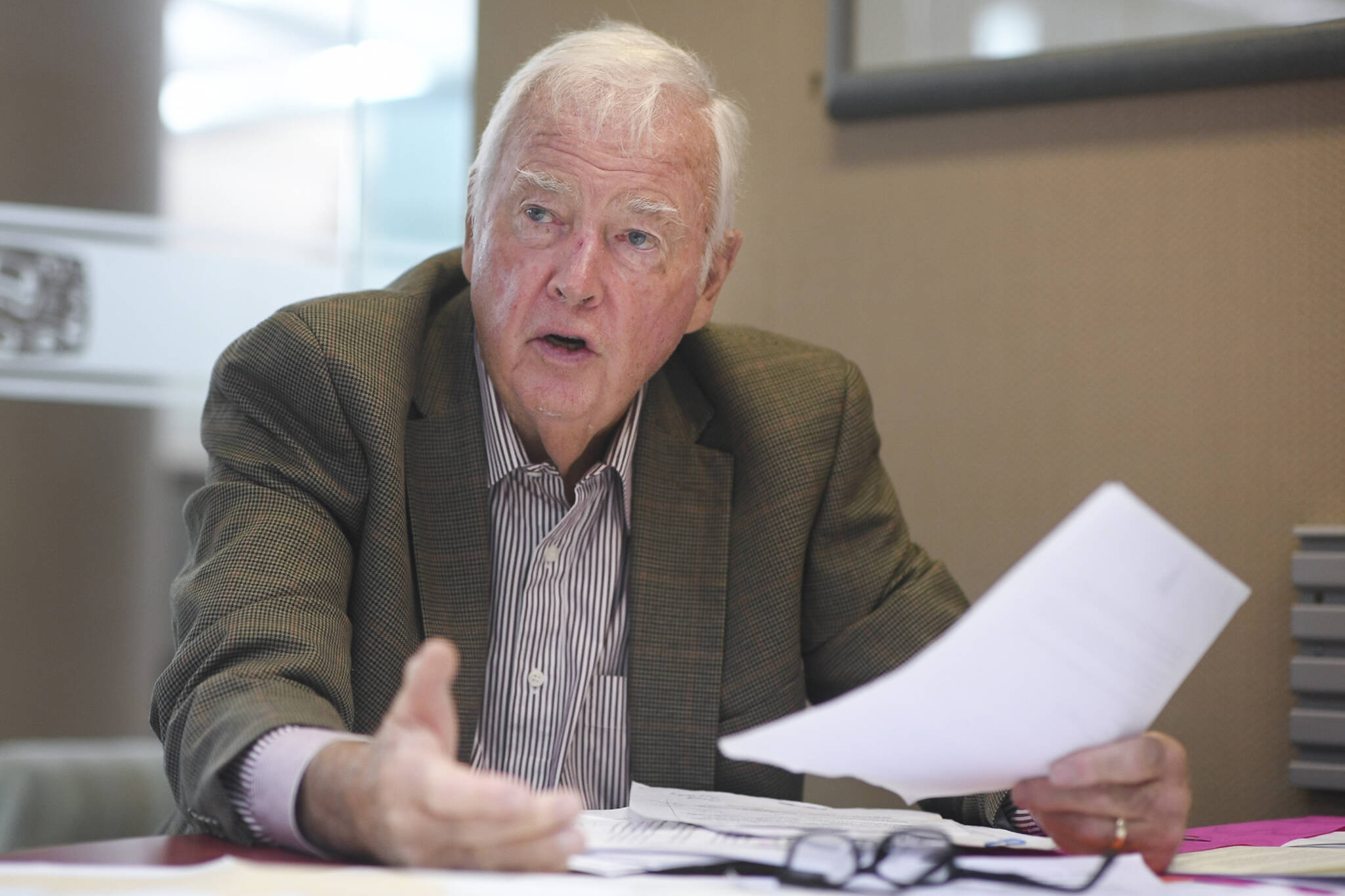
Former Gov. Frank Murkowski speaks on a range of subjects during an interview with the Juneau Empire in May 2019. (Michael Penn / Juneau Empire File)

Former Gov. Frank Murkowski speaks on a range of subjects during an interview with the Juneau Empire in May 2019. (Michael Penn / Juneau Empire File)

My Turn: Reimagining Alaska’s energy future: Extend the railroad to the North Slope

We should seriously consider the construction of a 450-mile rail extension from Fairbanks to the North Slope

  • By Frank H. Murkowski
  • Wednesday, August 27, 2025 10:08am
  • Opinion

The recent announcement of a potential merger between Union Pacific and Norfolk Southern railroads has prompted renewed reflection on Alaska’s own transportation infrastructure. While Glenfarne and the State continue to evaluate a one-way gas pipeline from the North Slope to tidewater, Alaska should use this time frame to consider a broader alternative.

We should seriously consider the construction of a 450-mile rail extension from Fairbanks to the North Slope — a project with far greater long-term economic benefit than a single purpose gas line.

The estimated costs for a two-way rail line is in the neighborhood of $10.5 billion. It could unlock the full economic potential of the North Slope. Liquid natural gas (LNG) could be transported in ISO containers as well as transfer points along the route. In addition, the railroad could deliver cleaner, cheaper energy to remote communities along the Yukon River. This could displace high-cost diesel and lower residential energy costs.

The benefits extend far beyond energy distribution:

Construction materials and goods could move more efficiently and affordably than current trucking options.

The extension would provide year-round access to the North Slope, overcoming seasonal obstacles that hinder current transportation methods. This reliability is crucial for timely resource extraction and transportation.

North Slope oil producers could reduce exploration and operational costs, enabling access to previously uneconomic reserves.

The rail corridor would help support development of the North Slope’s vast oil shale deposits, which cover approximately 30,000 square miles — three times larger than the West Texas basin that helped fuel the United States’ rise to become the world’s top oil producer.

The railroad would also reduce transportation costs for critical minerals exploration, so important in positioning Alaska to lead in supplying essential materials and precious metals.

It could serve strategic interests for the U.S. military, while also supporting a potential petrochemical manufacturing industry — building long-term value beyond raw resource export.

Most importantly, this vision is financially achievable, unlike the proposed $40-$50 billion (and now some say $70 billion) gas line. The Fairbanks-North Slope rail line could be financed through revenue bonds. The Alaska Railroad has the existing authority to issue tax exempt bonds, making this project more feasible without direct taxpayer burden. Repayment would come from the users: oil producers, mining companies, support services, the military, and future industries that benefit from access.

For these reasons, I strongly encourage the State of Alaska, the Alaska railroad and relevant federal partners to conduct a thorough cost-benefit comparison between extending the railroad from Fairbanks to the North Slope and the proposed costs of constructing the gas line. Rail offers a more flexible, resilient, and multipurpose solution that can serve Alaska’s economy and its communities for generations.

It’s time we invest in attainable infrastructure that delivers value, versatility, and vision.

• Frank H. Murkowski is a former U.S. senator and Alaska governor.

More in Opinion

Web
Have something to say?

Here’s how to add your voice to the conversation.

Win Gruening (courtesy)
OPINION: Eaglecrest’s opportunity to achieve financial independence, if the city allows it

It’s a well-known saying that “timing is everything.” Certainly, this applies to… Continue reading

Atticus Hempel stands in a row of his shared garden. (photo by Ari Romberg)
My Turn: What’s your burger worth?

Atticus Hempel reflects on gardening, fishing, hunting, and foraging for food for in Gustavus.

At the Elvey Building, home of UAF’s Geophysical Institute, Carl Benson, far right, and Val Scullion of the GI business office attend a 2014 retirement party with Glenn Shaw. Photo by Ned Rozell
Alaska Science Forum: Carl Benson embodied the far North

Carl Benson’s last winter on Earth featured 32 consecutive days during which… Continue reading

Van Abbott is a long-time resident of Alaska and California. He has held financial management positions in government and private organizations, and is now a full-time opinion writer. He served in the late nineteen-sixties in the Peace Corps as a teacher. (Contributed)
When lying becomes the only qualification

How truth lost its place in the Trump administration.

Jamie Kelter Davis/The New York Times
Masked federal agents arrive to help immigration agents detain immigrants and control protesters in Chicago, June 4, 2025. With the passage of President Trump’s domestic policy law, the Department of Homeland Security is poised to hire thousands of new Immigration and Customs Enforcement (ICE) agents, and double detention space.
OPINION: $85 billion and no answers

How ICE’s expansion threatens law, liberty, and accountability.

Yereth Rosen/Alaska Beacon
The entrance to the Alaska Gasline Development Corp.’s Anchorage office is seen on Aug. 11, 2023. The state-owned AGDC is pushing for a massive project that would ship natural gas south from the North Slope, liquefy it and send it on tankers from Cook Inlet to Asian markets. The AGDC proposal is among many that have been raised since the 1970s to try commercialize the North Slope’s stranded natural gas.
My Turn: Alaskans must proceed with caution on gasline legislation

Alaskans have watched a parade of natural gas pipeline proposals come and… Continue reading

Win Gruening (courtesy)
OPINION: Juneau Assembly members shift priorities in wish list to Legislature

OPINION: Juneau Assembly members shift priorities in wish list to Legislature

Letter to the editor typewriter (web only)
LETTER: Juneau families care deeply about how schools are staffed

Juneau families care deeply about how our schools are staffed, supported, and… Continue reading

Most Read