
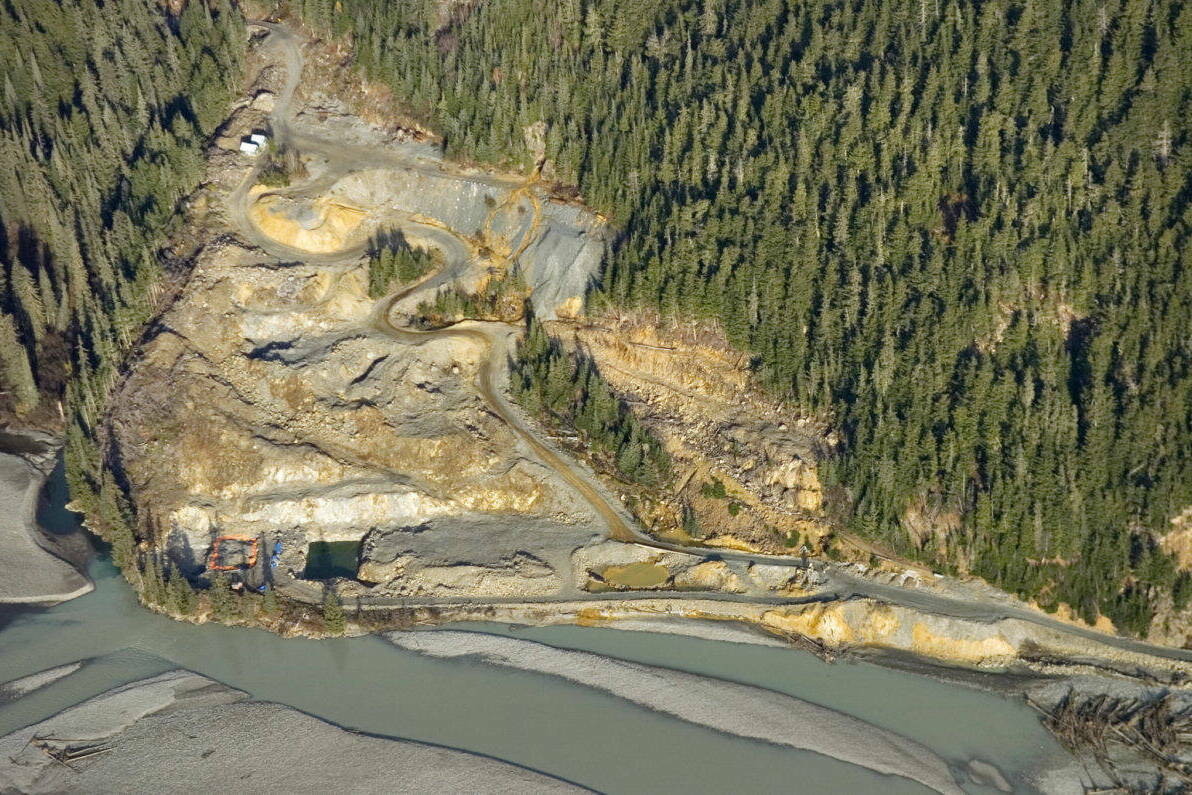
The Tulsequah Chief mine in northwest British Columbia, about 30 miles upstream of Juneau, has been discharging untreated mine waste into the Taku watershed for almost 70 years. There have been numerous plans and commitments to clean up this site, all unrealized to date.
Thirty-five years ago, I first became aware of the long-abandoned Tulsequah Mine. I was canoeing up the Taku to Atlin, into unimaginably wild country, a life-changing adventure. Following as best I could the old Tlingit travel route.
At the confluence of the Taku and Tulsequah rivers I came upon the abandoned fuel tanks being used by a homesteading fishing family for living space. These repurposed mine tanks were remnants of this long-gone industrial activity in an otherwise pristine and highly productive watershed. Along with loading me up with garlic from their cold storage, they described their concerns regarding the mine reopening and the ongoing toxic discharge from the abandoned mine. They were one of many families whose livelihoods were threatened by the mine.
A few years after my first visit, I was working as a habitat biologist for the Alaska Department of Fish and Game, tasked with reviewing a proposal from Redfern and then Chieftain to reopen the Tulsequah Chief Mine. The first assumption was the only way to clean up the effluent was to reopen the mine to provide cash flow. This was a financially compelling argument, but reopening the mine had numerous hurdles to overcome. Much has changed since the mine closed in 1957.
Access to this remote site has always been challenging. The original barge route used to refill those fuel tanks is silted in and shifty. Initially a road from Juneau was proposed and rejected by Alaska. Next a road from Atlin was rejected by the Taku River Tlingit. Both options were determined to have unacceptable impacts to cultural, subsistence, fish and wildlife resources.
Redfern’s team got creative, proposing a fleet of small barges to navigate the Taku River which resulted in a near capsize of the towing vessel. They then suggested a not-yet-developed hoverbarge designed to navigate the shallow water and sandbars in the summer, and fluctuating ice and snow in the winter of the Taku River. This proved technologically and financially unfeasible.
And there were other unresolved issues including where to dispose of treated, yet still degraded, wastewater from an operating mine and tailings pond and how to mitigate numerous environmental concerns. With regular glacial outburst floods in the Tulsequah River it was not certain if there was a viable fish habitat. By conducting seasonal studies documenting rearing and spawning activity in the Tulsequah River I became impressed with the adaptability of salmon to use the habitat available to them. Even so, it was clear there was no salmon use immediately below where mine effluent entered the river.
Alaska, British Columbia, Canadian and U.S. federal agencies worked together to address concerns raised by the Redfern proposal. But ultimately, after several reorganizations, investors decided overcoming these obstacles was not financially possible. As a result, in 2019, Canadian officials agreed the only responsible option was to clean up the TCM site by unspecified means and financing.
Fast forward to today: There is still no cleanup plan and little work has been done onsite. Additionally, Canagold is proposing a new gold mine, New Polaris, just downstream from the Tulsequah Chief Mine. This new mine will face similar challenges, raising concerns about whether New Polaris will be properly managed and cleaned up — unlike its predecessor.
The Tulsequah Chief Mine needs to be cleaned up, the existing situation is a festering wound in the Taku watershed. Alaska and British Columbia have an opportunity, to join forces and do what is right for both nations, the river, and the salmon. The technology exists to neutralize the highly toxic and acidic effluent entering the Tulsequah River and this should be prioritized before starting a new mine just a few miles downstream.
Let it be now, this year, to take actions so desperately needed and so long delayed.
• Ben Kirkpatrick is a retired state habitat biologist and current chair of the Rivers Without Borders Steering Committee. he lives in Haines.
