
State government is simply too big and the Alaska Legislature has not made adequate progress in reducing the burden of big government.
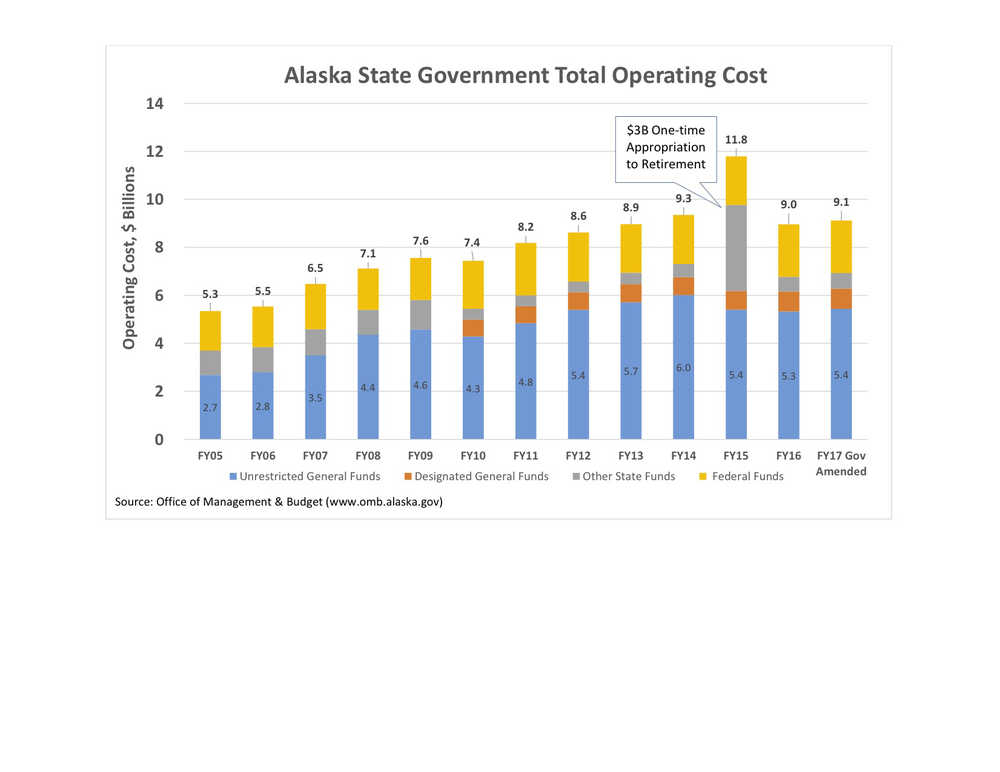
According to the State of Alaska, Office of Management and Budget, only minimal reductions in the total state operating budget have been achieved in the last two years. Note that the Fiscal Year 2015 operating budget was off trend and higher because of an extraordinary $3 billion direct appropriation for the state’s retirement liability. Comparing FY14 and FY16 total operating costs, a reduction of only 4.2 percent was achieved in two years! And for FY17, don’t hold your breath, because preliminary budgets recommended by Gov. Bill Walker and proposed by the House and Senate are projected to remain at historical highs.
Surprised? Despite the budget-cutting rhetoric coming out of Juneau, little progress has been made on real cost reductions. The numbers are clear, the impact is real, and this level of spending on state government is unsustainable. It is time to fundamentally change the cost structure of government before we take more hard-earned money from the citizens of Alaska or raid the Permanent Fund, the savings account which fortunately is protected by our state constitution.
So, why are the numbers so different? The House and Senate claim 10 percent cost reductions in proposed FY17 Unrestricted General Fund expenditures. And similar budget reductions have been reported for the current FY16 budget. Here’s the problem: Reporting a reduction in expenditure from only this one funding source is misleading. The Unrestricted General Fund is only a portion of the operating budget, albeit a significant portion. The total state operating budget is comprised of expenditures from the Unrestricted General Fund, Designated General Fund, other state funds and federal receipts.
When we talk about the cost of government, shouldn’t we talk about the total operating cost? When you talk about the budget for your household, wouldn’t you balance total expenditures against your total income? If you look at the total operating cost there is a clear reality: We have not reduced the massive footprint of big government.
While the Legislature works to cut Unrestricted General Fund, our savings accounts are being quietly depleted to back-fill reductions to the same fund. Also, when supplemental budgets are implemented they offset reductions reported in prior budget years. This is evident in FY16, where a supplemental spending request of approximately $185 million is pending in Legislature.
We must fundamentally change the way we construct the yearly State Operating Budget. Currently, the budget is constructed from the top down. We start with last year’s budget and the Governor’s request, and ask, “Is there anything we can cut?” We hold hearings where department commissioners vehemently defend their budgets, and special interest groups intensely lobby for pet funding.
Every potential budget cut has a constituency, and potentially a lobbyist, arguing passionately to keep their funding. Human nature and politics usually prevail, which make it very difficult to cut funding after programs and benefits have been established. Unfortunately, we grew state government during the good times, because again, human nature prevailed (it’s easy to give away someone else’s money to make someone happy).
There are many people and organizations coming to Juneau pleading for us to not reduce funding. However, the reality is we cannot afford to continue to spend at historic levels. The problem is that this bad behavior has left us in a difficult situation with difficult choices. While making these budget decisions we must never forget about the valued constituency, the businesses, the people and the next generation that will be asked to pay for these Denali-sized budgets.
In my opinion, we, the State of Alaska, need to go through every department, every function and every state-owned entity and ask, “Do we really need this function?” We also must ask, “Is it government’s role to provide this service?” We also need to benchmark the cost of state government by comparing the total operating cost for state government in Alaska to other states across the nation. As a starting point, we should target operating our state government at the national average.
Here’s the bottom-line: State government is still too big, too costly and too inefficient. Gov. Walker should take the lead and restructure his departments, improve operating efficiency and demand accountability. Benchmarking costs would provide a standard and a goal for achieving cost efficiency.
We must not tax Alaskans and draw from the Permanent Fund before we first ensure that Alaska is paying only for essential government services and delivering those services efficiently.
• Rep. Lora Reinbold, R-Alaska, represents District 14, Eagle River.
