
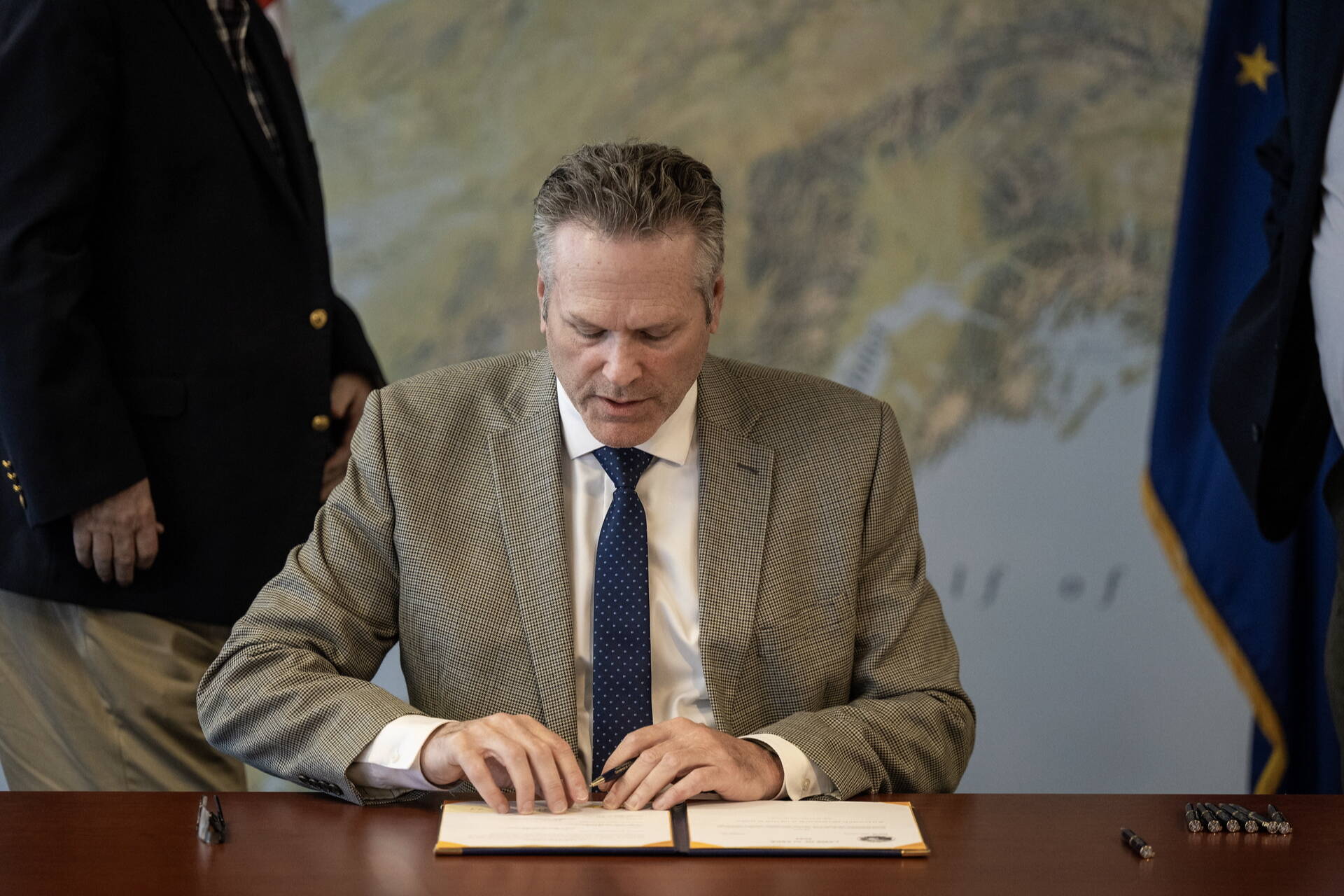
Gov. Mike Dunleavy has said that our state needs everybody to say “yes” to everything. For the governor’s purposes, “everything” can pretty much be defined as all industrial development.
There seems to be a vision in the governor’s mind of a transformation from whatever Alaska was in our fond memories to a sort of northern Detroit of heavy equipment, an expanding road network, mines with attendant effluent dams, and petroleum and gas production writ large.
However, the governor is walking a path that is strewn with a lot of “nos.” Consider the $70 million cuts over three years vetoed from the university in 2019. Or how about $13 million vetoed from the ferry budget in 2020, amid other reductions. And let us not forget $87 million vetoed from legislatively approved temporary help for the elementary schools in 2023.
The governor has also given a very large “no” to bears by sanctioning the killing of nearly 100 browns shot by the Alaska Department of Fish and Game in a single cull. Add to that the “no” to wolves with half or more of the population killed in a single year on Prince of Wales Island based on biologically bogus rationale supposedly to increase the deer population.
Add to this list an existential “no” to salmon (a bellwether species for the state) which are in trouble statewide with close-to-extinction numbers on the Yukon and Kuskokwim rivers, and a resounding “yes” to the big trawler interests based in Seattle that continue to decimate our salmon stocks and degrade the Bering Sea biosphere.
So we find the governor’s leadership highway paved with “nos,” which he justifies, calling funding for fisheries and wildlife scientific studies, the university, public transportation, basic level elementary school funding, all these and more “unsustainable increases” and demanding that we Alaskans must learn to “live within our means.”
But are the governor’s vetoes and downsizing of services across the spectrum really about living within our means? Does a governor who routinely proposes “unsupportable increases” in the PFD checks care about a “balanced” budget?
In a recent article by Nathaniel Herz in the Nov. 30 Anchorage Daily News, Gov. Dunleavy is reported to be planning to reinstate something called “well head gas production tax credits.”
Legislation creating these credits goes back as far as Gov. Frank Murkowski, and the credits were finally extinguished because of their immense cost to the public treasury (approaching $8 billion), and because of their failure to increase production.
Governors Walker and Dunleavy both promoted passage of HB 331, legislation that would have authorized $1 billion in bond debt to pay off outstanding tax production credits, even though the payments were not in default. In a unanimous vote in the Alaska Supreme Court, HB 331 was declared unconstitutional in its entirety. Had the Alaska Supreme Court not struck down the debt, to pay off the cash-for-credit scheme, the State of Alaska would still be paying off hundreds of millions in principal and interest for a program that didn’t work. The governor is apparently prepared to slip the cost of a renewed tax credit program under the umbrella of “living within our means.”
The implicit message here is obvious. Alaskans must make do with a double handful of “nos.” But businesses involved in exploring for gas and oil in our state deserve a break.
There is deep, abiding hypocrisy here. The oil companies, embedded in the laissez-faire market mantra — which dismisses the usefulness of government and enthrones financial and commodity markets as a controlling force — have at no time in their existence been able to function and profit without public fund subsidy. These subsidies have been made available by politicians at all times at every level, from infrastructure funding, to loan guarantees, to price supports, ad infinitum. It’s all in the category of public risk, private profit.
Governor Dunleavy is in lockstep with this crowd, sheltered from the needs of the people of the state under his “available resources” umbrella, and doling out state general funds in volume to private industry and its insatiable demands. Why the average Alaskan puts up with this kind of ruinous economic policy is a mystery.
•Eric Forrer is a retired carpenter/contractor living in Juneau who claims no political affiliation.
