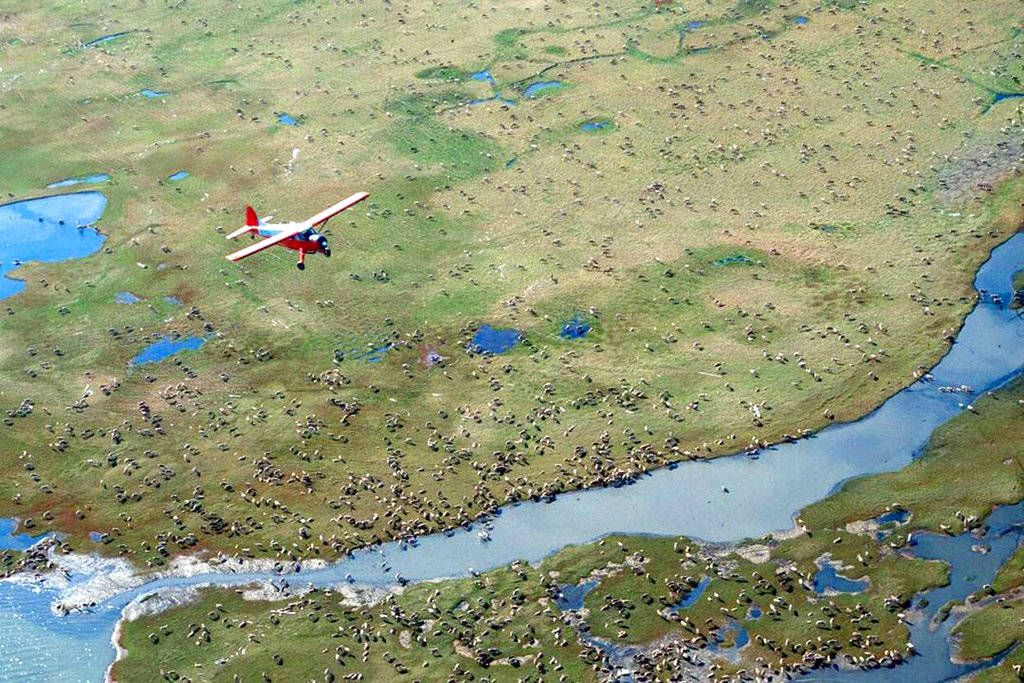
In this undated photo provided by the U.S. Fish and Wildlife Service, an airplane flies over caribou from the Porcupine Caribou Herd on the coastal plain of the Arctic National Wildlife Refuge in northeast Alaska. A showdown is looming in the nation’s capital over whether to open America’s largest wildlife refuge to oil drilling. A budget measure approved by the Republican-controlled Congress allows lawmakers to pursue legislation that would allow drilling on the coastal plain of the Arctic National Wildlife Refuge. The refuge takes up an area nearly the size of South Carolina in Alaska’s northeast corner. (U.S. Fish and Wildlife Service via AP)

In this undated photo provided by the U.S. Fish and Wildlife Service, an airplane flies over caribou from the Porcupine Caribou Herd on the coastal plain of the Arctic National Wildlife Refuge in northeast Alaska. A showdown is looming in the nation’s capital over whether to open America’s largest wildlife refuge to oil drilling. A budget measure approved by the Republican-controlled Congress allows lawmakers to pursue legislation that would allow drilling on the coastal plain of the Arctic National Wildlife Refuge. The refuge takes up an area nearly the size of South Carolina in Alaska’s northeast corner. (U.S. Fish and Wildlife Service via AP)

Let’s not ruin Alaska’s Arctic Refuge

  • By DEBBIE S. MILLER
  • Friday, December 8, 2017 4:20pm
  • Opinion

Standing on the coastal plain of the Arctic National Wildlife Refuge some years back, I watched in wonder as tens of thousands of caribou, many with newborn calves, swept over the tundra. I listened as they splashed across a river, chanting grunts and bleats, their hooves clicking like castanets. A caribou symphony of life.

There is no other place in America so wild, so full of life and so free, as the Arctic Refuge. The area in the northeast corner of Alaska was set aside in 1960 by Republican President Dwight Eisenhower to permanently protect its “unique wildlife, wilderness and recreational values.”

In and near the Arctic Refuge, the Gwich’in Athabaskan Natives of Alaska and Canada still hunt caribou, as they have for thousands of years. Some 9,000 residents, in a dozen villages, continue to feed their families with caribou, tan the hides, make clothing, sing caribou songs and perform caribou dances. They refer to the coastal plain as Iizhik Gwats’an Gwandaii Goodlit, “The Sacred Place Where Life Begins.” The Gwich’in Athabaskan are united in their opposition to oil drilling on the coastal plain of the Arctic Refuge, the birthplace of the caribou that define their lives.

But politicians in Alaska and elsewhere want access to the Arctic National Wildlife Refuge in the name of oil, money and jobs. To this end, they are trying to circumvent the democratic process by slipping an Arctic Refuge drilling provision into tax reform legislation. A poll released earlier this year showed that two-thirds of Americans oppose efforts to allow gas and oil drilling in the refuge.

Ironically, the push to open this area to drilling is not led by the oil industry. Its sites are already set on the National Petroleum Reserve-Alaska, 100 miles to the west, where recent discoveries show promise. Blind to climate change, the Trump administration plans to hold the largest lease sale in the reserve’s history — more than 10 million acres are up for grabs. And Alaska is already developing millions of acres of state land that surround Prudhoe Bay.

In her push for oil development in the Arctic Refuge, Alaska’s Sen. Lisa Murkowski deceptively asserts that only 2,000 acres of the coastal plain would be developed if Congress opens the door to oil drilling. This sounds like one small postage stamp on a big, blank envelope.

But these 2,000 acres are not consolidated. They would be scattered over a much larger area, along with the accompanying drilling pads, settling ponds, garbage dumps and gravel pits — all connected by a web of roads and pipelines. Hundreds of oil spills come with this industrialization.

The unbroken wilderness of the Arctic Refuge, including the only sliver of Arctic coastline that is now protected, would be lost.

Must we sell off one of America’s greatest natural treasures? Where are the Republican leaders who, like Teddy Roosevelt, honor conservation and our precious natural heritage?

Congress has a clear choice. Members can honor the original purposes of the Arctic Refuge, protecting our wilderness and wildlife heritage for future generations, or vote to destroy our greatest refuge for a short-term budget fix and would-be fossil fuel revenues that may never materialize.


Debbie S. Miller, a longtime Alaskan and former school teacher in Arctic Village, is the author of “Midnight Wilderness: Journeys in Alaska’s Arctic National Wildlife Refuge (Braided River).” She resides in Sitka.


More in Opinion

Web
Have something to say?

Here’s how to add your voice to the conversation.

Construction equipment operating at night at the White House. (photo by Peter W. Stevenson/The Washington Post)
Opinion: Gold at the center of power

What the White House’s golden ballroom reveals about Modern America

veggies
File Photo 
Community organizations that serve food at their gatherings can do a lot by making menus of whole, nutritious offerings according to health and wellness coach Burl Sheldon.
Food served by “groups for good” can be health changemakers

Health and wellness coach thinks change can start on community event menus

Win Gruening (courtesy)
Opinion: Affordability message delivered to Juneau Assembly; but will it matter?

On October 7, frustrated voters passed two ballot propositions aimed at making… Continue reading

Alaska Children’s Trust Photo
Natalie Hodges and Hailey Clark use the online safety conversation cards produced by the Alaska Children’s Trust.
My Turn: Staying connected starts with showing up

When our daughter was 11 and the COVID lockdown was in full… Continue reading

Telephone Hill as seen from above (Photo courtesy of City and Borough of Juneau)
Letter: For Telephone Hill, remember small is adaptable

Writer finds the finances don’t add up on planned development

Doug Mills/The New York Times 
President Donald Trump disembarks the USS Harry S. Truman before delivering remarks for the Navy’s 250th anniversary in Norfolk, Va., Oct. 5, 2025.
Opinion: Trump’s job is done

The ultra-rich have completed their takeover of America.

Google Maps screenshot
The star shows the approximate location of the proposed Cascade Point Ferry terminal by the Alaska Department of Transportation & Public Facilities in partnership with Goldbelt, Inc.
Opinion: An open letter to Cascade Point ferry terminal proponents

To: Governor Dunleavy, DOT Directors, and Cascade Point ferry terminal project consultants,… Continue reading

My Turn: Supreme Court decision treats Alaskans with mental illness worse than criminals

A criminal in Alaska who’s in custody must be presented with charges… Continue reading

Win Gruening (courtesy)
Gratitude for our libraries, museums and historians

The thanksgiving weekend is a chance to recognize those who preserve local history

photo by Peter W. Stevenson / The Washington Post 
President Donald Trump on Oct. 24.
Opinion: ‘Hang them,’ Trump said

A president’s threat against Congress and the duty of Alaska’s delegation.

Google Maps screenshot 
The star shows the approximate location of the proposed Cascade Point Ferry terminal by the Alaska Department of Transportation & Public Facilities in partnership with Goldbelt, Inc.
My Turn: Cascade Point terminal would not be efficient

I have enjoyed traveling on the Alaska State Ferries over the years… Continue reading