
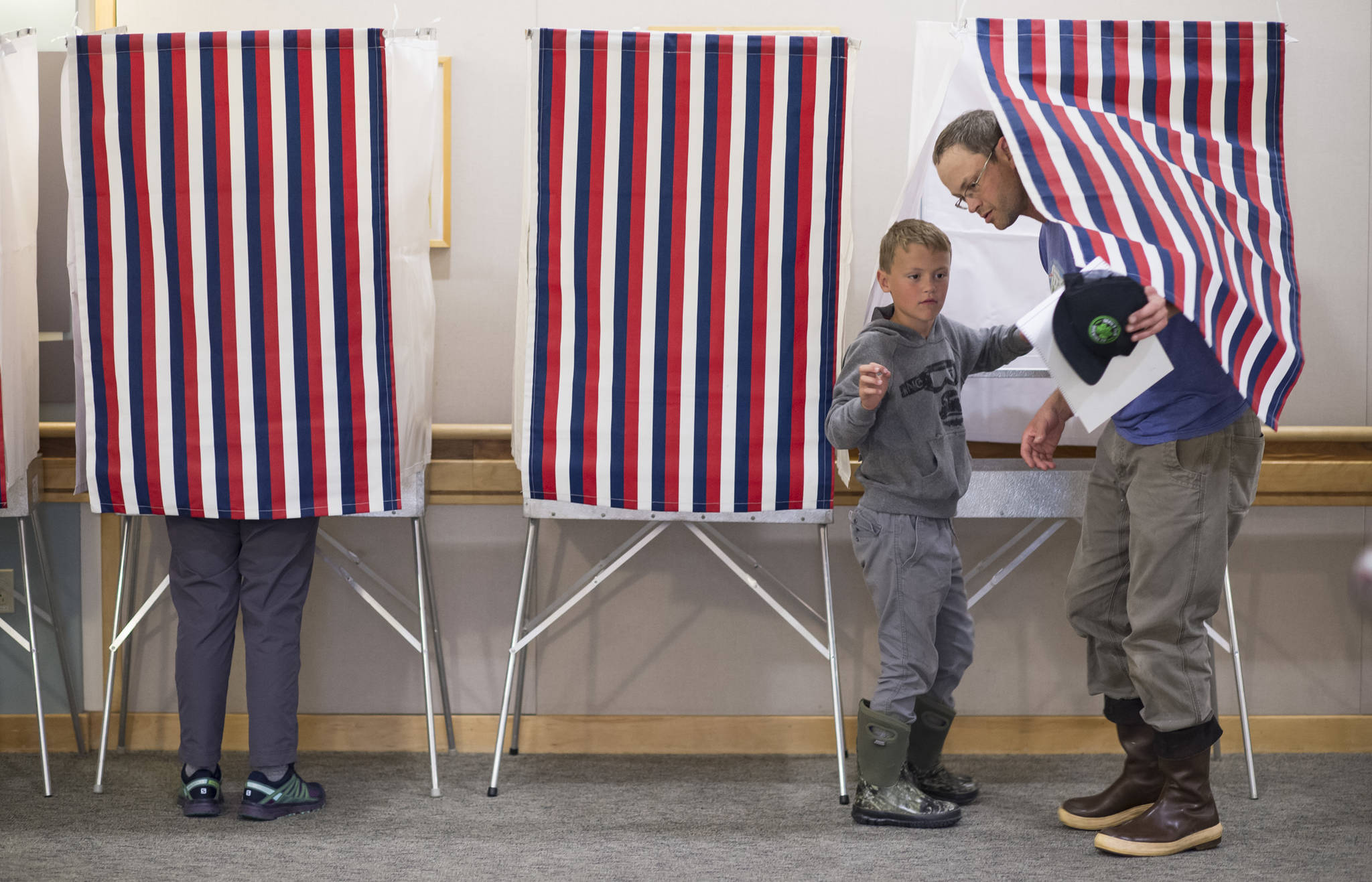
Editor’s Note: The Empire will be publishing a weekly column from the nonpartisan League of Women Voters leading up to this year’s municipal election, in the hopes that it will help inform voters about the process. Here is a note from League member carolyn Brown. Stay tuned for the next column in next Wednesday’s paper.
The election cycle is before us. The League’s mission and purpose is “to promote political responsibility through informed and active participation of citizens in government and to act on selected issues.” Over the next weeks, League members will share information and opinions about issues of importance to Juneau’s citizens and the election processes involved. We similarly invite your responses and opinions to enhance all of our knowledge bases.
The League of Women Voters is about “Making Democracy Work.” If we do not decide, we can be assured that someone else will do this for us. We have choices. We can register to vote, get and stay informed, participate and vote our choices.”
— carolyn Brown
• • •
Are you with me or against me? And if you’re not with me, then you must be against me! Or so seems to go political dialogue at the national level.
The hyper partisanship which has infected our political system may not be anything new, but when fueled by social media — which is new — it has reached its long virulent arms further into our culture than ever before. Even to the point where some elected officials no longer act as if they represent all constituents but only those who voted for them. As a result, this country’s system of democratic representation is very sick — certainly at the federal level, with some heavy infections at state levels. Thankfully, health can still be found at the local level — possibly due to a more nutritious diet of nonpartisanship.
Alaska’s local governments are required to adopt rules for their local elections and have significant flexibility about how to do that. Juneau’s Charter, adopted in 1970, provides that our local elections shall be nonpartisan. Most municipalities in the state have chosen the same method. In fact, an estimated two-thirds of all municipalities across the country have chosen to use nonpartisan elections for local offices — this includes three (Los Angeles, Chicago, and Phoenix) of our five most populous cities, leaving two (New York and Houston) still in the partisan camp. In 2010, California voters passed Proposition 14, which requires nonpartisan elections not only for local but also state and federal offices. Louisiana and Nebraska similarly use nonpartisan elections for their state legislatures. Reform efforts are underway in other states, reflecting dissatisfaction with existing partisan systems.
Surveys have shown that voters currently tend to hold local elected officials in higher regard than those at state or federal level. Some academics ascribe the difference, in part, to the fact that so many local elections are nonpartisan. Interestingly, voter turnout tends to be lower in local elections — could this be an indicator that people have more trust in local officials to represent them effectively than elected officials at the state or federal level?
Local officials must respond to local problems, on which neighbors can be strongly divided — but not necessarily (or even usually) along party lines. Local problems are best solved when the decision makers can work together, understand how residents feel about the issues (and why), and are open to different points of view. It can be hard to work together if officials have campaigned negatively against each other in the past. Hurt feelings hamper harmony — in public debate just as much as at the dinner table. Emotions drive perceptions of reality and opinions just as much as facts do. Partisanship that focuses on us vs. them, winning vs. losing, only serves to push people against each other and pre-empts critical thinking. It also blocks the ability to see the humanity in, and point of view of, those on “the other side.”
When voters register in Alaska, they must choose a political affiliation. Voters are given choices of:
• One of the four recognized political parties (Democratic, Libertarian, Republican or Independence),
• Nonpartisan (not affiliated with a party), or
• Undeclared (do not wish to declare a political affiliation).
In Juneau, only 35 percent of currently registered voters have picked a major party designation, 41 percent chose undeclared, and 19 percent chose nonpartisan. One wonders if the 60 percent undeclared or nonpartisan choose those designations so as to avoid stumbling into partisan discussions with their friends and neighbors.
Juneau’s municipal founders chose well in deciding to make our local elections nonpartisan. While candidates sometimes have party affiliations, our community is better served when party apparatuses stand on the sidelines during local election seasons. That way, the issue of “whose side” does not short circuit the ability of those elected to work together to solve our local problems for the good of the entire community.
• Pat Watt is a member of the League of Women Voters.
