
Alaska Editorial: Time and Tongass

  • Tuesday, July 12, 2016 1:00am
  • Opinion
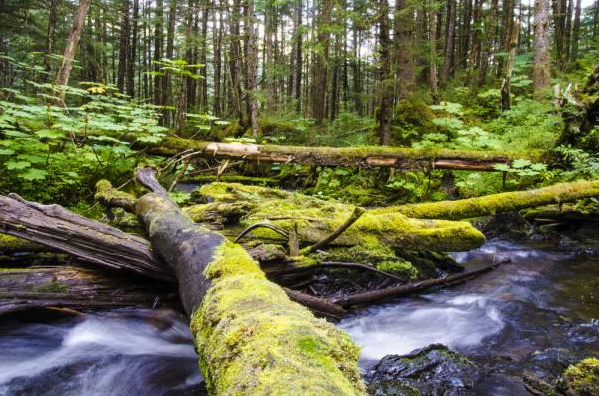
The Tongass National Forest is seen on Mount Jumbo in August 2013.

The Tongass National Forest is seen on Mount Jumbo in August 2013.

The following editorial first appeared in the Ketchikan Daily News:

Tick tock.

The U.S. Forest Service has released an amended Tongass Land Management Plan, along with a draft record of decision and a final environmental impact statement.

Litigation often follows release of a Tongass plan; time will tell whether this is the case.

But, perhaps, instead of litigation, maybe it will be new law to affect the plan. Ketchikan-born Sen. Lisa Murkowski supports the timber industry — what remains of it — and will carry its torch in Congress.

With the decline in Alaska’s economy, i.e. the multi-billion state budget deficit robbing Alaskans of jobs and services, Tongass inhabitants would benefit from a Tongass plan that allows for a viable and sustainable timber industry.

The industry has growth potential. Timber is what the area largely depended upon for its economy before the discovery of oil on Alaska’s North Slope made Alaska a wealthy state. That and fishing. But a steep drop in oil prices created deficit state expenditures.

The crux of the Tongass plan in terms of the timber industry provides a way for transitioning from old-growth to young-growth harvests.

The plan calls for a 16-year transition, of which particular conservationists say is too long and industry officials maintain is too short. Industry says an economically stable switch from old- to young-growth is a 30-year endeavor, while others want to see it accomplished in 10-15 years.

Young trees should be harvested at an age when they will realize the most marketable product. And old trees should be harvested before they die.

Obviously, opinions as to when that is differ. But it’s key for having timber jobs that will enhance the economy of the state and the region.

The City of Ketchikan opposes the amended Tongass plan and has asked Sen. Murkowski to delay its implementation.

The Ketchikan City Council in April unanimously passed a resolution calling for a “credible financial analysis of the proposed transition,” noting that the transition from old- to young-growth would require a federal subsidy and the federal government has its own deficit to contend with.

The council’s resolution calls for the Forest Service to continue to provide old-growth timber sales at an estimated 140 million board feet annually — an amount spelled out in the Tongass Land Management Plan and the Tongass Timber Reform Act.

The Forest Service has provided a 30-day comment period of the environmental impact statement and 60 days for public comment on the amended plan and record of decision. The clock started ticking for those periods on June 25.

Information about the documents is available on the Internet at: www.fs.usda.gov/tongass.

Tick tock. Tick tock. Tick tock.

Related stories:

Juneau rally urges lawmakers to ‘Do your jobs!’

Legislature starts fifth special session with no clear path forward

SEADOGS, JMR locate lost hikers near Spaulding Meadows Trail

More in Opinion

Web
Have something to say?

Here’s how to add your voice to the conversation.

A sign reading, "Help Save These Historic Homes" is posted in front of a residence on Telephone Hill on Friday Nov. 21, 2025. (Mari Kanagy / Juneau Empire)
OPINION: The Telephone Hill cost is staggering

The Assembly approved $5.5 million to raze Telephone Hill as part of… Continue reading

Win Gruening (courtesy)
OPINION: Eaglecrest’s opportunity to achieve financial independence, if the city allows it

It’s a well-known saying that “timing is everything.” Certainly, this applies to… Continue reading

Gov. Mike Dunleavy gestures during his State of the State address on Jan. 22, 2026. (Photo by Corinne Smith/Alaska Beacon)
OPINION: It’s time to end Alaska’s fiscal experiment

For decades, Alaska has operated under a fiscal and budgeting system unlike… Continue reading

Atticus Hempel stands in a row of his shared garden. (photo by Ari Romberg)
My Turn: What’s your burger worth?

Atticus Hempel reflects on gardening, fishing, hunting, and foraging for food for in Gustavus.

At the Elvey Building, home of UAF’s Geophysical Institute, Carl Benson, far right, and Val Scullion of the GI business office attend a 2014 retirement party with Glenn Shaw. Photo by Ned Rozell
Alaska Science Forum: Carl Benson embodied the far North

Carl Benson’s last winter on Earth featured 32 consecutive days during which… Continue reading

Van Abbott is a long-time resident of Alaska and California. He has held financial management positions in government and private organizations, and is now a full-time opinion writer. He served in the late nineteen-sixties in the Peace Corps as a teacher. (Contributed)
When lying becomes the only qualification

How truth lost its place in the Trump administration.

Jamie Kelter Davis/The New York Times
Masked federal agents arrive to help immigration agents detain immigrants and control protesters in Chicago, June 4, 2025. With the passage of President Trump’s domestic policy law, the Department of Homeland Security is poised to hire thousands of new Immigration and Customs Enforcement (ICE) agents, and double detention space.
OPINION: $85 billion and no answers

How ICE’s expansion threatens law, liberty, and accountability.

Yereth Rosen/Alaska Beacon
The entrance to the Alaska Gasline Development Corp.’s Anchorage office is seen on Aug. 11, 2023. The state-owned AGDC is pushing for a massive project that would ship natural gas south from the North Slope, liquefy it and send it on tankers from Cook Inlet to Asian markets. The AGDC proposal is among many that have been raised since the 1970s to try commercialize the North Slope’s stranded natural gas.
My Turn: Alaskans must proceed with caution on gasline legislation

Alaskans have watched a parade of natural gas pipeline proposals come and… Continue reading

Most Read