
Alaska Editorial: A solution for the Marine Highway

  • Tuesday, September 27, 2016 1:00am
  • Opinion
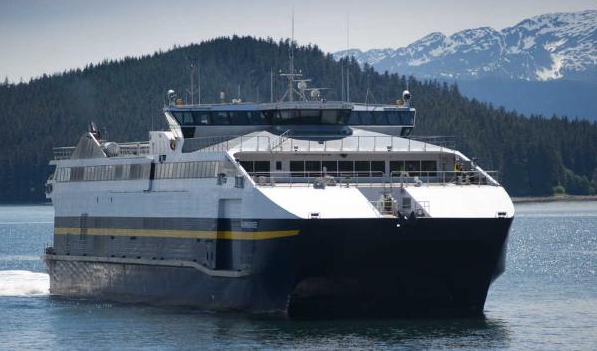
The Alaska State Marine Highway Ferry Fairweather pulls up to the Auke Bay Terminal in June 2015.

The Alaska State Marine Highway Ferry Fairweather pulls up to the Auke Bay Terminal in June 2015.

The following editorial first appeared in the Ketchikan Daily News:

Alaska’s ferry system is sailing in stormy seas these days, buffeted by a growing tempest of unfavorable conditions with no safe harbor yet in sight.

The latest rogue wave to strike was a damaged propeller on the ferry Columbia, which required the Alaska Marine Highway System to cancel northbound service next weekend on the major route from Bellingham, Washington, to Alaska. Folks who wanted to sail to Ketchikan and points north in Alaska next Saturday now have to wait until Oct. 1.

Some passengers can and will wait another week. Others can’t, or won’t. Either way, the perceived reliability of Alaska’s state ferry transportation system takes yet another hit. If you buy a ticket, can you get to where you need to go, when you need to go, on an AMHS ferry?

To be fair, one can’t predict a dinged propeller. But circumstances do arise — especially given a mainliner fleet that’s mostly a half-century old. What appears to have changed, though, is the ferry system’s ability to react to such circumstances and minimize disruptions to the traveling public. The mainliner Taku is tied to the dock year-round now, which makes financial sense, but also which, with the mainliner Malaspina out of service for a capital improvement project, makes covering for the Columbia a difficult proposition.

The Taku lay-up and the longterm layups of the fast ferries Fairweather and Chenega are a symptom of the underlying woes besetting the Alaska Marine Highway System. In general, the state’s worsening financial situation has limited funding available to the ferry system beyond farebox revenues. The state’s political process makes it difficult for the system to know what funding will be available for the next year — or even the next few months at times. The system responds by taking vessels out of service and making other changes. Service suffers, potentially affecting ridership.

It’s encouraging that many people recognize the cycle will be disastrous if it continues much longer. It’s also encouraging that there’s a serious effort underway to figure out a better future for ferry transportation in Alaska.

Southeast Conference — an entity itself created in 1958 to pursue the original establishment of the Alaska Marine Highway System — is involved in a new effort to develop an organizational structure that will be able to provide reliable ferry transportation for Alaska in the future.

Southeast Conference members and other attendees of its annual meeting last week in Petersburg will see the result of the first phase of the project — a study of the AMHS governance structure and how other large ferry systems operate.

The 64-page document by the Elliott Bay Design Group is a fascinating early read on the current state of AMHS and how various organizational models — the current model of AMHS as a line agency of state government, in addition to the municipal authority and state corporation models — would assist or detract from a future ferry system.

The document seems like a good start. But we hear state bookshelves are crammed with studies that have gathered dust since the day they were published.

This one might be different. Southeast Conference’s participation made a difference in forming the Alaska Marine Highway System. Perhaps Southeast Conference’s focus and involvement can identify real, beneficial changes for the system.

And once identified, a course to achieve them can then be set.

Read more Opinion:

My Turn by Gov. Bill Walker: Smaller dividends are painful but prudent

My Turn: Obama’s marine momuments are good start, but ignore coastal seas

Alaska Editorial: A tale of two Alaska buildings

More in Opinion

Web
Have something to say?

Here’s how to add your voice to the conversation.

Northern sea ice, such as this surrounding the community of Kivalina, has declined dramatically in area and thickness over the last few decades. Photo courtesy Ned Rozell
20 years of Arctic report cards

Twenty years have passed since scientists released the first version of the… Continue reading

Dr. Karissa Niehoff
OPINION: Protecting the purpose

Why funding schools must include student activities.

A sign reading, "Help Save These Historic Homes" is posted in front of a residence on Telephone Hill on Friday Nov. 21, 2025. (Mari Kanagy / Juneau Empire)
OPINION: The Telephone Hill cost is staggering

The Assembly approved $5.5 million to raze Telephone Hill as part of… Continue reading

Win Gruening (courtesy)
OPINION: Eaglecrest’s opportunity to achieve financial independence, if the city allows it

It’s a well-known saying that “timing is everything.” Certainly, this applies to… Continue reading

Gov. Mike Dunleavy gestures during his State of the State address on Jan. 22, 2026. (Photo by Corinne Smith/Alaska Beacon)
OPINION: It’s time to end Alaska’s fiscal experiment

For decades, Alaska has operated under a fiscal and budgeting system unlike… Continue reading

Atticus Hempel stands in a row of his shared garden. (photo by Ari Romberg)
My Turn: What’s your burger worth?

Atticus Hempel reflects on gardening, fishing, hunting, and foraging for food for in Gustavus.

At the Elvey Building, home of UAF’s Geophysical Institute, Carl Benson, far right, and Val Scullion of the GI business office attend a 2014 retirement party with Glenn Shaw. Photo by Ned Rozell
Alaska Science Forum: Carl Benson embodied the far North

Carl Benson’s last winter on Earth featured 32 consecutive days during which… Continue reading

Van Abbott is a long-time resident of Alaska and California. He has held financial management positions in government and private organizations, and is now a full-time opinion writer. He served in the late nineteen-sixties in the Peace Corps as a teacher. (Contributed)
When lying becomes the only qualification

How truth lost its place in the Trump administration.

Jamie Kelter Davis/The New York Times
Masked federal agents arrive to help immigration agents detain immigrants and control protesters in Chicago, June 4, 2025. With the passage of President Trump’s domestic policy law, the Department of Homeland Security is poised to hire thousands of new Immigration and Customs Enforcement (ICE) agents, and double detention space.
OPINION: $85 billion and no answers

How ICE’s expansion threatens law, liberty, and accountability.

Yereth Rosen/Alaska Beacon
The entrance to the Alaska Gasline Development Corp.’s Anchorage office is seen on Aug. 11, 2023. The state-owned AGDC is pushing for a massive project that would ship natural gas south from the North Slope, liquefy it and send it on tankers from Cook Inlet to Asian markets. The AGDC proposal is among many that have been raised since the 1970s to try commercialize the North Slope’s stranded natural gas.
My Turn: Alaskans must proceed with caution on gasline legislation

Alaskans have watched a parade of natural gas pipeline proposals come and… Continue reading

Win Gruening (courtesy)
OPINION: Juneau Assembly members shift priorities in wish list to Legislature

OPINION: Juneau Assembly members shift priorities in wish list to Legislature