
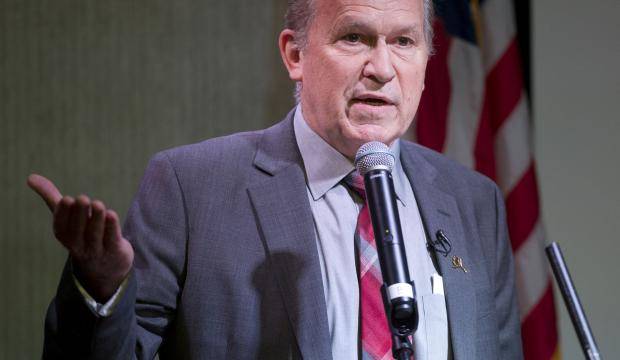
Gov. Bill Walker called himself a “traditional Alaskan Republican” when declaring his independent run for governor in 2013. Even though he’ll now be on the Democratic primary election ballot as an independent, he can still put those three adjectives before his name better than any of the candidates on the GOP ballot. That’s because the first two mean more a lot more to him than the party ever did.
Walker’s break from the GOP was qualified by claiming he’d “always put Alaska first.” At the time, he believed Republicans in the Governor’s Mansion and Legislature had given a higher priority to the interests of North Slope oil producers. He said it was wrong to let them “warehouse Alaska’s natural gas” while developing “competing projects around the globe.” And he complained the “massive oil-tax cuts” enacted that year came “without any guarantees of increased production.”
The anti-tax cut position doesn’t square well with traditional Republican values. But it does with an older tradition of state leaders standing up to outside business interests. That “Alaska first” perspective was one of the primary energies behind the statehood movement.
And it was the philosophy an earlier Republican governor followed when she pushed through Alaska’s Clear and Equitable Share (ACES) tax law in 2007. Alaskans own the oil, Sarah Palin said when unveiling her plan, and “deserve a fair return for our non-renewable resource.”
Like Walker, Palin also successfully challenged a sitting Republican governor. But before she took on Frank Murkowski, she antagonized the GOP establishment by filing an ethics complaint against Randy Ruedrich, the state party chairman.
Palin and Ruedrich had both been appointed to the Alaska Oil and Gas Conservation Commission by Murkowski. While tasked with industry oversight, Ruedrich helped organize fundraisers for party candidates, including one hosted by oil company executives. Palin’s complaint forced him to resign from the commission and resulted in what the state attorney general believed to be “the largest civil fine ever imposed in a state ethics case.”
Murkowski was next. A traditional Republican who served in the U.S. Senate for 22 years, he came home to his Ketchikan roots in 2002 and easily won the governor’s race. But maybe he’d been in the nation’s swamp too long to know what Alaska first meant. Palin argued that he, like Ruedrich, was too close the oil industry. And Murkowski gave everyone that impression after announcing he had secretly negotiated a gas pipeline deal and oil tax agreement with the state’s major oil producers.
Palin won the general election after easily beating Murkowski in the primary. Unlike Walker though, she was pardoned for her rebellion. She had gained widespread public support for her principled stand. And the party needed a new face to clean up its image after several Republican lawmakers were indicted in the VECO/oil pipeline service scandal.
ACES, however, was never popular among the GOP establishment. It became law because Palin had support from Democrats. And don’t forget, in 2013 when the Senate vote 11-9 to replace ACES with Senate Bill 21, two of the Republicans who pushed it over the top were employed by ConocoPhillips.
It’s certainly a stretch to claim that a conflict between state and oil industry interests is a Republican value. But that it appears as often as it has should be a serious concern for all voters, especially anyone naturally inclined to distrust the loyalties of politicians and behind-the-scenes maneuvers of their comrades in their party’s hierarchy.
The most visible conflict Walker has had is staying true to his traditional Republican values while governing a state edging toward a fiscal cliff. It’s forced him to expand “Alaska first” beyond just being the owners of the state’s oil and gas resources. He’s put his principles aside by proposing new personal taxes to balance the state budget.
Meanwhile, Sen. Mike Dunleavy and Rep. Mike Chennault, the two frontrunners in the GOP’s race for governor, still believe there’s plenty of fat to cut from the state budget before raising taxes. And they both voted to replace ACES with SB 21. Maybe they sincerely believe they’re acting in Alaska’s best interests. But it’s also conceivable they don’t mind putting the party before the people.
With Walker, we know that’s never been, and never will be the case.
• Rich Moniak is a Juneau resident and retired civil engineer with more than 25 years of experience working in the public sector. He contributes a regular “My Turn” to the Juneau Empire. My Turns and Letters to the Editor represent the view of the author, not the view of the Juneau Empire.
