
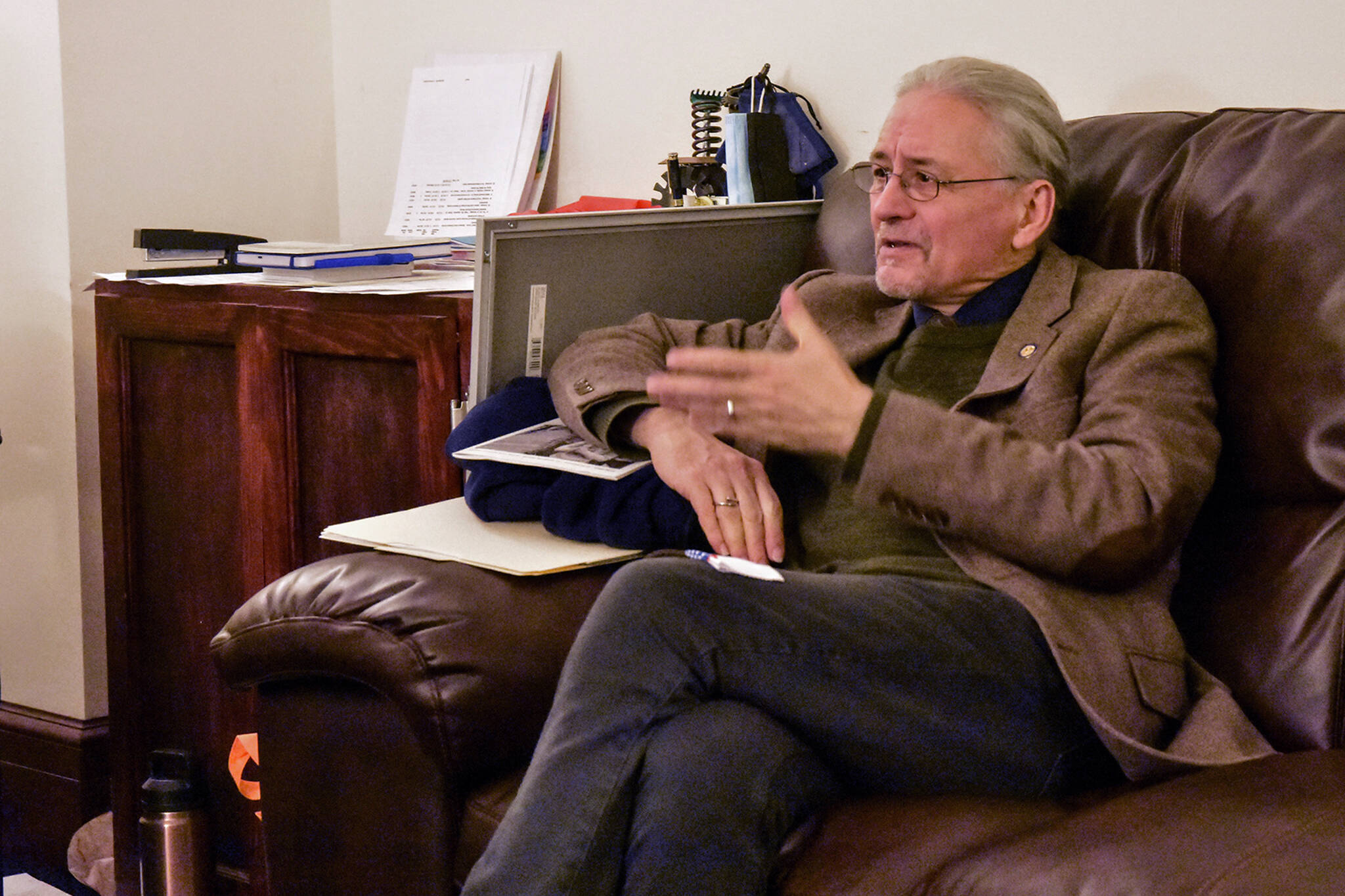
Two years ago the Alaska Reads Act was announced in an Anchorage news conference by state Sen. Tom Begich and Gov. Mike Dunleavy.
Begich, a Democrat, and Dunleavy, a Republican, touted the bill as a bipartisan effort to improve the state’s educational outcomes. But a similar bill remains in the Senate — the body where the Alaska Reads Act was introduced — and with the latest session expected to be contentious as lawmakers remain divided by budget issues, the bill’s fate remains unclear.
There are two reading bills currently working their way through the Legislature, House Bill 164 and Senate Bill 111. The latter bill is a combination of Begich’s original bill and another reading bill from Sen. Shelley Hughes, R-Palmer.
The Senate bill is no longer called the Alaska Reads Act but is now known as the Academic Improvement and Modernization Act. The House bill is still called the Alaska Reads Act.
Despite the divisions in the Legislature, Begich said in an interview with the Empire he’s confident at least one of the bills will pass this session.
“I’m oddly confident that it will (pass),” Begich said.
The Senate bill moved out of the Senate Education Committee last session with some changes Begich said he wasn’t a fan of — a sunset clause for pre-K program funding and limiting the number of low performing schools that can receive additional assistance to only 10 — but none of which made him oppose the bill.
“Here’s what I know for sure, SB 111, it’s not perfect but it’s pretty good,” Begich said.
The bill moved out of the Senate Education Committee with Begich and Hughes as co-sponsors along with state Sen. Roger Holland, R-Anchorage.
“The three of us are optimistic that the bill with very little change will come out of Senate Finance,” Begich said.
[USDA grants $500,000 for mariculture facility on Prince of Wales]
Due to changes in Alaska’s student population, the Finance Committee hasn’t yet requested fiscal notes on the bill until after an updated count is done, said Löki Tobin, legislative staff to Begich. But previous estimates of the bill put the cost at around $168 million, with the state spending about $17 million a year on Pre-K once various elements of the program are stood up, Begich said.
In addition to the pre-K program, the reading bill would provide intervention programs for struggling students, and specialized training to help teachers and parents in helping students to read.
Speaking to the Senate Education Committee on Wednesday, Department of Education and Early Development Commissioner Michael Johnson emphasized the importance of strengthening the state’s reading programs.
“The state (Board of Education and Early Development) remains supportive of a comprehensive reading bill without a lot of accessories,” Johnson said. “By comprehensive, I mean a bill that includes high-quality Pre-K, accountability for reading intervention and additional resources for our lowest-performing schools.”
The SB 111 contains those things, but bills are subject to change in committee or during floor sessions by a simple majority of votes.
At Wednesday’s committee hearing, Johnson said improving reading levels in the state would improve outcomes in other subjects.
“Please stay the course,” Johnson told the committee. “Reading is the pathway out of our challenges.”
In an interview with the Empire Thursday, Johnson said he hoped a reading bill would pass without substantial changes. Johnson said the three provisions mentioned in the meeting —pre-K, reading intervention and extra resources for low-performing schools —needed to be critical components of whatever bill the Legislature passes.
“In order to implement this well, I need a clean reading bill,” Johnson said in a phone interview. “It’ll just make it better for the department to have a very concise and clear reading bill.”
The bill would provide three-year grants to districts that wanted to start pre-K programs. Begich’s bill initially allocated $5 million in the first year, rising by the same amount each year. However, in the Senate Education Committee, that amount was reduced to $3 million.
In an email, Dunleavy spokesperson Shannon Mason said the governor doesn’t generally commit to signing bills before they reach his desk, but provided a statement expressing support for improving reading outcomes.
”As a former educator, Gov. Dunleavy has seen the profound ways that schools can shape children’s lives,” Mason said. “Alaska absolutely has bright spots in education. However, some subject areas need improvement, especially reading. As a state, Governor Dunleavy believes we need to insist on better educational outcomes. Improvements in reading skills will be the cornerstone for ensuring a bright future for Alaska’s children.”
SB 111 is currently scheduled to be heard by the Senate Finance Committee on Tuesday, Jan. 25, at 11 a.m. HB 164 will be heard by the House Education Committee on Friday, Jan. 28, at 8 a.m.
• Contact reporter Peter Segall at psegall@juneauempire.com. Follow him on Twitter at @SegallJnuEmpire.
