
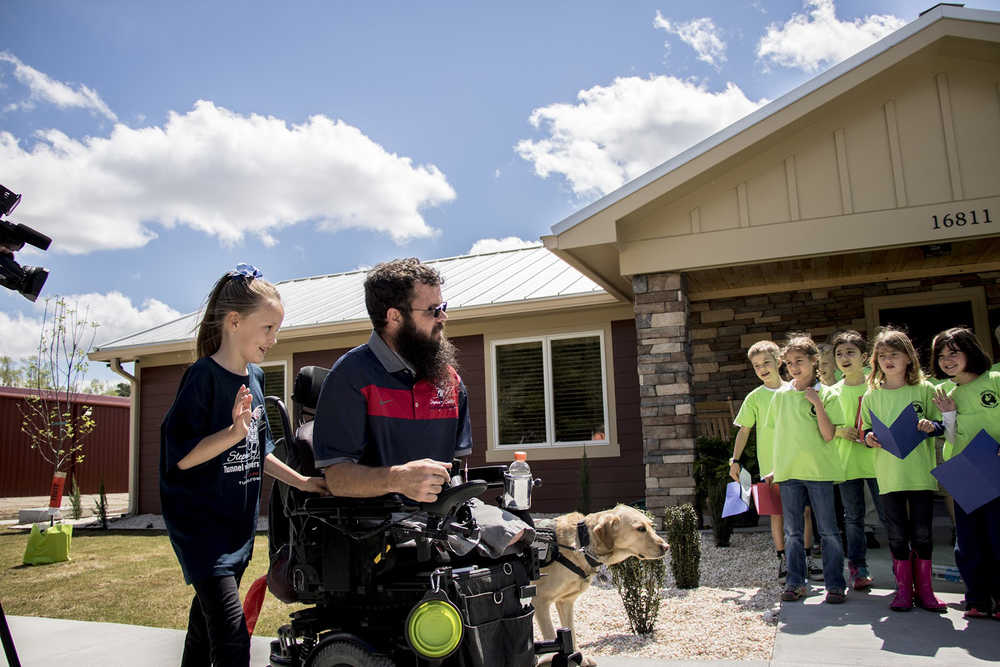
After living in hospitals and other people’s homes for four years, Thomas McRae said the feeling of sleeping in your own bed in your own home is indescribable.
“Being taken care of by other people for so long can be difficult and stressful, especially when you’re at a point when you want to live on your own,” the 34-year-old said in a phone interview.
“And all of a sudden, it’s finally here. I crossed, at least, that finish line and it’s amazing,” McRae said.
On April 7, the former Juneau resident and his daughter Aidan, 8, moved into their very own “smart home” in Maple Hill, North Carolina, built by the organization Stephen Siller Tunnel to Towers Foundation, in partnership with the Gary Sinise Foundation, through its “Building for America’s Bravest” program.
McRae, a retired explosive ordnance disposal technician for the U.S. Marine Corps, is a triple amputee. In 2012, he was catastrophically injured when an improvised explosive device detonated under him while on foot patrol near a Marine patrol base in the Helmand province in southern Afghanistan. It was his second tour in Afghanistan. He had already served three tours of duty in Iraq.
McRae lost both his legs, his left arm, his right eye and suffered a traumatic brain injury.
“There are certain things about a brain injury you will probably never get over, but you find tools to help you,” said McRae, who still has trouble remembering dates and appointments. “My cellphone runs my life.”
Now, a smart home is accommodating his accessibility needs. With an iPad, McRae can control a lot of the things in the house, like the lights, TV and temperature.
He can keep his own room, office and bathroom at — what he considers — a comfortable 65 degrees while the rest of the house is between 70 and 75.
“Anybody that has a lot of amputations, your body is hot all the time. You can’t cool your body down because your limbs do that. When you only pump your blood in your core, you’re always hot,” McRae explained.
The smart home features moveable kitchen parts, like a sink, stovetop and cabinets.
“So I can pull up in front of the sink, which is at counter top level, and I push a button and it’ll drop down eight inches so it’s at my personal level,” said McRae, who mostly gets around in a wheelchair.
The home, which also features wider hallways and doors, is allowing McRae to have a newfound sense of independence.
“I did my own laundry for the first time in four years. It felt good,” he said.
“I’m hoping that he can find his life back,” said McRae’s mom and caregiver Carolee Ryan.
“I’m extremely proud of Tom for as far as he’s come. Now, we’re walking into a new journey,” Ryan said of McRae’s new independence.
Ryan was in her home in Juneau with her husband, Tim Ryan, in 2012 when she received the call that McRae was injured — the day that changed her life.
“At that moment I felt like I was thrown in a garbage can, shook around and thrown out to figure out what I was going to do to protect my baby,” Ryan recalled. “He’s an adult and I know that, but I’m his mom.”
Ryan, who used to work for SERCC, uprooted her life in Juneau and moved to be with her son — first to the Walter Reed National Military Medical Center in Bethesda, Maryland, and then to Maple Hill, North Carolina in 2014.
Until a couple weeks ago, they all lived together — Ryan, McRae and McRae’s daughter.
“I think that they will be okay. I’m extremely excited for Tom and Aidan,” Ryan said. “And I’ll be able to pull back.”
But not completely. McRae still needs a driver and help with Aidan, Ryan said. Despite missing her hometown of Juneau, Ryan said she’ll remain in North Carolina for the time being, in her house that’s around the corner and a mile away from McRae’s new home.
Ryan and McRae are still uncertain about what the future will bring. No matter how smart McRae’s new home is, there are still plenty of things that he can’t do with a swipe of an iPad or the touch of a button.
“The biggest challenge for me is to see how much I can do on my own with me and my daughter. I know there are certain things that I can do, but being able to actually live in a house and do everything, there are going to be grey areas that I haven’t discovered yet,” McRae said.
Like making a bed.
“It may be one of those activities that I have a hard time getting, say, a fitted sheet on a bed, but that doesn’t mean I’m not going to try every which way that I can figure out to get it done,” he said.
McRae is also learning how to walk again. McRae first started using prosthetic legs at the end of 2012. Then he had another surgery on his right femur a year and a half ago, which prevented him from using prosthetics for a year.
Lately, he’s been using the kitchen counter to help brace himself as he practices walking.
“It’s a slow process. It’s not like riding a bicycle at all. It’s not like you jump on it four years later and you can ride it again. It’s really hard to start walking again,” McRae said. “I don’t know how long that will take to be proficient again.”
Even though he hasn’t lived in Juneau for some time, McRae still has a lot of people from his hometown cheering him on.
Juneau Rep. Cathy Muñoz originally nominated McRae for the smart home program through Tunnel to Towers and the Gary Sinise Foundation.
“We worked in this office to find a way to help him. It was a devastating loss to him and his family,” Muñoz said.
In 2012, Muñoz sponsored a Legislative citation recognizing McRae’s honorable service in the military.
“We’re delighted that he’s in his new home, and it’s going to be great beginning for him and his daughter,” she said.
“There’s not enough words to tell how grateful I am to everyone for what they’ve done for my grandson,” said McRae’s grandmother, Juneau resident Sarah McRae.
She was in North Carolina earlier this month to watch McRae move into the smart home. For her birthday last year, a friend gave Sarah McRae a round-trip ticket to anywhere she wanted to go.
“I couldn’t think of anything that my heart wanted more than to see my grandson receive the keys to his new home, and that’s what I did,” Sarah McRae said.
She said his face was shining when he first walked into the house.
“He’s my hero,” Sarah McRae said.
She said people in Juneau still ask her about McRae every day. She tells them he continues to fight the battle of his life.
“I’m so very proud of my grandson and his fighting attitude. He was wounded but he was never defeated,” Sarah McRae said.
McRae said he doesn’t dwell on what happened to him in Afghanistan.
“I’ve put personally what happened to me so far behind me, I don’t really think about it much,” McRae said.
He said he still does everything he used to do before getting “blown up,” like ski and ride horses, just in a different and oftentimes longer way.
“I’m fine. I’m still kicking,” McRae said. “They may be fake feet, but I’m still kicking.”
The Stephen Siller Tunnel to Towers Foundation has 200 other service members on its waiting list for a smart home. To donate to the “Building for America’s Bravest” program, go to the website tunnel2towers.org.
