Lacking the usual amount of data to guide them, federal fishery managers relied on last year’s reports to set the coming year’s harvests for the nation’s top-volume commercial fish species: Alaska pollock.
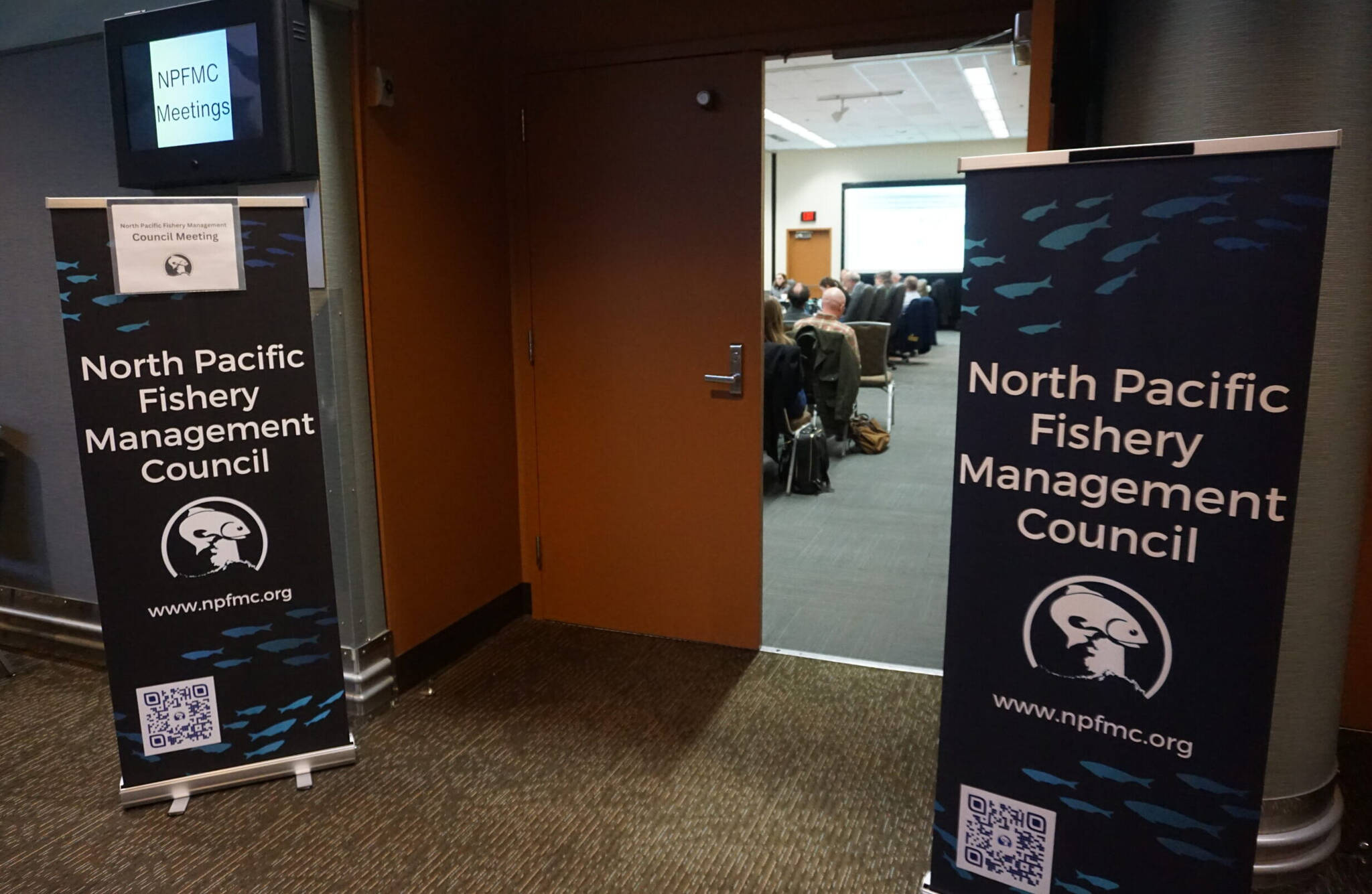
The North Pacific Fishery Management Council, the panel that sets harvest levels and other rules for fisheries conducted in federal waters off Alaska, voted on Sunday to keep 2026 pollock catch limits in the Bering Sea at about the same level as this year’s limits while paring back the pollock catch limit for the Gulf of Alaska.
Pollock, one of key species in the North Pacific Ocean, is widely sold as fish patties and fillets, fish sticks, imitation crab meat and other products.
The council, which sets the coming year’s groundfish harvest limits each December, typically bases those decisions on detailed annual Stock Assessment and Fishery Evaluation reports, known as SAFE reports. But this year, the prolonged federal government shutdown prevented National Oceanic and Atmospheric Administration scientists and their partners from completing SAFE reports for the Bering Sea and Gulf of Alaska.
Instead, the council used the 2024 SAFE reports, supplemented with some newer data about harvests completed this year and some preliminary information about ecosystem conditions. The newer information did not reveal any conservation concerns that would justify harvest reductions, the council determined.
Information that goes into SAFE documents comes from ocean surveys and analysis done by NOAA’s Alaska Fisheries Science Center, with cooperation from research partners. Like all years’ SAFE reports, the 2024 documents for the Bering Sea and Gulf of Alaska featured two-year projections, extending through 2026.
Bob Foy, the center’s director, said that while all of this year’s planned ocean surveys were completed, despite numerous challenges, information from them had not been fully reviewed or vetted.
However, last year’s reports are solid, Foy said.
“Those stock assessments are incredibly robust,” he told the council on Thursday. “What we put together last December was based on decades of information, decades of decisions, piles of information on biology, surveys and whatnot.”
Council members voted to set the Bering Sea and Aleutian Islands harvest of pollock at 1.375 million metric tons, slightly below the limit set for 2025.
Counting all species of groundfish, a category that includes Pacific cod, sablefish, arrowtooth flounder and mackerel as well as pollock, the council set the total Bering Sea and Aleutian harvest limit at 2 million metric tons, unchanged from the 2025 limit.
The council set the Gulf of Alaska pollock harvest limit at 129,749 metric tons, considerably below the 2025 limit of 176,496 metric tons. The total Gulf of Alaska groundfish harvest limit was set at 464,336, compared to the 514,619 metric ton limit set for this year. Less than half of that 2025 limit has been harvested as of early November, according to council data.
Caitlin Yeager, representing owners of catcher-processor trawl vessels that harvest pollock, said the 2024 SAFE report held the “best scientific information available” to set 2026 harvests.
Yeager, vice president for policy and engagement for the Seattle-based At-sea Processors Association, told the council that its plans for the 2026 pollock harvest were responsible.
“Maintaining these specifications ensures not only continuity but also legal defensibility and avoids the risk of a regulatory lapse that would otherwise halt our fishery operations” next spring, she said in testimony to the council on Saturday.
Some industry representatives, citing positive indicators turned up by scientists’ surveys this year, argued for an increase in the allowable catch of Gulf of Alaska Pacific cod. The council did not take that step, but members agreed to revisit cod catch limits in the next few months if Alaska Fisheries Science Center scientists are able to provide enough information to warrant an adjustment.
While fishing industry representatives welcomed the council’s decisions, some environmental and community advocates expressed concern.
Some testifying to the council or submitting written comments argued that catch limits for pollock and other groundfish should be reduced, citing information gaps and the ongoing and controversial incidental catches of river-bound salmon. Those accidental catches are called bycatch.
Megan Williams, fisheries scientist with Ocean Conservancy, was among those urging caution. She noted that this year, the annual ecosystem reports were not completed. That “represents another key data gap in 2026,” she said.
Abbreviated reports available in October contained some “red flags” that justified a more cautious approach to harvest limits, she said. “Data from 2024 and 2025 indicated a return to warm conditions with marine heatwaves occurring in all regions at given points, and reduced sea ice and cold-pool extent in the Bering Sea,” she said. The cold pool is an area of chilled deepwater that usually lingers in the Bering Sea in the summer, separating fish populations in the southern part of the sea from those in the north.
Francis Thompson, president of the Algaaciq Native Village in the Yukon River village of St. Marys, said the council was jumping too far ahead with its projections, not only for the coming year but for the year after that, given lack of information about salmon and other issues.
“It amazes me that you guys are already projecting 2026 and 2027 for allowable harvest of pollock,” he said in testimony on Saturday.
It is not fair that industrial fishing operators in the Bering Sea are allowed to continue their harvests at steady levels, he said, while subsistence users on the Yukon and elsewhere in Western Alaska have been forced to stop fishing because of low runs. The subsistence fishers account for only about 1 percent of the salmon catch, at most, but are bearing all the conservation burden, he said.
“We’re not going to be fishing for a while. And many of the folks in our area, the 1 percent that have put aside their fishing to save the resource for the escapement, are tired,” he said.
Escapement is the term used to describe salmon that reach their freshwater spawning grounds, allowing them to reproduce.
The council did not take action on salmon bycatch. Limits on Chinook bycatch already exist for the pollock fleet, and action on a chum salmon bycatch limit is scheduled to be taken at the council’s next meeting, to be held in February.
Council member Anne Vanderhoeven, during Sunday’s deliberations, said there is not yet any justification to reduce pollock harvests to conserve depressed runs of salmon in Western Alaska.
“The impacts of the salmon crisis are truly devastating to subsistence users and Alaska Native culture,” she said. “But the best scientific information available does not support the assertion that relatively small adjustments to the pollock (total allowable catch) will measurably or significantly increase salmon escapement to Western Alaska rivers.”
Yereth Rosen came to Alaska in 1987 to work for the Anchorage Times. She has been reporting on Alaska news ever since, covering stories ranging from oil spills to sled-dog races. She has reported for Reuters, for the Alaska Dispatch News, for Arctic Today and for other organizations. She covers environmental issues, energy, climate change, natural resources, economic and business news, health, science and Arctic concerns — subjects with a lot of overlap. In her free time, she likes to ski and watch her son’s hockey games.
Alaska Beacon is part of States Newsroom, the nation’s largest state-focused nonprofit news organization.
