
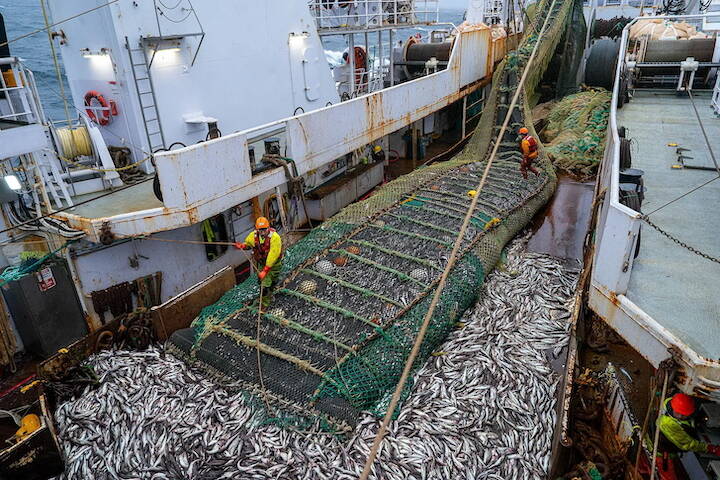
Amid catastrophic shortfalls in salmon harvests in some of Alaska’s rural, Indigenous communities, advocates have pleaded for a crackdown on unintentional catch of those same salmon by the trawl vessels that harvest billions of pounds of whitefish in the Bering Sea.
But the politically appointed regional council that manages Bering Sea fisheries has largely resisted those requests.
So instead, advocates are now taking another approach. They’re pushing the Biden administration for a workaround: a rewrite of the federal guidelines that tell the regional council, and its counterparts across the country, how to manage all the fisheries under their supervision.
The idea has broad support from conservation groups, Alaska Native tribes, small-boat fishermen and Alaska Democratic U.S. Rep. Mary Peltola, who made her opposition to the unintentional salmon harvests, known as “bycatch,” a key plank in her recent congressional campaigns.
But the Biden administration, after asking for feedback earlier this year on possible revisions to the guidelines, has not yet committed to taking action. And any such efforts face opposition from politically connected fishing businesses and industry groups that say tougher bycatch rules and limits could cut into their profits or even shut down entire fishing fleets.
“There’s a lot of question in my mind about whether they’re going to really follow through,” said Peltola, referring to the Biden administration. “There are so many things that the administration could do…that they haven’t done.”
Council inaction amid crisis
The new debate comes after several years in which salmon have returned to Western Alaska’s Yukon and Kuskokwim rivers in numbers far below usual, forcing outright closures of fisheries or strict limits.
Residents of dozens of Indigenous communities along those rivers depend on salmon to feed their families and generate cash income in a region where groceries are expensive and well-paying jobs can be hard to find.
Families would once catch hundreds of salmon every summer and fall. The absence of fish, in recent years, has posed what some tribal leaders describe as an existential crisis.
Scientists say that warming ocean waters, more than bycatch in Bering Sea fisheries, are driving the declines.
But advocacy groups and Western Alaska leaders have nonetheless aggressively pushed the North Pacific Fishery Management Council to set stricter bycatch limits, arguing that it’s unjust for corporate-owned vessels to accidentally catch thousands of salmon when subsistence harvesters face fishing bans.
The North Pacific council — most of whose voting members were chosen by Alaska Republican Gov. Mike Dunleavy — has not agreed to the requested caps on the trawl vessels. For now, it’s chosen to study such proposals.
That’s prompted advocates’ more recent push for executive action from the Biden administration.
The effort centers on provisions of the Magnuson-Stevens Act — the landmark federal law passed in 1976 that still sets out the framework for America’s federally managed fisheries.
The act contains 10 “national standards” that the North Pacific council and its other regional counterparts must follow as they draft management plans for each fishery. To help the councils, the law also called for the executive branch, through the National Marine Fisheries Service, to publish guidelines with more detail about each of the different standards.
The guidelines aren’t technically law. But judges can still look to them when deciding fisheries-related lawsuits because of what’s known as “deference” — the idea that agency interpretations of laws should carry significant weight in court.
Climate change, environmental justice goals prompt review
Earlier this year, the fisheries service, known as NMFS, published a formal notice saying it was considering revisions to the guidelines for three of the 10 national standards, including the one that applies to bycatch. The two other guidelines under review apply to allocation — the division of fish harvests between different groups of harvesters — and impacts to communities.
NMFS officials say they’re doing the review in part because it’s been more than a decade since some of the guidelines were last updated. They also say they want to make sure that the language is aligned with overarching Biden administration directives to incorporate climate change planning, environmental justice and equity goals into federal policy.
“Those issues are very real for our fishermen across the country,” Kelly Denit, the director of NMFS’ Office of Sustainable Fisheries, said in an interview. “There is a general interest in making sure that we’re looking at our system as a whole and trying to think about how we adjust and adapt to changing climates in particular.”
The notice, which asked the public for feedback and ideas about possible revisions to the guidelines, generated a tidal wave of responses.
Some 400 formal comments came in from individuals, fishing industry interests and coalitions, tribal advocacy organizations, state government agencies and conservation groups.
The responses from fishing businesses and groups involved in the harvest of Bering Sea whitefish — and the bycatch of salmon — largely argued against any changes.
Seattle-based United Catcher Boats, which represents dozens of whitefish trawlers, said in its four-page letter that the Biden administration is considering “skirting Congress to advance partisan goals” — an idea that it called “deeply concerning.”
Another industry trade group, Seafood Harvesters of America, said it supports the intent behind the Biden administration’s idea. But it urged “extreme caution” and suggested that the Biden administration is contemplating changes to broad, national fisheries policy to address what’s really a narrow problem.
“We are aware of the growing calls for better bycatch management in certain regions,” the group’s leaders wrote. “However, we strongly urge NMFS to resist the urge to make significant changes to fundamental management principles and guidelines to appease one specific region or sector.”
Other stakeholders opposing guideline revisions include Dunleavy’s administration and the North Pacific Fishery Management Council itself — which, like many others, criticized NMFS for ignoring requests to extend its four-month comment period until after the summer fishing season.
Peltola blasts “status quo”
Alaska’s two Republican U.S. senators, Lisa Murkowski and Dan Sullivan, both requested an extension but didn’t submit substantive feedback in response to NMFS’ formal call for comments.
A spokesman for Murkowski declined to comment, while a spokeswoman for Sullivan, Amanda Coyne, said the senator is “closely following” the process.
Given the importance of the guidelines, “it is critical that any revisions be carefully thought through and done intentionally in an effort to avoid unintended consequences,” Coyne added.
Peltola submitted her own five-page comment letter saying that “the status quo is failing most Alaskans, and NMFS needs to ensure the National Standards reflect the ocean’s changing conditions and decreased productivity.”
“The North Pacific Fishery Management Council has a moat around it. It is not interested in listening to citizens,” Peltola said in the interview.
Dozens of other Alaska commenters said they want NMFS to follow through with revisions, including Anchorage-based Native Peoples Action. The group’s letter included more than 200 co-signers and said inaction on the guidelines would result in “cultural genocide.”
“We understand that fisheries management is complex and there are multifacets to the decline in returns,” the group’s letter said. “However, it is critical to address the compounding issues of bycatch and its impacts to communities across Alaska. Policy should prioritize equity for Indigenous fishing communities.”
Others endorsing revisions include a small-boat cruise line, The Boat Co.; an array of tribal governments ranging from Southeast Alaska to a Bering Sea island; small-boat fishing groups; and conservation organizations like Oceana and SalmonState.
NMFS is now reviewing the hundreds of comments it received and has not yet decided its next steps, said Denit. If the agency decides to move forward, it aims to propose its revised guidelines in the spring, she added — a step that would kick off more public comment and participation.
“We recognize the national standard guidelines are important to all our regional fishery management councils. And we also understand that changes to those guidelines can cause potentially significant complications to our fishery management system,” Denit said. “If we do decide to pursue any changes, we will be doing it in a very thoughtful and engaging way.”
• Nathaniel Herz is a freelance reporter who’s spent a decade as a journalist in Alaska, including stints at the Anchorage Daily News and Alaska Public Media. His articles published in the Alaska Beacon first appeared in his newsletter, Northern Journal, at natherz.substack.com.
