
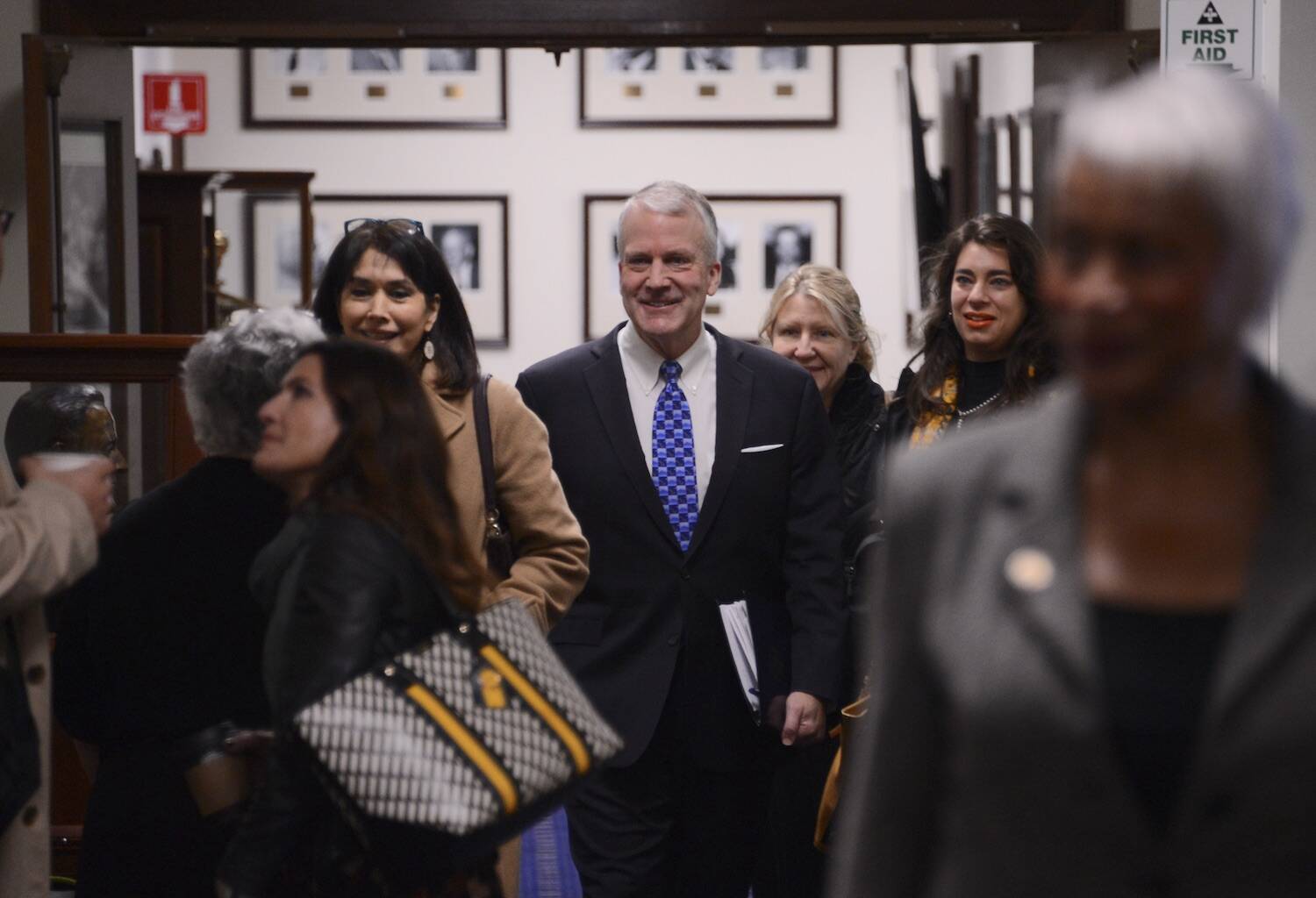
Alaska Republican U.S. Sen. Dan Sullivan has picked a nine-member panel to help him select nominees for a long-vacant federal judgeship in Alaska, eschewing the traditional process.
In a written statement, Sullivan said the new Alaska Federal Judiciary Council will help “identify federal judiciary candidates of character, experience, and an unflinching commitment to the rule of law.”
Alaska’s senior Senator, Republican Lisa Murkowski, said conversations about changing the selection process “should have started a long time ago” and implied that switching processes now could extend the time that Alaska is without a federal judge.
One of Alaska’s three federal district court seats has been vacant since the retirement of Judge Timothy Burgess at the end of 2021.
Federal judges serve lifetime appointments. Formally, they’re nominated by the President and subject to a confirmation vote by the U.S. Senate.
Under custom and tradition, home-state senators suggest a list of nominees to the president, who selects from that list in order to reduce the chance that the nominee is blocked by one of the state’s senators.
Alaska’s senators have traditionally relied on advice from the Alaska Bar Association to inform their picks for vacant seats on the judicial bench.
In March, after a request from Murkowski, the Alaska Bar Association asked interested attorneys to submit their resumes and other information.
Fourteen people applied, and the bar polled the state’s other attorneys with a simple question: Is the candidate qualified for the job?
The four applicants with the highest ratio of the most positive answers were Anchorage Superior Court Judge Yvonne Lamoureux, U.S. Attorney S. Lane Tucker, Stoel Rives partner Tina Grovier, and Alaska Solicitor General Tamara DeLucia.
The Bar Association sent those names to Murkowski and Sullivan in May along with a letter asking the senators to ensure “that the nomination proceeds as expediently as possible.”
Murkowski, in a written statement released Wednesday, said she’s interviewed the possible candidates since then and is ready to make some decisions.
“My process is now complete,” Murkowski said in a Wednesday statement. “Alaskans have waited long enough for the district court to operate at full capacity, and I look forward to the vacancy being filled without further delay.”
Sullivan is taking a different approach.
Studies have found a significant and growing correlation between education and political preference: Americans with college degrees are more likely to vote Democratic than Republican, and the tendency is even stronger among Americans with advanced degrees.
Partially because of that trend, conservatives have grown increasingly skeptical of the role that bar associations — made up of attorneys with advanced degrees — play in nonpartisan judicial selection processes.
In the Alaska Legislature, Republicans — including Gov. Mike Dunleavy — have repeatedly and unsuccessfully attempted to change the role that the nonpartisan Alaska Judicial Council plays in judicial selection.
That council consists of three public members, three attorneys selected by the bar, and the state’s chief justice, who votes only to break a tie.
Sullivan’s new council somewhat resembles the Alaska Judicial Council, except that all nine members were picked by him alone.
Among the selectees are several attorneys, including former Gov. Sean Parnell, former Lt. Gov. Loren Leman, and Jonathan Katchen, who was nominated for a prior Alaska federal judgeship but later withdrew from consideration.
The council includes non-attorneys, such as Kim Reitmier, president of the ANCSA Regional Association, and attorneys who are not listed as part of the Alaska Bar, such as Stephen Cox, a contributor to the conservative Federalist Society who works as general counsel and senior vice president for Bristol Bay Industrial.
Sullivan’s statement did not include a timeline for making his nominations to the president.
“The gravity of a federal judge’s responsibilities warrants a thorough search for candidates, a serious examination of their records, and the input of those who will be most impacted by their rulings—Alaskans,” he said. “With this inclusive and diverse council, we’ve convened not only some of Alaska’s sharpest legal minds, but also those with detailed knowledge of many critical facets of Alaska, including crime victims, law enforcement, resource development, and Alaska Native communities.”
The federal judicial appointment process can move slowly. The last time Alaska had a vacancy, it took almost five years before the U.S. Senate confirmed former Department of Interior attorney Josh Kindred.
Of 72 current vacancies in the federal judiciary, Alaska’s is tied as the 19th-oldest; the oldest dates to 2017.
With one seat vacant, more work now falls on Alaska’s roster of five “senior” judges, those who have officially retired from the bench but may hear cases as needed.
• James Brooks is a longtime Alaska reporter, having previously worked at the Anchorage Daily News, Juneau Empire, Kodiak Mirror and Fairbanks Daily News-Miner. This article originally appeared online at alaskabeacon.com. Alaska Beacon, an affiliate of States Newsroom, is an independent, nonpartisan news organization focused on connecting Alaskans to their state government.
