
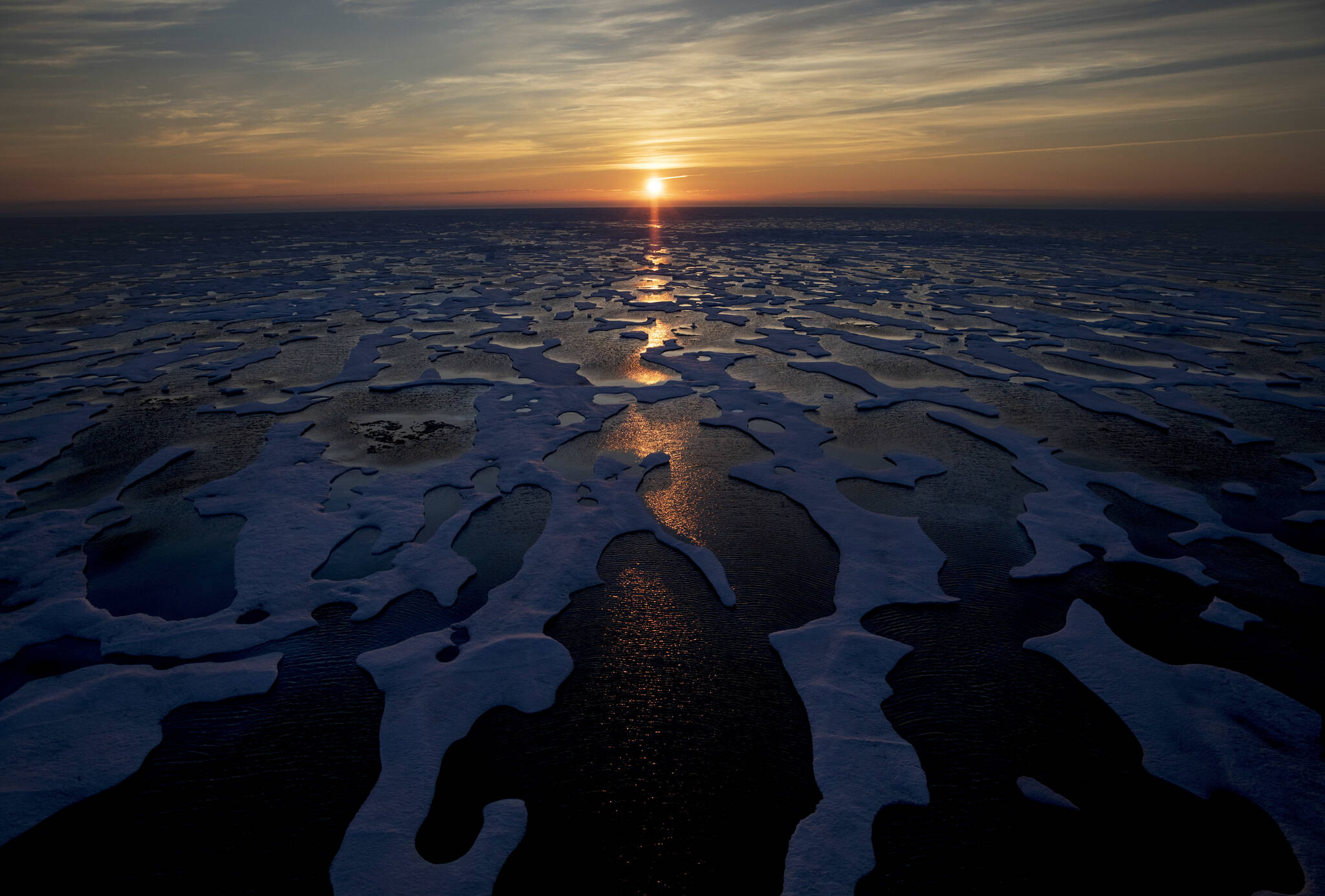
In this July 2017 photo, the midnight sun shines across sea ice along the Northwest Passage in the Canadian Arctic Archipelago. The Biden administration is stepping up its work to figure about what to do about the thawing Arctic, which is warming three times faster than the rest of the world. The White House said Friday, Sept. 24, 2021, that it is reactivating the Arctic Executive Steering Committee, which coordinates domestic regulations and works with other Arctic nations. It also is adding six new members to the U.S. Arctic Research Commission, including two indigenous Alaskans. (AP Photo / David Goldman)

In this July 2017 photo, the midnight sun shines across sea ice along the Northwest Passage in the Canadian Arctic Archipelago. The Biden administration is stepping up its work to figure about what to do about the thawing Arctic, which is warming three times faster than the rest of the world. The White House said Friday, Sept. 24, 2021, that it is reactivating the Arctic Executive Steering Committee, which coordinates domestic regulations and works with other Arctic nations. It also is adding six new members to the U.S. Arctic Research Commission, including two indigenous Alaskans. (AP Photo / David Goldman)

White House steps up work on what to do about thawing Arctic

The White House said Friday it is reactivating the Arctic Executive Steering Committee.

  • By Seth Borenstein AP Science Writer
  • Friday, September 24, 2021 11:06am
  • NewsNational News

By Seth Borenstein

AP Science Writer

The Biden administration is stepping up its work to figure about what to do about the thawing Arctic, which is warming three times faster than the rest of the world.

The White House said Friday it is reactivating the Arctic Executive Steering Committee, which coordinates domestic regulations and works with other Arctic nations. It also is adding six new members to the U.S. Arctic Research Commission, including two Indigenous Alaskans.

The steering committee had been moribund for the past four years, not meeting at a high level, said David Balton, appointed to direct it. He said “it will step up and do more in the Arctic.”

The revamped committee will try to figure out what “needs to be done to get a better handle on addressing the changes in the Arctic,” Balton said.

University of Colorado scientist Twila Moon, who is not involved with the committee or commission, praised the developments. She said that because the Arctic is changing so quickly, “serious issues like national security, stability of buildings and roads, food availability, and much more must be considered and acted on promptly,” Moon said. “The U.S. cannot afford to sit back on Arctic issues.”

Balton, in an interview, said the Arctic is “opening up in a number of ways. Most of this is bad news.”

“But there’s also increased tourism and increased shipping, potentially other industries coming up into the Arctic that need regulation,” he said. “And right now the nations and the peoples of the Arctic are scrambling to keep up with this change.”

The new efforts emphasize working with Indigenous people.

“It’s really important to achieve these goals, so it has to be done in partnership with people who live in the area,” said committee deputy director Raychelle Alauq Daniel, a climate policy analyst and Yup’ik who grew up in Tuntuliak, Alaska.

Superpower tensions are likely to increase in the region as it becomes more ice-free in parts of the year, allowing not just more shipping but the temptation for going after resources such as oil, Balton said.

People who live in the Lower 48 states should still care about what happens in the polar region, Balton said.

“The Arctic is kind of a bellwether for what happens to the planet as a whole. The fate of places like Miami are tied very closely to the fate of Greenland ice sheet,” Balton said. “If you live in Topeka, Kansas, or if you live in California, if you live in Nigeria, your life is going to be affected. … The Arctic matters on all sorts of levels.”

More in News

The northern lights are seen from the North Douglas launch ramp late Monday, Jan. 19. A magnetic storm caused unusually bright northern lights Monday evening and into Tuesday morning. (Chloe Anderson/Juneau Empire)
Rare geomagnetic storm causes powerful aurora display in Juneau

The northern lights were on full display Monday evening.

teaser
Juneau activists ask Murkowski to take action against ICE

A small group of protesters attended a rally and discussion on Wednesday.

A female brown bear and her cub are pictured near Pack Creek on Admiralty Island on July 19, 2024. (Chloe Anderson for the Juneau Empire)
Pack Creek permits for bear viewing area available now

Visitors are welcome from April 1 to Sept. 30.

Cars pass down Egan Drive near the Fred Meyer intersection Thursday morning. (Clarise Larson / Juneau Empire file photo)
Safety changes planned for Fred Meyer intersection

DOTPF meeting set for Feb. 18 changes to Egan Drive and Yandukin intersection.

Herbert River and Herbert Glacier are pictured on Nov. 16, 2025. (Mari Kanagy / Juneau Empire)
Forest Service drops Herbert Glacier cabin plans, proposes trail reroute and scenic overlook instead

The Tongass National Forest has proposed shelving long-discussed plans to build a… Continue reading

A tsunami is not expected after a 4.4-magnitude earthquake northwest of Anchorage Wednesday, Feb. 4, 2026. (U.S. Geological Survey)
No tsunami expected after 4.4-magnitude earthquake in Alaska

U.S. Geological Survey says 179 people reported feeling the earthquake.

ORCA Adaptive Snowsports Program staff member Izzy Barnwell shows a man how to use the bi-ski. (SAIL courtesy photo)
Adaptive snow sports demo slides to Eaglecrest

Southeast Alaska Independent Living will be hosting Learn to Adapt Day on Feb. 21.

Cars drive aboard the Alaska Marine Highway System ferry Hubbard on June 25, 2023, in Haines. (Photo by James Brooks)
Alaska’s ferry system could run out of funding this summer due to ‘federal chaos problem’

A shift in state funding could help, but a big gap likely remains unless a key federal grant is issued.

Photo by James Brooks/Alaska Beacon
U.S. Sen. Dan Sullivan stands with acting Coast Guard Commandant Adm. Kevin Lunday during the after the commissioning ceremony for the Coast Guard icebreaker Storis on Sunday, Aug. 10, 2025, in Juneau, Alaska.
Coast Guard’s new Juneau base may not be complete until 2029, commandant says

Top Coast Guard officer says he is considering whether to base four new icebreakers in Alaska.

Most Read