
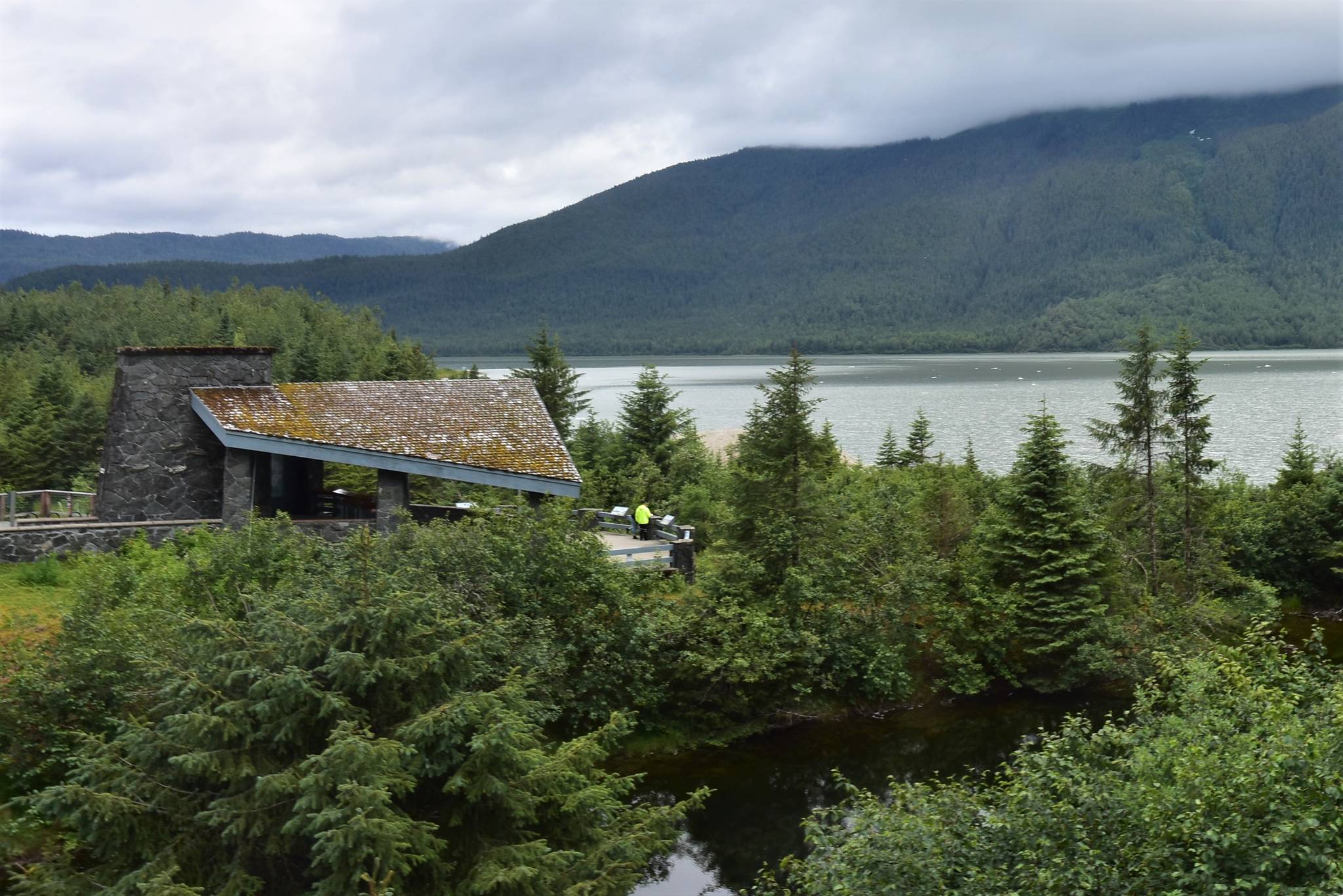
What changes to a federal environmental law mean for a proposed project at what is ordinarily Juneau’s most-visited site is still being worked out, according to the U.S. Forest Service.
Expansion and renovation plans for the Mendenhall Glacier Visitor Center and surrounding recreation area are currently under National Environmental Policy Act review, which last week was largely eliminated by President Donald Trump.
The immediate impacts of the rollback are still being assessed, according to the U.S. Forest Service. It’s unclear if the rule will apply retroactively to projects currently undergoing a NEPA process. Forest Service spokesperson for the Tongass National Forest Paul Robbins said in an email last week that staff were still reviewing the new guidelines, and he could not say when a decision would be made about implementation.
Robbins said he was able to provide the following information:
“For ongoing NEPA analyses initiated prior to the rule’s effective date, agencies may choose whether to apply the final rule or follow existing Forest Service NEPA procedures. Note: Once in effect, (Council on Environmental Quality)’s regulations will immediately supersede any provision within the agency’s NEPA procedures that are inconsistent with CEQ’s revised regulations, unless there is a clear and fundamental conflict with the requirements of another statute.”
[‘It’s like we’re loving this to death’: Commenters say Mendenhall plan has drawbacks]
The Empire requested an interview with Forest Service staff for clarification Friday and was told the request was forwarded to other local staff and the national office. The Empire repeated these requests Monday and Tuesday but received no reply from the federal office.
Under the new rules, federal agencies’ environmental policy will be largely overseen by the Council on Environmental Quality, which is a part of the White House.
The current CEQ chair Mary Neumayr was appointed by Trump and unanimously confirmed by the Senate in 2019. She’d been CEQ chief of staff since 2017, according to her White House biography, and before that worked in various positions on a U.S. House of Representatives energy committee.
CEQ provides on its website a copy of the revised NEPA regulations with changes made by the Trump administration highlighted in red.
Items removed include firstly, “our basic national charter for protection of the environment” and requiring federal agencies to the fullest extent possible, “encourage and facilitate public involvement in decisions which affect the quality of the human environment.”
Proponents of the changes, including Alaska’s congressional delegation and governor, say the loosening of rules will allow critical infrastructure projects to move forward without a costly and burdensome environmental review process.
In a speech at the White House Gov. Mike Dunleavy said President Donald Trump had restored hope to the American Dream. Alaska Sens. Lisa Murkowski and Dan Sullivan, both Republicans, praised the rollback calling it a “modernization” of the country’s environmental rules. In an email, Rep. Don Young applauded the move saying it streamlined what has become, a bureaucratic and lawsuit-prone monstrosity.”
Alaska Department of Environmental Conservation Commissioner Jason Brune said environmental protections remain in the state and pushed back against calling the changes a “rollback.”
“The way NEPA was originally intended…it had page limits and time requirements,” Brune said. “This brings things more in line with the original intent (of the statute)
“This is a federal permitting process,” he added. “The state is often if not always allowed to be a cooperating agency, but these are federal decisions. The state will always (be involved) if the lead federal agency agrees the state meets the requirements.”
There will till be opportunities for public input and review of project information, Brune said, adding that the previous process could be dragged out for years or challenged in court, driving business away from the state.
“I don’t think that anything that has changed will lessen the environmental requirements of companies, or not lead federal agencies to make informed permitting decisions,” Brune said.
Streamlining may have been the intent of the initial reform efforts, said John Neary, former director at the Mendenhall Glacier Visitor Center, but the Trump administration’s changes have gone far beyond streamlining.
“Now they’re trying to make (environmental review) really corporate-friendly and give corporations the right to prepare their own analyses. Talk about a fox in the hen house,” Neary said Tuesday in an interview. “I never heard anybody say they wanted to get rid of NEPA. There was legitimate concern it was getting so bogged down, as a person who was trying to propose projects it could become frustrating.”
Neary could not recall the exactly when or under which presidential administration discussions about NEPA reform first began, but he said they originally focused on streamlining projects with limited environmental impact, such as hiking trails around Juneau. Low-impact projects such as trails certainly need some kind of environmental review, Neary said, “but does it need an environmental assessment?”
[Mendenhall Glacier master plan calls for major change]
“The original intent was to streamline (NEPA) so projects without large environmental impacts could be pushed through,” he said. “What the Trump administration has down with it is really a perversion of that idea.”
Under the previous rules, Neary said, NEPA required companies to pay for a third-party contractor to conduct the environmental review. That contractor would work with the Forest Service, Neary said, but under the new guidelines that is no longer necessary and companies can produce and act on their own environmental review process and are no longer required to produce or consider as many reasonable alternatives.
“NEPA arose because the people felt they needed a voice, and now they want to say you don’t need any alternatives and contractors can prepare their own (environmental review),” Neary said. “You would then get companies producing their own flawed analysis in their own favor. Instead of having to consider all reasonable alternatives, they are limiting the number.”
The Empire did not receive clarification from the Forest Service on whether the NEPA process would be completed on the Mendenhall Glacier area plans, but Neary said it was unthinkable that amount of work would be thrown out.
“I don’t believe you can stop an existing process, I can’t envision that really happening,” Neary said, but added, “The Trump Admin is trying all kinds of things.”
• Contact reporter Peter Segall at psegall@juneauempire.com. Follow him on Twitter at @SegallJnoEmpire.
