
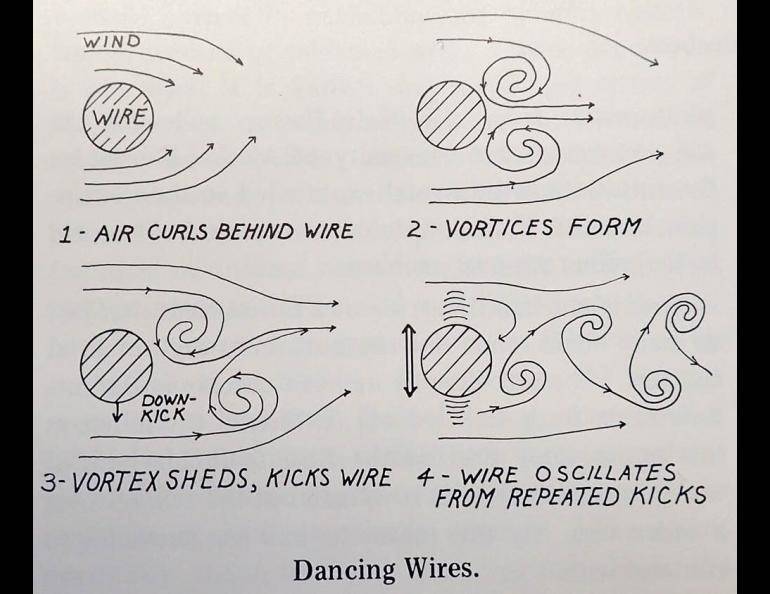
A diagram from "Alaska Science Nuggets" shows the science behind mysterious dancing power wires. (Courtesy Image)

What makes wires move like jump ropes? Here’s the answer

Wire they dancing?

  • By Ned Rozell
  • Friday, February 12, 2021 10:54am
  • NewsScience

By Ned Rozell

On these quiet, still days, as winter plods on, Alaskans tend to notice any movement outside their windows, such as dancing power wires strung between poles.

The answer as to why the wires bounce is in Neil Davis’s “Alaska Science Nuggets.”

First, though, a refresher on that book — a compilation of 400 of these columns — and why you are reading this right now.

Neil Davis was a do-all scientist at UAF’s Geophysical Institute from the 1960s to the 1980s. He started this column in 1976 at the urging of a newspaper editor.
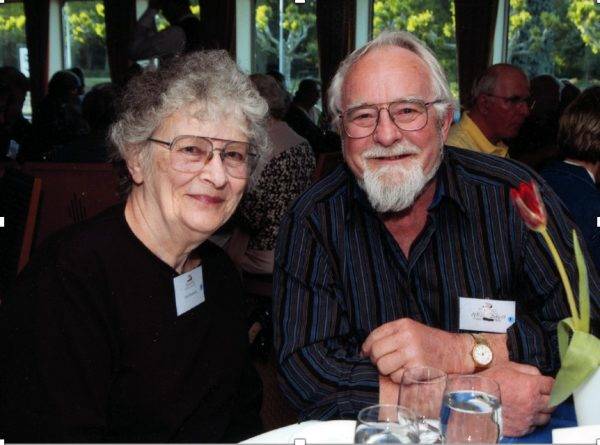
The late couple Rosemarie and Neil Davis of Fairbanks. (Courtesy Photo / Merritt Helfferich)

Davis wrote hundreds of the columns, which the Geophysical Institute has distributed free to newspapers. Other writers took over the column from Davis, who died in 2016. I am the latest in that line, having started in fall of 1994. The directors of the Geophysical Institute have supported the column since its beginning.

[Alaska Science Forum: The gardening potential of the Last Frontier]

Back to the dancing wires. Each wire out there has a certain tune to which it responds, known as a resonant frequency. It’s what a little girl finds when she twirls a jumprope at just the right speed and — without much effort — gets a perfect loop whistling through the air.

Sometimes, even if we can’t feel it, a slight breeze nudges a power wire. Wires are even more responsive to wind when snow clings to them, as it often does up here in the Interior.

“If the wire can be repeatedly tickled ever so slightly at the proper frequency, it will build up a major oscillation,” Davis wrote.

To move, wires need energy applied at their ends, or in the middle. The latter is similar to a finger plucking a guitar string. In this case the wind is acting as the finger.

As a guest writer of this column in 1978, late butterfly and moth expert Ken Philip described the process:

“Air moving past the wire is impeded by the wire; the air closest to the wire moves the slowest. The result is a curling up of the air behind the wire to form vortices — rotating spirals within which the air spins faster the closer it is to the center.”

These invisible little curls of air shove the wire as they depart. Sometimes those kicks happen at the sweet frequency of the wire, which responds by moving.

For the overly curious who must confirm things, Philip suggested blowing soap bubbles into the winter air beneath the wires. They will float on a breeze that no cheek or anemometer can detect, allowing you to visualize the air that tickles the wire.

• Since the late 1970s, the University of Alaska Fairbanks’ Geophysical Institute has provided this column free in cooperation with the UAF research community. Ned Rozell ned.rozell@alaska.edu is a science writer for the Geophysical Institute. A version of this column ran in 2015.

More in News

A house on Telephone Hill stands on Dec. 22, 2025. (Mari Kanagy / Juneau Empire)
Court sets eviction date for Telephone Hill residents as demolition plans move forward

A lawsuit against the city seeks to reverse evictions and halt demolition is still pending.

Juneauites warm their hands and toast marshmallows around the fire at the “Light the Night" event on winter solstice, on Dec. 21, 2025. (Mari Kanagy / Juneau Empire)
A mile of lights marked Juneau’s darkest day

Two ski teams hosted a luminous winter solstice celebration at Mendenhall Loop.

A Capital City Fire/Rescue truck drives in the Mendenhall Valley in 2023. (Clarise Larson / Juneau Empire file photo)
Juneau man found dead following residential fire

The cause of the fire is still under investigation.

CBJ sign reads “Woodstove burn ban in effect.” (City and Borough of Juneau photo)
Update: CBJ cancels air quality emergency in Mendenhall Valley Sunday morning

The poor air quality was caused by an air inversion, trapping pollutants at lower elevations.

A dusting of snow covers the Ptarmigan chairlift at Eaglecrest Ski Area in December 2024. (Eaglecrest Ski Area photo)
Update: Waterline break forces closure at Eaglecrest Friday, Saturday

The break is the latest hurdle in a challenging opening for Juneau’s city-run ski area this season.

Patrick Sullivan stands by an acid seep on July 15,2023. Sullivan is part of a team of scientists who tested water quality in Kobuk Valley National Park’s Salmon River and its tributaries, where permafrost thaw has caused acid rock drainage. The process is releasing metals that have turned the waters a rusty color. A chapter in the 2025 Arctic Report Card described “rusting rivers” phenomenon. (Photo by Roman Dial/Alaska Pacific University)
Ecosystem shifts, glacial flooding and ‘rusting rivers’ among Alaska impacts in Arctic report

NOAA’s 2025 report comes despite Trump administration cuts to climate science research and projects

The U.S. Capitol in Washington, D.C., on Oct. 1, 2025. (Photo by Jennifer Shutt/States Newsroom)
Moderate US House Republicans join Dems to force vote on extension of health care subsidies

WASHINGTON — Republican leaders in the U.S. House will face a floor… Continue reading

The National Weather Service Juneau issues a high wind warning forDowntown Juneau, Southern Douglas Island and Thane due to increased confidence for Taku Winds this afternoon. (National Weather Service screenshot)
Taku winds and dangerous chills forecast for Juneau

Gusts up to 60 mph and wind chills near minus 15 expected through the weekend.

Chloe Anderson for the Juneau Empire
Fallen trees are pictured by the Mendenhall river on Aug. 15, 2025. Water levels rose by a record-breaking 16.65 feet on the morning of Aug. 13 during a glacial outburst flood.
Lake tap chosen as long-term fix for glacial outburst floods

The U.S. Army Corps of Engineers and Juneau leaders agreed on the plan.

Most Read