
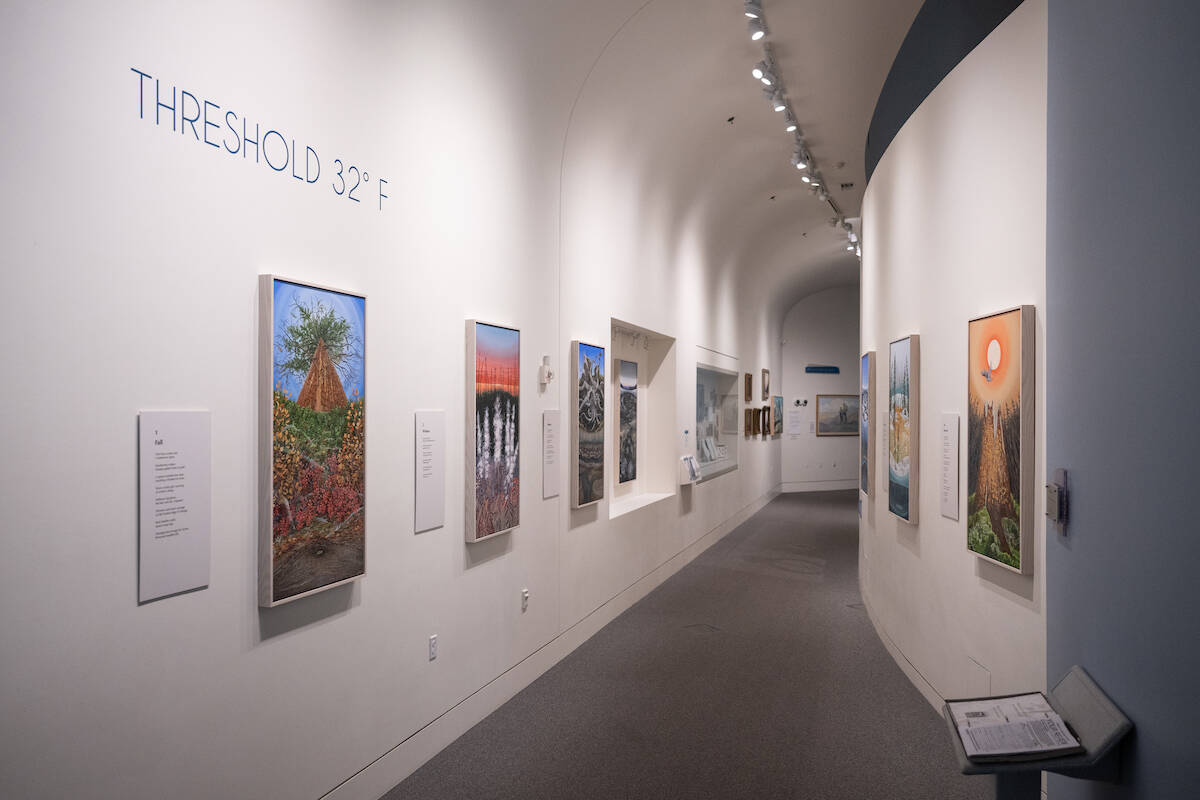
When Debbie Clarke Moderow was running the Iditarod — the 1,100-mile sled dog race through Alaska’s frozen interior — she had a moment.
Her hands were chapped, her feet were cold and her dogs were beat. She had come to Alaska in 1979 to climb a mountain but ended up falling in love, marrying and raising two children and 20 huskies who lived to hear her call out “Ready, let’s go!” Now it was 2005 and she was 49 and still hollering as her team plowed through snow. By the time they crossed the finish line in Nome — for the first time after two attempts — she knew it was time for a change.
“I always wanted to be a writer,” Moderow said on a painfully hot August day in Fairbanks. “I had no clue how hard it would be.”
Two decades after getting a master’s degree and publishing a memoir, she is doing something even harder: writing about climate in a time when many deny it is changing. And she is doing it as a poet alongside an artist and an ecologist in a traveling exhibit called “Threshold 32°F.”
Named after the freezing temperature of water, the show depicts the lives of northern plants and animals through one full season, with 10 interconnected oil paintings displayed next to poems and scientific notes.
“It’s a continuous narrative of change,” Moderow explained as she and her collaborators toured the exhibit, which is currently on display at the Museum of the North in Fairbanks through Nov. 16. Paired with images of ice and trees, and data on the deadly beauty of methane and bark beetles, “It tells a story and seeks to educate,” she said.
The project — by Moderow; Klara Maisch, a backcountry guide and painter; and Rebecca Hewitt, an assistant professor of environmental studies at Amherst College — will travel to the Patricia Valian Reser Center for the Creative Arts at Oregon State University from Jan. 5 to Feb. 7, and Michigan State University’s (SCENE) Metrospace in fall 2026, from Nov. 5 to Dec. 13.
Art is increasingly being used to address climate change — from the impact of wildfires in Los Angeles to the iceberg art of Olafur Eliasson, which physically shows warming in a tangible way.
This project seeks to do that by showing viewers that what happens when the permafrost thaws has an impact on everyone.
It takes visitors into Alaska’s boreal forest, the belt of trees that make up a third of the world’s forests. Each painting has a poem next to it and field notes to allow viewers to see, read and understand the impact of warming (the story is told chronologically, beginning in autumn).
The first pairing begins on a warm September day with a white-backed bumble bee, a key pollinator of blueberries and willows that hibernates when temperatures drop. If there is no freeze, not only do the bees die, but so do countless plants and animals relying on them.
While these pieces are about time, hidden underground worlds, the power of sun, snow and fire to give and take life, and what happens when this balance is disturbed, the larger hope, said the collaborators, is reaching those who may not realize that what is happening here impacts weather patterns across the country.
“Call it what you will, it’s happening. And it’s happening to all of us,” Moderow said, mentioning once in-a-century storms and fires that are affected by Arctic change.
The project is produced by In a Time of Change, a collaborative arts-humanities-science program focused on environmental change in Alaska and funded by the National Science Foundation.
“With each painting, we assigned a feeling like hope, uncertainty, fear, comfort,” explained Maisch, 36, who regularly hikes to glaciers to paint them — in winter, she can work on shifting ice for weeks. “I want people who’ve never heard of the boreal forest to come away feeling curious.”
As Moderow said, “Most poetry requires a lot of effort on the part of the reader,” but this is “hopefully” the opposite.
“It’s also a new way to observe, for us and viewers,” added Hewitt, 43, who specializes in plant-microbe interactions.
As soil warms and permafrost thaws, thousands of years of stored carbon is released into the atmosphere, making temperatures rise in Alaska — and the rest of the world.
“The forest is in transition,” Moderow said. “It’s profoundly different from when I first came up here in ’79.”
For one, there is less snow — the Iditarod has been rerouted because of that — and less groundwater when it melts. That can lead to bark beetles that prey on thirsty trees, hollowing them out and turning them into tinder for wildfires.
And how, too, will all those ancient microbes being released from the permafrost affect these cycles, Hewitt asked.
Perhaps the biggest worry is that the loop is accelerating, since methane, a gas 25 times more potent than carbon, is also being released from this thaw.
“The hope is someone in the middle of the country will look at things differently,” Moderow said of the crisis.
“Threshold 32°F” began in late 2021 when Moderow and Maisch met over Zoom as part of a cohort of artists and researchers telling stories about the boreal forest, a project developed by the In a Time of Change program.
Both living in Alaska, they became fast friends. Phone and email brainstorms were constant, with the writer crafting forest narratives and the artist replying with sketches.
When they finally met, they set out on skis and followed the tracks of an ermine on a picture perfect March day.
Eventually they brought in Hewitt — who lives in Massachusetts but does field work in Alaska — to add a research layer. Then they presented the idea to a dancer-turned-microbiologist named Mary Beth Leigh.
Leigh, who teaches environmental microbiology at the University of Alaska Fairbanks, is the director of In a Time of Change, which she cofounded in 2007 to support shows like this.
But it is a tough time for government-supported climate work. Washington has cut over 100 environmental rules and policies, federal agencies attack and retract established science, and the National Science Foundation has sliced $1.4 billion in grants (the foundation supports two In a Time of Change programs to the tune of about $1.3 million).
From an office full of papers and potted plants, Leigh, who has a background studying modern dance and playing cello in bands — including performing with the Flaming Lips — admitted that “no one knows what’s next.”
With each artist getting a $1,000 stipend, and Threshold so far receiving around $10,000 for exhibit fabrication and artist travel, it is very much a labor of love.
“Having an emotional response,” she hopes, will keep this program alive and lead to people taking action.
Back at the museum, the team remains adamant that this story — of their project and of the changing climate — is not over. And since many of their scenes capture the triumph of species, “we’re trying to point toward resilience and hope, too,” Moderow said.
“It’s celebratory of the forest and the people who live here,” added Maisch, calling it a privilege to look out her window at birch trees and have wildlife as neighbors. “The forest is our home and I couldn’t picture myself living anywhere else. We love this place.”
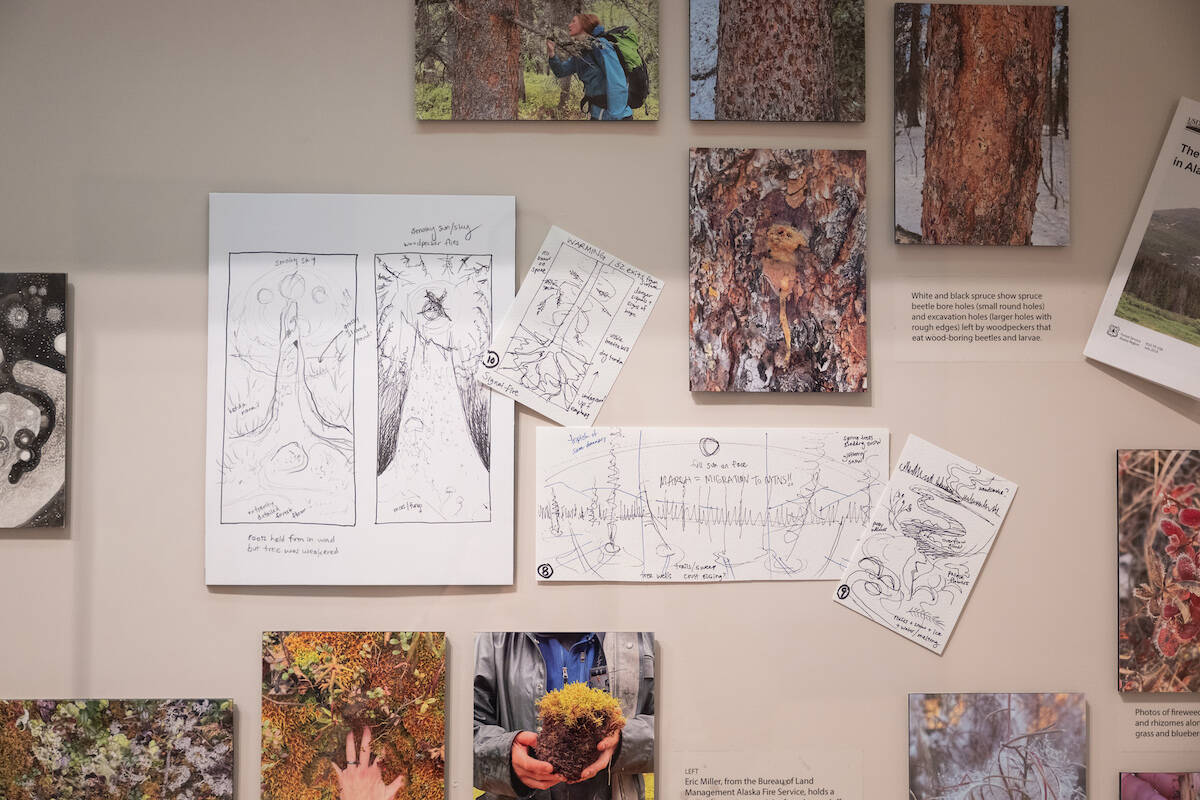
Field notes and artifacts produced for the “Threshold 32°F” exhibit at the Museum of the North in Fairbanks, Alaska, Aug. 2, 2025. Named after the freezing temperature of water, the show depicts the lives of northern plants and animals through one full season. (Chona Kasinger/The New York Times)
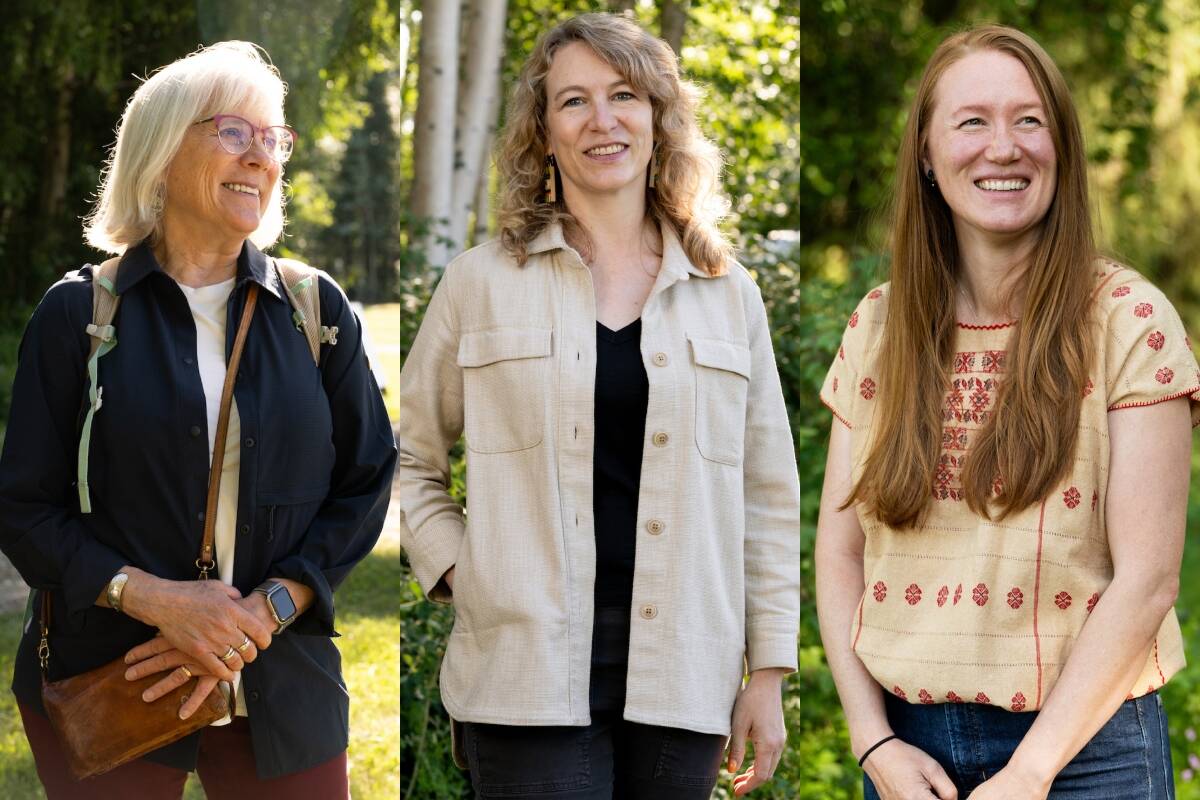
Debbie Clarke Moderow, Mary Beth Leigh and Rebecca Hewitt. (Chona Kasinger/The New York Times)
