
The headline in this story has been corrected to omit reference to a scheduled visit to Skagway that was cancelled.
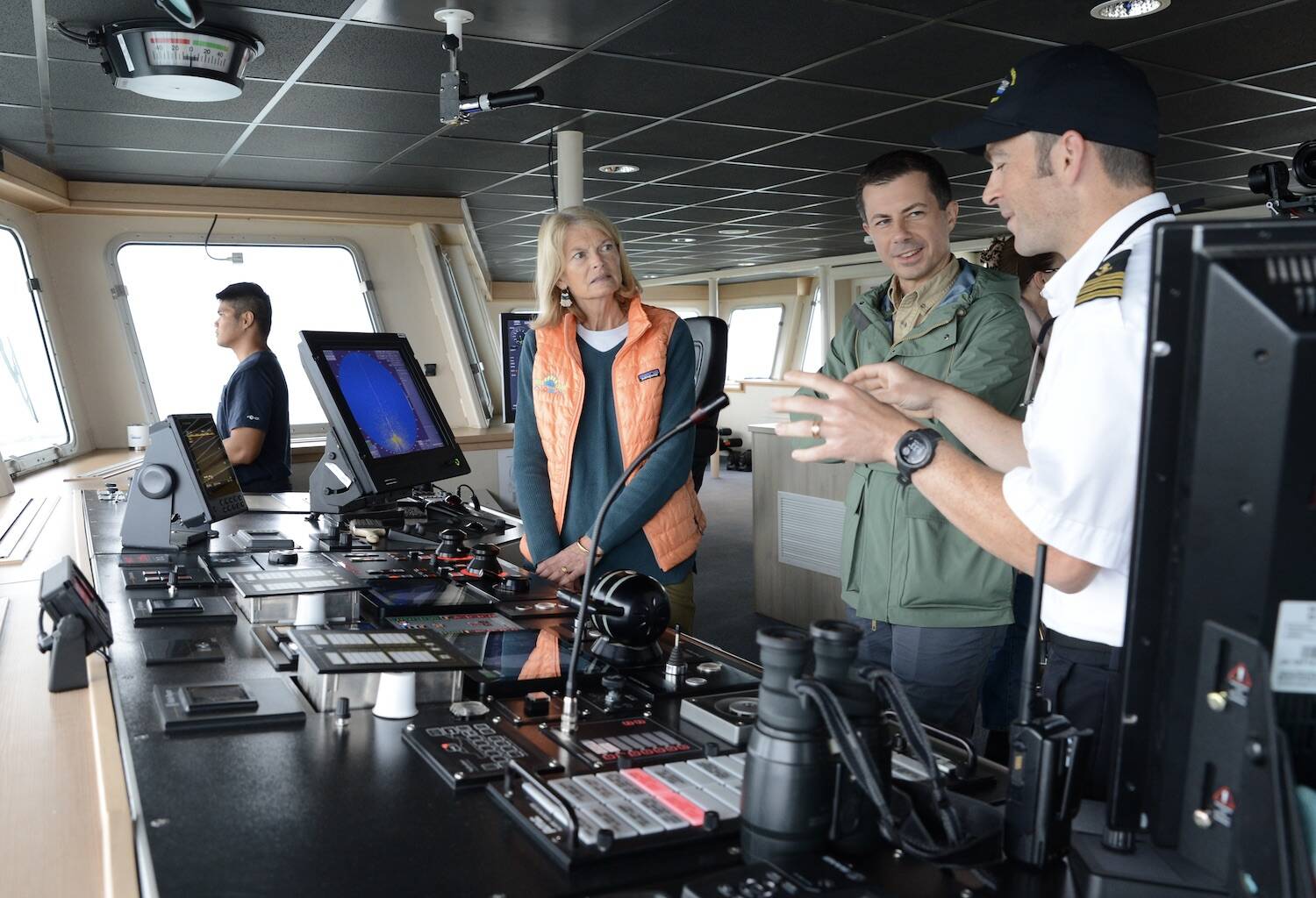
When U.S. Secretary of Transportation Pete Buttigieg’s flight from Juneau to Haines was rained out on Wednesday, he changed plans and did what Alaskans have done for decades: He boarded a ferry.
Sen. Lisa Murkowski, R-Alaska, traveled with Buttigieg and said the last-minute switch in travel plans “was a typical Alaska jump ball.”
It was an appropriate capstone to Buttigieg’s three-day Alaska visit: a trip intended to emphasize the benefits of the Biden administration’s infrastructure law, passed by Congress in 2021. As of July, that law has sent $5.2 billion in federal funding to Alaska.
The Alaska Marine Highway System will receive more than $286 million. That figure, which includes funding for new ferry terminals and ships, is more than three times the size of the ferry system’s annual budget.
For the first time, the federal government is also subsidizing ferry operations here. That’s a major policy change: While the federal government underwrites most of the cost of hard-surface roads and can underwrite the cost of new ferry boats, Alaska has borne the cost of operating them.
After a decade of state-directed budget cuts here, the system’s supporters say that money will be a godsend.
“It is salvaging what was the certain demise of the ferry system and allowing a modern version to emerge that can serve us in the future,” said Robert Venables, director of Southeast Conference, the regional economic development organization for Southeast Alaska.
“It’s incredibly important,” said Rep. Louise Stutes, R-Kodiak, who traveled with Buttigieg on the trip to Haines. “Let’s face it. Alaska is very, very fortunate in relation to the federal dollars we get. The challenge is using those dollars in a way where all Alaskans get to benefit from them.”
On Wednesday, Buttigieg spent four hours aboard the ferry Hubbard, talking to Murkowski, tribal and governmental leaders before touring Haines, whose Lutak cargo dock is slated to receive $20 million in federal infrastructure aid.
The Haines visit included a meeting with tribal and city officials, plus some souvenir shopping at the grocery store owned by the city’s mayor. One of the purchases was a copy of the local newspaper whose headline story was Buttigieg’s visit.
Speaking aboard the Hubbard, Buttigieg said the ferry funding is “something that is here largely by way of Sen. Murkowski,” who insisted that Alaska’s ferries “be considered in a big way” as part of the federal infrastructure law.
Murkowski, together with Sen. Dan Sullivan, R-Alaska, were two of the key votes needed in the U.S. Senate to pass the law through the chamber, and Murkowski used Buttigieg’s trip on Wednesday to re-emphasize the importance of the ferry system to Alaska.
The size of the resulting law is a “once in a lifetime” opportunity for improving American infrastructure, including Alaska’s ferry system, Buttigieg said.
Alaska is slated to receive $8.6 million to design a new ferry, more than $68 million to build a new mainline ferry, and another $46 million to build an electric ferry. The latter boat could run between Haines, Skagway and Juneau, Buttigieg suggested, taking advantage of the clean hydroelectricity used in those communities.
But Buttigieg’s trip also demonstrated that federal help won’t completely solve the system’s woes. In Haines, he spoke with ferry workers who stressed the problems the system has had hiring new workers.
That problem has been exacerbated by uncompetitive pay and benefits, they said, including the lack of a pension plan for new employees.
“Without a pension, it’s really hard to keep people in this environment, because it is not the happiest place,” ferry captain Gabriel Baylous told Murkowski and Buttigieg. “Sometimes it’s hard — especially with our economic woes and budget woes — to ride through those without that pension.”
The infrastructure law doesn’t address issues with pay and benefits, or the national maritime worker shortage.
“I would look at it as a partnership,” Buttigieg said when asked about the possibility of further federal support. “No one level of government, not even the federal government, can lift up a transportation system on its own. So a partnership with the state — and the cost shares will always be important — but the more the state is ready to put forward, the better partner we can be at the federal level.”
Bryan Ritter, an ordinary seaman who was among the ferry crew who spoke to Buttigieg, said he’s concerned by budget cuts that have reduced service to Sitka, home to a regional hospital.
Ten years ago, the state budget included $160.8 million for the ferry system. Five years ago, that figure was down to $138 million. This year, it’s just $91.2 million.
The infrastructure law includes $44 million for rural ferry operations. That’s not enough to restore all of the cut routes, but it will help, Ritter said.
“More reliable ferry funding means people are going to be able to make it to their doctor’s appointments, and that’s huge,” he said.
The law also includes more than $45 million for new ferry terminals, including some in Southeast to serve the state-funded Alaska-class ferries, which were built even though the state failed to construct the ferry terminals intended to support them.
In part because the state has retired so many ferries, the Alaska-class ships are being pressed into routes they weren’t designed for, and the state has spent tens of millions of dollars to add crew quarters aboard the Alaska-class ferry Hubbard, allowing it to sail for longer stretches of time.
Federal infrastructure money will pay for similar quarters aboard the Tazlina, the other Alaska-class ship.
Other problems appear to be persisting.
On Wednesday, the Hubbard suffered a generator failure after delivering Buttigieg to Haines, and it wasn’t immediately clear whether the ship could return to Juneau with passengers aboard.
Buttigieg flew back to Juneau aboard a small commercial plane, sitting in the co-pilot’s seat as the aircraft traveled through skies that had somewhat cleared from morning rain.
It was his first trip to Alaska, he said, but he intends to return, even if the next time is on a personal visit rather than a professional one.
“I certainly hope to (come back), and I’d love to come back with my family. It’s such a remarkable place, both professionally and personally. I’ve seen a lot, and I think there’s a lot more to see,” he said.
