
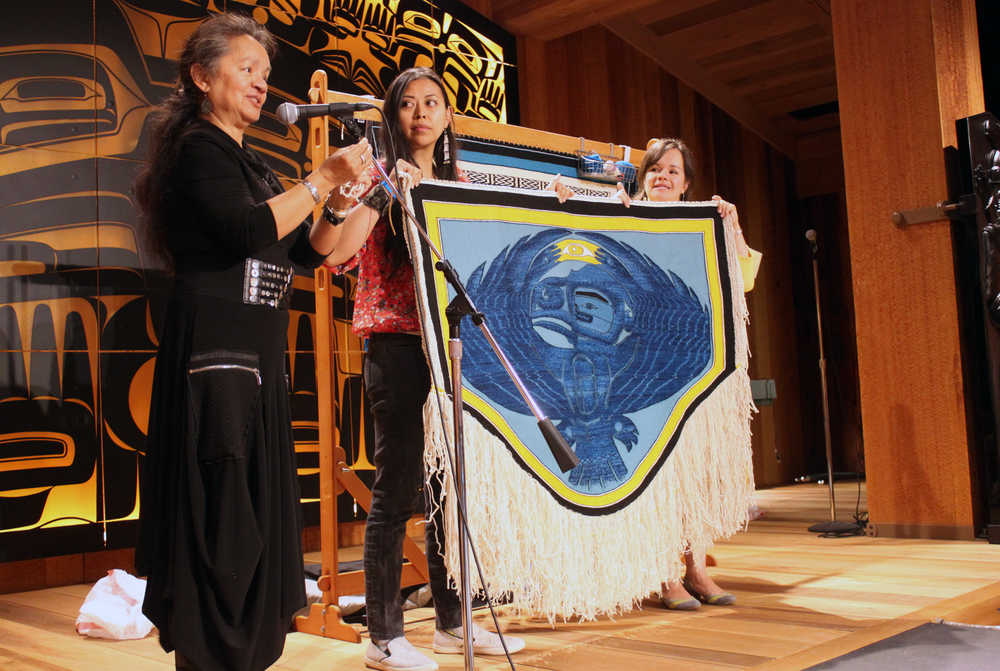
Whenever Juneau weaver Shgen George travels, her loom goes with her. She transports the large portable loom in a ski bag, advice she got from Clarissa Rizal.
“This loom and this ski bag have literally traveled around the world with me and I weave every day, pretty much no matter what, even if it’s two minutes,” George said.
She spoke during the Chilkat and Ravenstail Weaving Symposium to a packed clan house audience inside the Walter Soboleff Building Wednesday. It was one of the first official events of Sealaska Heritage Institute’s Celebration 2016.
Chilkat and Ravenstail are traditional weaving practices of the Tlingit, Haida, Tsimshian and other Northwest Coast people of Southeast Alaska, the Yukon and British Columbia. It’s traditionally used to make ceremonial regalia, like robes, dance tunics, aprons, leggings, vests, bags and hats. Artists spend years weaving a robe or ceremonial blanket.
During the symposium, George dragged the ski bag in front of the audience and assembled the wood pieces with nuts and bolts in front of everyone.
“I pulled this bag through Narita [International] Airport in Japan,” said George, who is a teacher for the Juneau School District and did a teaching exchange in Japan.
There she weaved a headband, apron and robe in various shades of pink for her daughter, Gabby Kay. When they returned to Juneau, Sealaska Heritage Institute purchased the whole ensemble, and now George and her daughter are working on another robe, a blue one, to replace the sold one.
As George finished putting the loom together at the clan house, the symposium audience let out “oohs” and “aahs” and clapped when her work-in-progress was revealed.
“It soothes me to just go to my loom and weave,” George said. “My daughter and I stand at my loom and weave together.”
She said it’s her hope that her children will continue to pass on weaving to future generations.
Weaver Marsha Hotch described a practice that’s been taking place for centuries — how she processes mountain goat hair for Chilkat weaving. She learned from Agnes Bellinger.
During the symposium, Hotch shared slideshow photos of bloody mountain goats in the back of a pickup truck or slung around the shoulders of a hunter.
“I’m sorry if this offends you, but this is how mountain goat is processed,” Hotch said. “It takes collaboration with the community to be able to weave. It’s wonderful to weave, but the preparation and how a weaver gets to weave, there’s a process there and that process wasn’t always mentioned.”
One of her photos showed her son, Stanley Hotch, packing a goat off a mountain behind Klukwan.
“These can weigh anywhere from 180 to 200 pounds and some billy goats over 300 pounds,” Hotch said.
Once the goat is skinned, she said, “the cleaning part is a chore.” The hide has to be rolled up and left for some time in a cool place.
She described the first she time she unrolled a hide.
“After leaving it, I started unrolling my hide to slip the wool off and when that smell started getting up to me, I started having memories tumbling out and I just started crying. I actually had my hands in mountain goat wool as a little girl,” Hotch said.
“I had forgotten that,” she said, but was reminded by “just smelling that mountain goat and having my hands in it and pushing it again.”
“Spinning was another chore. The earlier you get your mountain, the shorter the fibers,” Hotch said. “I had to be very patient.”
When it comes to dying the wool, Hotch showed pictures of her “accidents” when a mistake changed a teal color to a gray.
She recalled once bringing her own wool to the state museum where she viewed archived weaving items.
“I just wanted to old to meet the new and let them know we’re still trying to do the best we can,” Hotch said.
Haida and Tlingit weaver Della Cheney said every piece of art and regalia that’s displayed in museums around the world are “part of us and our history.”
“When I look into the room and see the weavers, I see how we’re connected. Each of us is a warp and the things we create are the weft,” Cheney said, using weaving terminology.
She said weavers give woven items to family members and children.
“Each robe, each hat, each apron will move forward with our children and grandchildren through time. Today as I weave and create new regalia, the techniques I practice are from the time before us,” she said.
“This process of weaving is a healing therapy for all of us, and it’s just a very powerful way of life.”
• Contact reporter Lisa Phu at 523-2246 or lisa.phu@juneauempire.com.
Related articles
Weaving: ‘A very powerful way of life’
Celebration’s lead dance group has some surprises up its sleeve
Celebration: No border between us
Building bridges for Native LGBTQ: ‘You’re not alone’
Boxley wins ‘Best of Show’ in Celebration art competition
Celebration calendar for Friday, June 10
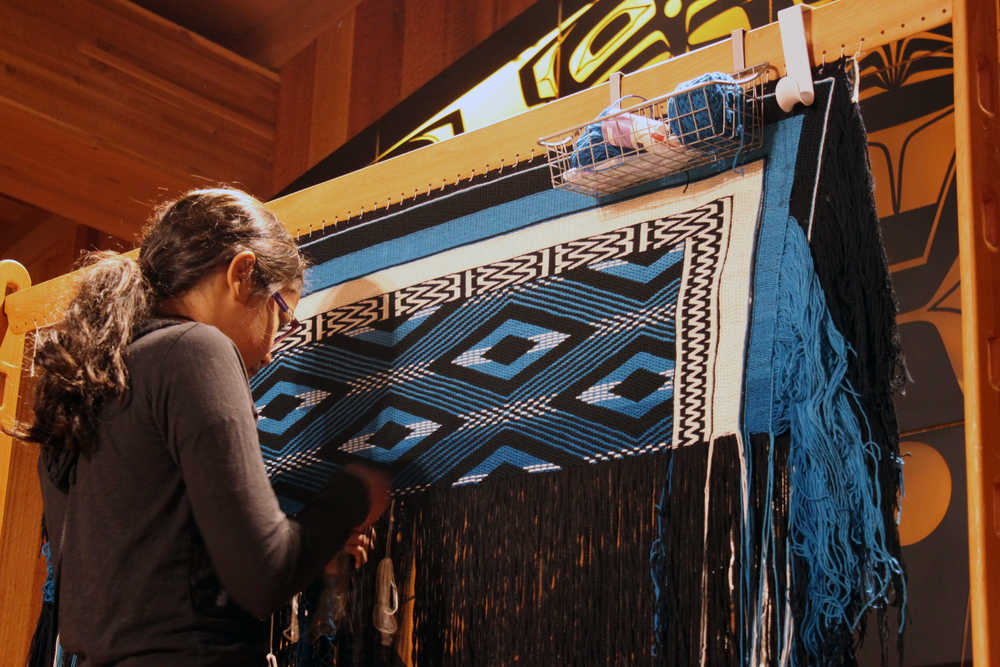
Gabby Kay shows how she helps her mother, Shgen George, weave during the Ravenstail and Chilkat Weaver Symposium at the Walter Soboleff Building’s clan house Wednesday.
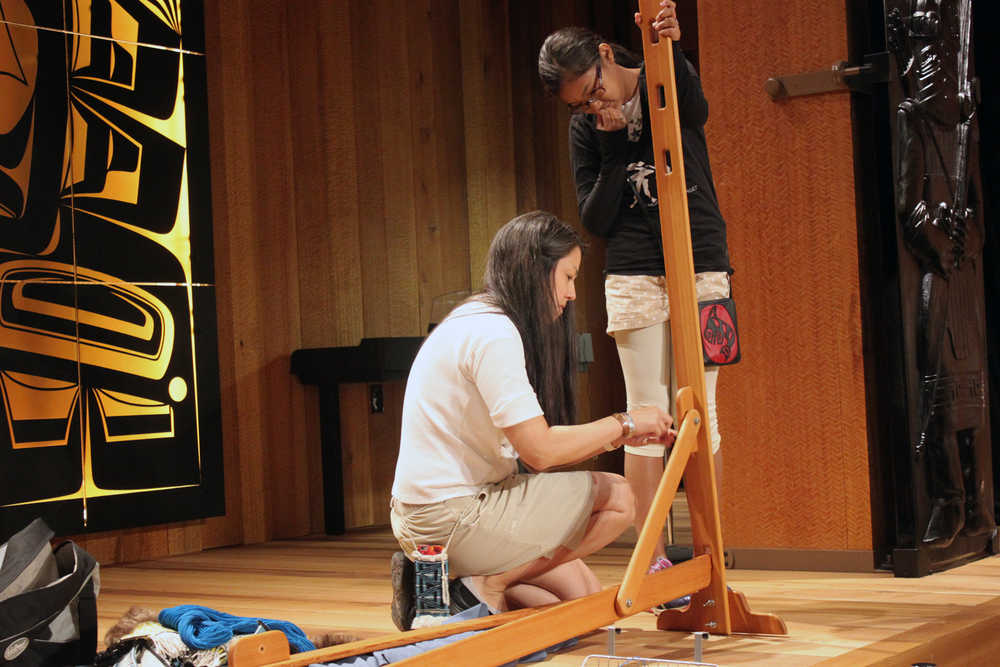
Shgen George and daughter Gabby Kay set up a portable weaving loom during the Ravenstail and Chilkat Weavers Symposium at the Walter Soboleff Building’s clan house Wednesday.
