
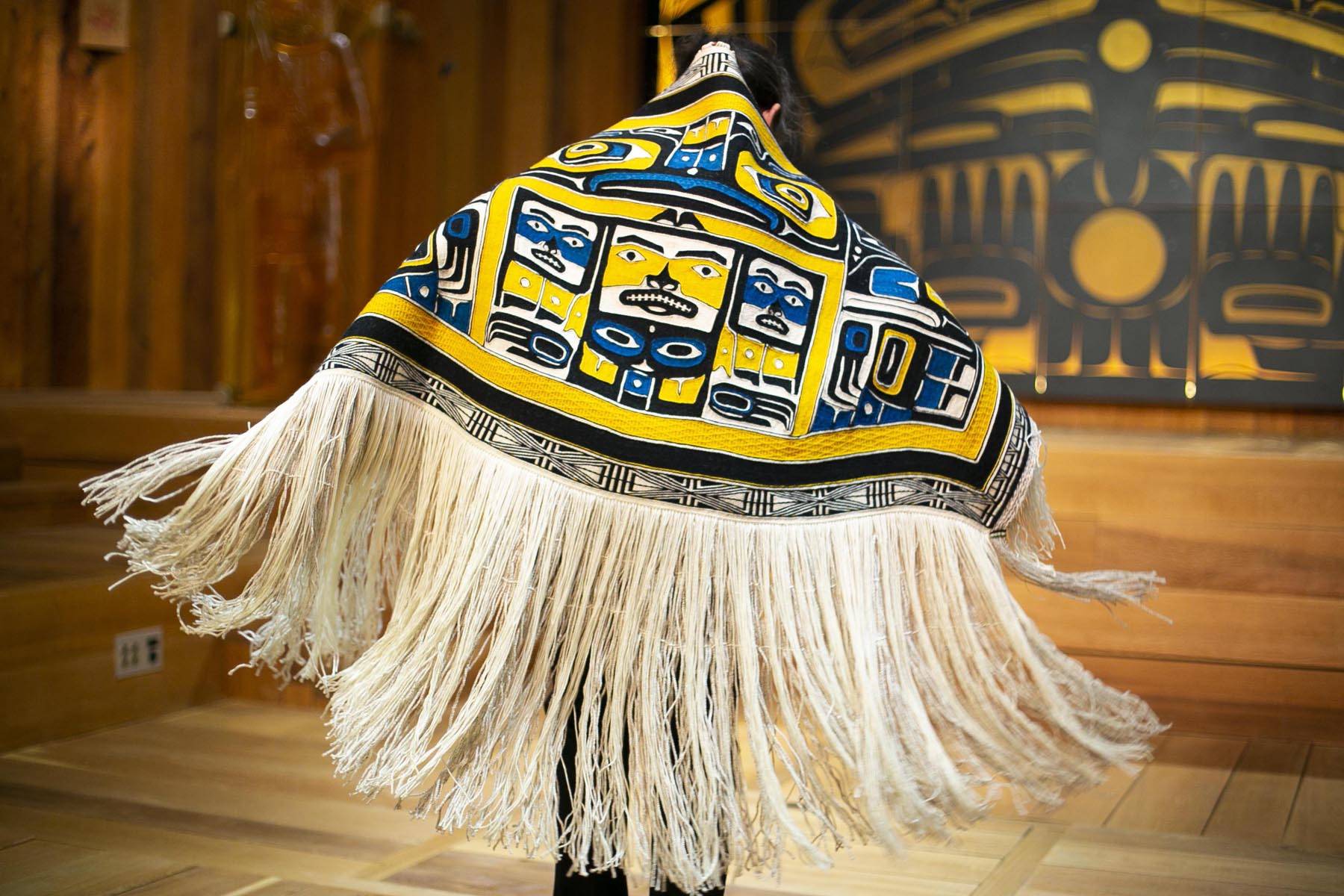
Lily Hope and Ricky Tagaban, two of Juneau’s preeminent Chilkat and Ravenstail-style weavers, celebrated the completion of a robe Monday night with its first dance, held at Sealaska Heritage Institute’s Shuká Hít clan house.
“The first dance event stemmed from my mother, Clarissa Rizal,” said Hope in a phone interview. “She taught me and Ricky to weave. In 2016, when she finished her 11th Northwest Coast textile. It was the first time she had had a dance for the release of a blanket.”
The first dance of a robe or other creation is to commemorate the journey of the weaver and blanket, Tagaban said. It’s becoming more regular to hold a first dance, something Hope plans to incorporate for everything she creates.
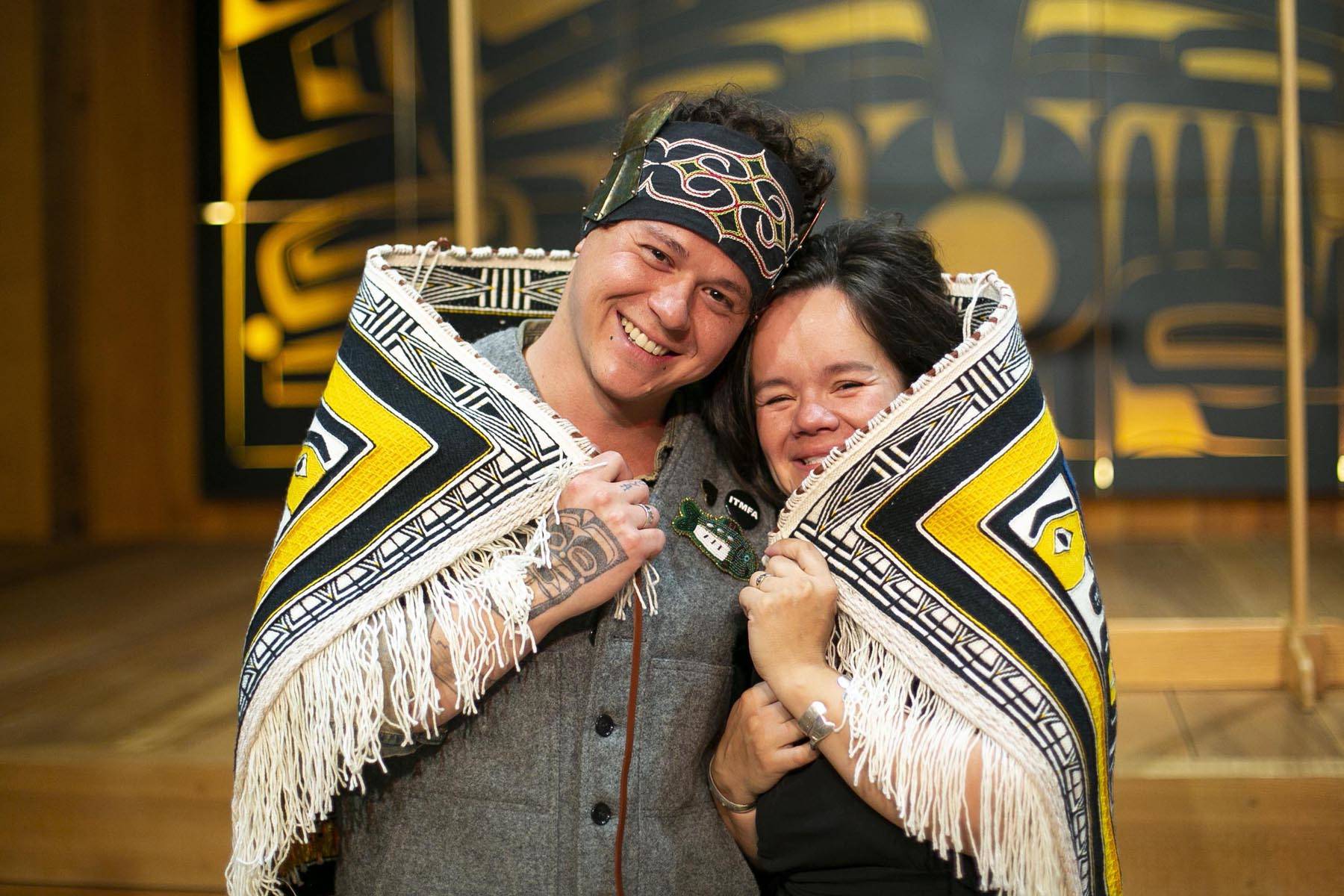
Lily Hope and Ricky Tagaban display the robe they collaborated to weave at its First Dance ceremony at the Sealaska Heritage Institute on Monday, June 22, 2020. (Courtesy photo | Annie Bartholomew)
“She (Rizal) said “make sure you have them danced in public and acknowledged this way because this is the first time I have not been depressed when a blanket goes home,” Hope said, speaking of the first time Rizal held a first dance for one of her textiles. “Make sure you have first dance, and you as the weavers get to witness the first moves of the blanket.”
The ceremony includes songs of celebration accompanying the first dance itself, all steeped in the long tradition of the weavings, Tagaban said.
“Those pieces we make are connected to our lineage and the language,” Tagaban said. “We make time to follow that protocol. There are songs that are appropriate for those moments.”
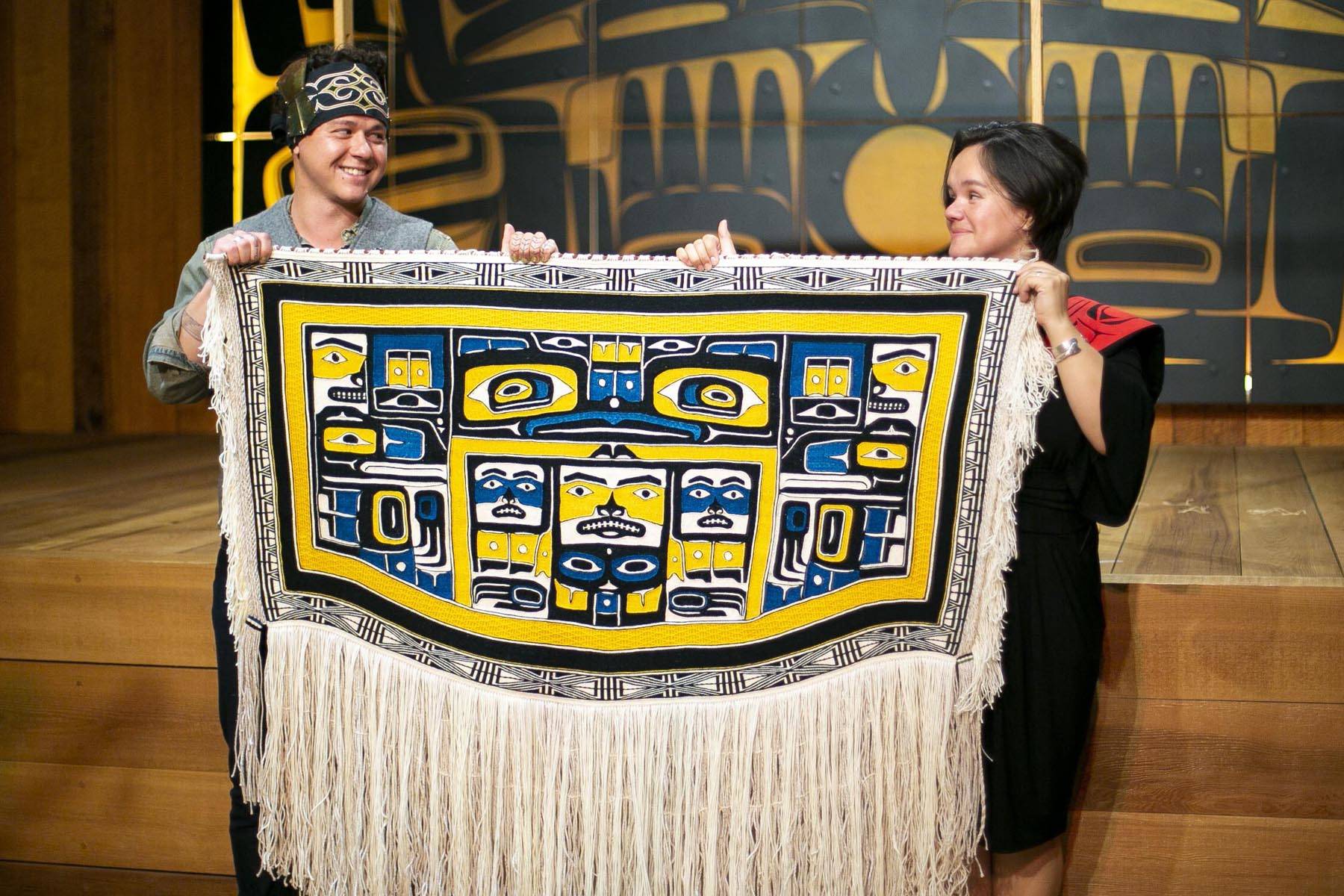
Lily Hope and Ricky Tagaban display the robe they collaborated to weave at its First Dance ceremony at the Sealaska Heritage Institute on Monday, June 22, 2020. (Courtesy photo | Annie Bartholomew)
A resurgent style
The garment itself, a robe made for a private collector, was a collaborative effort between Hope and Tagaban. It took between 1,200 and 1,500 hours of work to make, Hope said.
“I likely will not let go of a blanket without doing a first dance event. I am going to adhere to that,” Hope said. “There’s a huge relief watching it Dance for the first time and being like, whew, it’s over.”
Tagaban concurred about the palpable relief he felt.
“Last night, (Monday) was the hardest I’ve slept in my life,” Tagaban said. “It wasn’t rough and it wasn’t heavy, not in a bad way. I could feel a lot of anticipation. There’s a lot of recognition that this doesn’t happen very often and it’s such a unique thing to our coast, this style of weaving. It feels good for sure, and I feel a ton of excitement about everything else I want to make.”
While there are very few daily weavers of Chilkat and Ravenstail style still operating, Hope said, holding fast to their traditions, rebuilding the infrastructure, and showing people whenever they can will help stoke the fires once more.
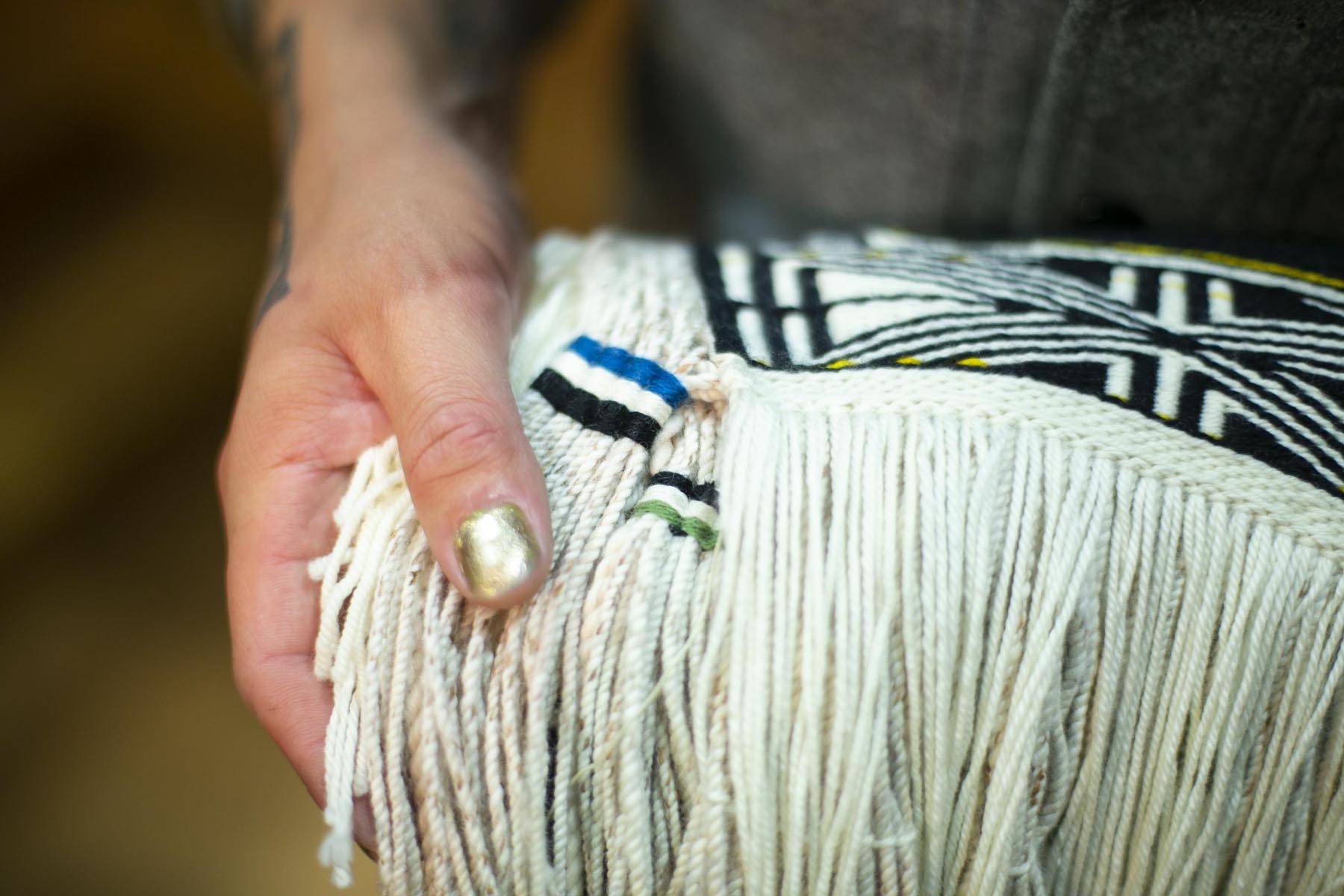
Ricky Tagaban shows the woven artist signatures on the robe he and Lily Hope collaborated to weave at its first dance ceremony at the Sealaska Heritage Institute on Monday, June 22, 2020. (Courtesy photo | Annie Bartholomew)
“It’s also an educational opportunity for people,” Hope said. “My long-term goal is for people across the world to know Chilkat and Ravenstail weavings as well as they know Navajo weavings.”
Hope and Tagaban both have big plans for the future. Hope has plans for the introduction of several new robes, which she plans to hold first dances for around the beginning of the physical Celebration honoring Southeast Alaska Native culture, which was rescheduled to next year in light of coronavirus concerns.
Tagaban mentioned that he plans to create a blanket for his family when he gathers the materials. Neither has any intention of slowing down.
“It’s really not dying. It’s not where it was hundreds of years ago,” Tagaban said. “We’re working to rebuild that infrastructure. There’s a pulse and we’ve got our finger on the pulse.”
For more information about the traditionally weaved robes and blankets, check out the Burke Museum. Hope and Tagaban’s sites are here.
• Contact reporter Michael S. Lockett at 757.621.1197 or mlockett@juneauempire.com.
