
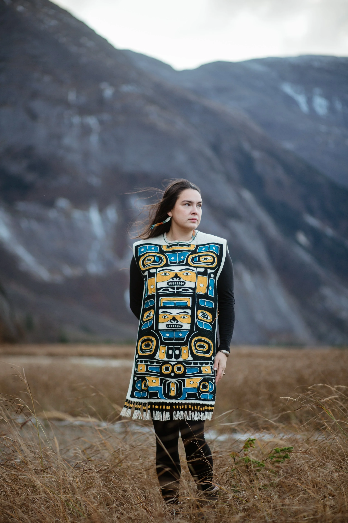
Sealaska Heritage Institute selected Chilkat weaver Sydney Akagi to weave the first 100% mountain goat Chilkat robe in more than 150 years. A selected dancer will wear the robe at SHI’s biennial dance-and-culture festival, Celebration 2028, and the robe will be added to SHI’s permanent collection in Juneau.
“Chilkat Robes have been the predominant weave and robe worn by Northwest Coast tribes and are significant in that the designs represent clan crests and spirits,” SHI President Rosita Worl wrote in a statement to the Empire.
Mountain goat weaving among Native communities has declined since Americans arrived in the late 1880s as traditional cultural practices were suppressed, diseases ravaged communities and commercial wools were introduced. Today, the mountain goat hunting season is in the fall while the best wool is harvested in the spring, Akagi said.
Akagi began weaving in the traditional Ravenstail style in 2018, falling in love with its geometrical style. Two years later Akagi committed herself to the newer style of Chilkat weaving.
“This undertaking marks a significant cultural milestone, as it revives the weaving of a full Chilkat robe made entirely from mountain goat wool for the first time in more than a century and a half,” Akagi wrote in her project proposal to SHI. “My approach to this project will maintain cultural accuracy and artistic integrity, while also providing apprentices with the depth of processing and weaving knowledge that will carry them through in their weaving journey,”
ArtNews named Akagi among the “25 Indigenous Artists to Know” in 2025. Her work has been supported by the Rasmuson Foundation and entered private and public collections, including the Gochman Collection in New York City. Her colleague and former teacher, Lily Hope, has rooted Akagi’s weaving practice in a lineage carried on by Tlingit artists Clarissa Rizal, Jennie Thlunat and Clara Benson.
Fiber processing lead mentor Laine Rinehart is processing the harvested wool. He brings more than 10 years of experience in Ravenstail and Chilkat weaving. He has worked on a dozen hides and has spun hundreds of yards of mountain goat wool.
SHI will select four apprentices to work with Akagi and Rinehart. They will learn fiber preparation, dyeing, spinning, warping and weaving practices and complete smaller regalia items like leggings, headbands and aprons. T selected dancer will also wear these items during Celebration 2028.
Rinehart said he developed an appreciation for the use of traditional materials and gained an understanding of the importance of adapting and utilizing available materials.
“The whole entire mountain goat is being used, which I think is really incredible, because then it makes it a little bit more sustainable,” Akagi said. “80% of the mountain goats harvested from here are people from down south coming up to hunt. So knowing that local people are getting these mountain goats, and the food is going to local people, and people are learning that knowledge of how to traditionally process the meat, and we’re getting to use the hides fully is really special.”
