
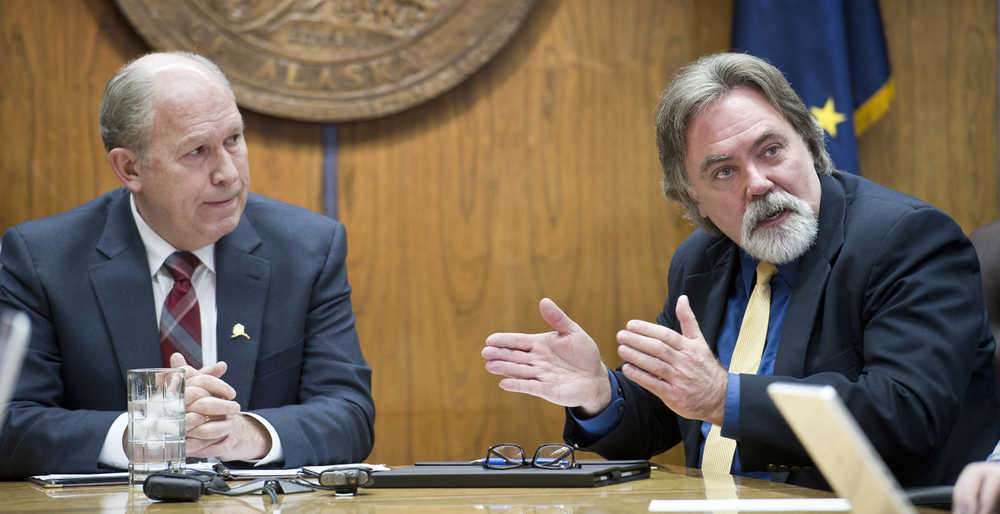
Even as members of the Alaska Legislature promote a slow-and-steady approach to fixing Alaska’s $4 billion annual deficit, Gov. Bill Walker said he wants to see fast action on the state’s oil-driven financial woes.
“Our goal is that we get a sustainable budget by 2019,” Walker said, but no plan being seriously considered by the Legislature meets that deadline.
The governor held a 30-minute question-and-answer session Wednesday to provide his view on the latest actions taken by the Legislature.
At the start of this year’s Legislative session, Walker proposed a slate of bills including spending cuts and increased taxes, but his ideas met a lukewarm reception.
On Tuesday, the 99th day of the Legislative session, lawmakers were not seriously considering any of the tax increases Walker proposed. None had received a hearing in almost two weeks.
“We’re not interested at this time on passing any new taxes,” Senate President Kevin Meyer, R-Anchorage, said Monday.
While taxes aren’t on the Legislature’s agenda, lawmakers aren’t sitting idle. Walker has repeatedly said his plan for solving the deficit is “written in pencil, not in pen,” and legislators have taken advantage of that fact.
Earlier this month, the Senate Finance Committee unveiled a plan built around a proposal to use some of the investment earnings of the Alaska Permanent Fund. The plan also incorporates cuts to state drilling subsidies, spending from the Alaska Permanent Fund, cuts to state government, and reforms to Medicaid and the criminal justice system.
According to an analysis of that package, the state deficit would not go away (barring an unexpected spike in oil prices) but it would be reduced to the point that the state’s savings would be enough to keep state government operating through at least 2050.
“Whatever happens, there will be some significant changes,” Walker said.
The key to a budget agreement, lawmakers have said, is House Bill 247, a proposal to reduce the state’s subsidy for oil and gas drilling. If the state cuts subsidies for drillers, the popular belief is that wavering lawmakers will be more willing to vote for a Permanent Fund plan that reduces Alaskans’ Permanent Fund Dividends in the course of funding government operations.
A new version of HB 247 was released on Tuesday by the House Rules Committee.
“I like that there’s some movement,” Walker said of the proposal, but “I’m concerned about the balance on tax credits.”
As proposed by Walker, HB 247 would have been a net gain of $300 million per year for the state through tax increases and a reduction in the state subsidy.
House lawmakers were alarmed by the bill’s predicted impact on oil and gas operations within the state, and have gone back and forth on the bill. The latest measure promises savings similar to those offered by Walker’s original bill, but it doesn’t deliver those savings until 2020. Walker’s bill would have brought them immediately.
The new bill also changes the most contentious portion of the state’s subsidy from a tax credit into a tax deduction. As a credit, the subsidy can be sold by new drillers to raise money before production starts. As a deduction, it can only be used once the driller starts producing oil and must pay production taxes.
“It really creates a situation where someone who has current production can take advantage of it much more immediately,” Revenue Commissioner Randall Hoffbeck said.
Walker said he’ll have to “wait and see” as to whether the new version of HB 247 works for him. “It all has to fit into the plan,” he said. “Any level of savings we don’t achieve there, we’ll have to find somewhere else.”
Walker has long said the state’s principal problem is not the deficit itself but the uncertainty it brings. Until the deficit is resolved, he said, Alaskans and Outside investors will be concerned about what the state might do instead of dealing with what it has done.
• Contact reporter James Brooks at james.k.brooks@juneauempire.com.
