US Sec. Kennedy, in Alaska trip, repeats doubts of vaccines, while promising new ‘universal vaccine’
Published 10:30 pm Tuesday, August 5, 2025
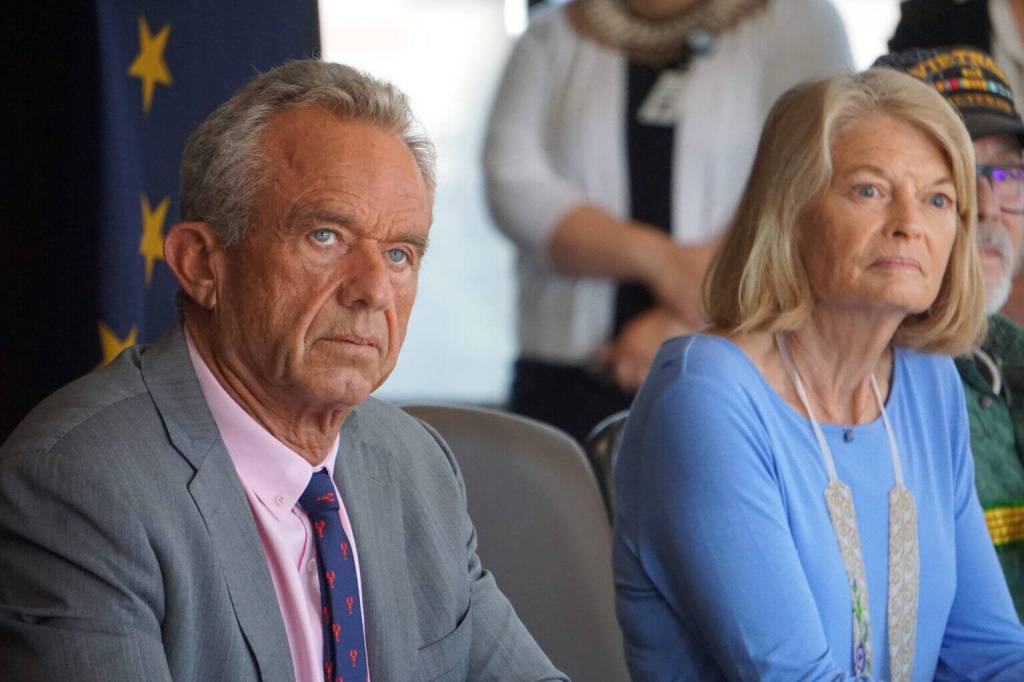
U.S. Health Secretary Robert Kennedy Jr., in an Anchorage news conference, justified his decision to cancel about $500 million in federal funding for mRNA vaccine development by claiming that the vaccine developed to fight COVID-19 actually “prolonged the pandemic.”
“The mRNA vaccines, you know from COVID, don’t work,” he said, contradicting medical experts, at the news conference, held Tuesday at the Alaska Native Tribal Health Consortium headquarters in Anchorage.
Kennedy pointed to the COVID-19 virus mutating, “to which the vaccine was ineffective.”
But that led to the development of adapted vaccines to target variants like the Omicron virus, beginning in 2022, that were shown to be effective in preventing infection and severe disease.
Vaccines work by prompting the body’s natural immune response to fight infection. Kennedy repeated his questionable claims casting doubt on the science of vaccines, and said the Trump administration is “putting major funding” toward the National Institute of Health to develop a “universal vaccine.”
“We’re going to fund that money. We’re going to shift that money to develop universe vaccines that are much better technology, much safer,” he said Tuesday.”
In a social media post, the president of the American Medical Association criticized the cancellation and countered Kennedy’s claims.
“COVID-19 vaccines using mRNA technology helped save countless lives during the pandemic. We urge the Administration to continue vital research to improve mRNA vaccines, not throw the baby out with the bathwater by effectively preventing research from moving forward,” Dr. Bobby Mukkamala, the organization’s president, said in a post on X.
An estimated 2.5 million lives were saved by COVID-19 vaccines globally from 2020 to 2024, according to a study by the Journal of American Medical Association, and 15 million life-years saved. Scientists whose work led to development of the mRNA vaccine for COVID-19 won a Nobel Prize in 2023.
Also at the Anchorage news conference, Kennedy reiterated his more general criticism of vaccines administered to children. He falsely claimed they are untested and that the department plans to now do randomized testing to check their safety, although all vaccines have already been tested before federal approval.
“The current vaccine schedule is exempt from safety testing, and so none of the vaccines, with the exception of the COVID vaccine, has been tested against an inert placebo. That means that we don’t know the risk profiles for those products. And people need to know that, and doctors need to know it,” he said.
Without such testing, it is unknown whether the vaccines cause more harm than good, he said.
COVID vaccines have to go through three phases of clinical trials, according to the U.S. Centers for Disease Control and Prevention, to make sure they are safe and effective, especially against severe illness, hospitalization and death.
“So for the first time, we are now going to do real randomized trials on vaccines. Never happened before,” he said.
Scientists have raised concerns around the ethics of placebo testing for vaccines, as there is risk of harm for those that go without treatment. The American Medical Association’s Code of Medical Ethics states that where there are accepted interventions, the use of a placebo requires “thoughtful ethical justification.”
Sen. Lisa Murkowski, R-Alaska, who also spoke at the press conference, defended vaccines and repeated some earlier criticism of Kennedy’s decision to fire members of the Advisory Committee on Immunization Practices, or ACIP.
“I am a strong believer that vaccines save lives,” she said.
Parents and patients should have “quality, unbiased scientific backing” for vaccines, she said. “I think this is where the advisory boards that provide for recommendations for the vaccines are important and that the credibility of those boards is really held intact. And so I have been critical of the fact that the ACIP board was basically terminated, and a new group of individuals was installed, because I feel that that challenges the credibility of the advisory board itself.”
But Murkowksi tempered her criticism at Tuesday’s news conference by saying Kennedy had the right to seek new information on vaccine safety.
“I don’t fault the secretary for wanting to ensure that there is a more rigorous testing process for vaccines, although I do believe that we have many vaccines that have been in place for years, if not decades, that have clearly demonstrated that efficacy over a period of time,” she said.
National medical organizations, including the American Medical Association and the American Academy of Pediatrics, have had stronger criticism of Kennedy’s ACIP actions.
In an Aug. 1 statement, eight organizations blasted Kennedy’s decision to exclude them from the vaccine advisory committee.
“For decades, liaisons from our organizations have reviewed published and unpublished data and literature related to vaccine efficacy, effectiveness, and safety and provided unbiased input for ACIP’s consideration. To remove our deep medical expertise from this vital and once transparent process is irresponsible, dangerous to our nation’s health, and will further undermine public and clinician trust in vaccines,” said the statement.
The visit to ANTHC, including the news conference, was part of Kennedy’s itinerary during an Alaska trip that includes travel to Fairbanks, to rural areas and to the Kenai Peninsula.
Native leaders elsewhere the nation have said that Kennedy’s policy decisions are disproportionately hurting tribal communities.
Yereth Rosen came to Alaska in 1987 to work for the Anchorage Times. She has been reporting on Alaska news ever since, covering stories ranging from oil spills to sled-dog races. She has reported for Reuters, for the Alaska Dispatch News, for Arctic Today and for other organizations.
Corinne Smith started reporting in Alaska in 2020, serving as a radio reporter for several local stations across the state including in Petersburg, Haines, Homer and Dillingham. She spent two summers covering the Bristol Bay fishing season. Originally from Oakland, California, she got her start as a reporter, then morning show producer, at KPFA Radio in Berkeley.
This article originally appeared at alaskabeacon.com. Alaska Beacon is part of States Newsroom, the nation’s largest state-focused nonprofit news organization.