
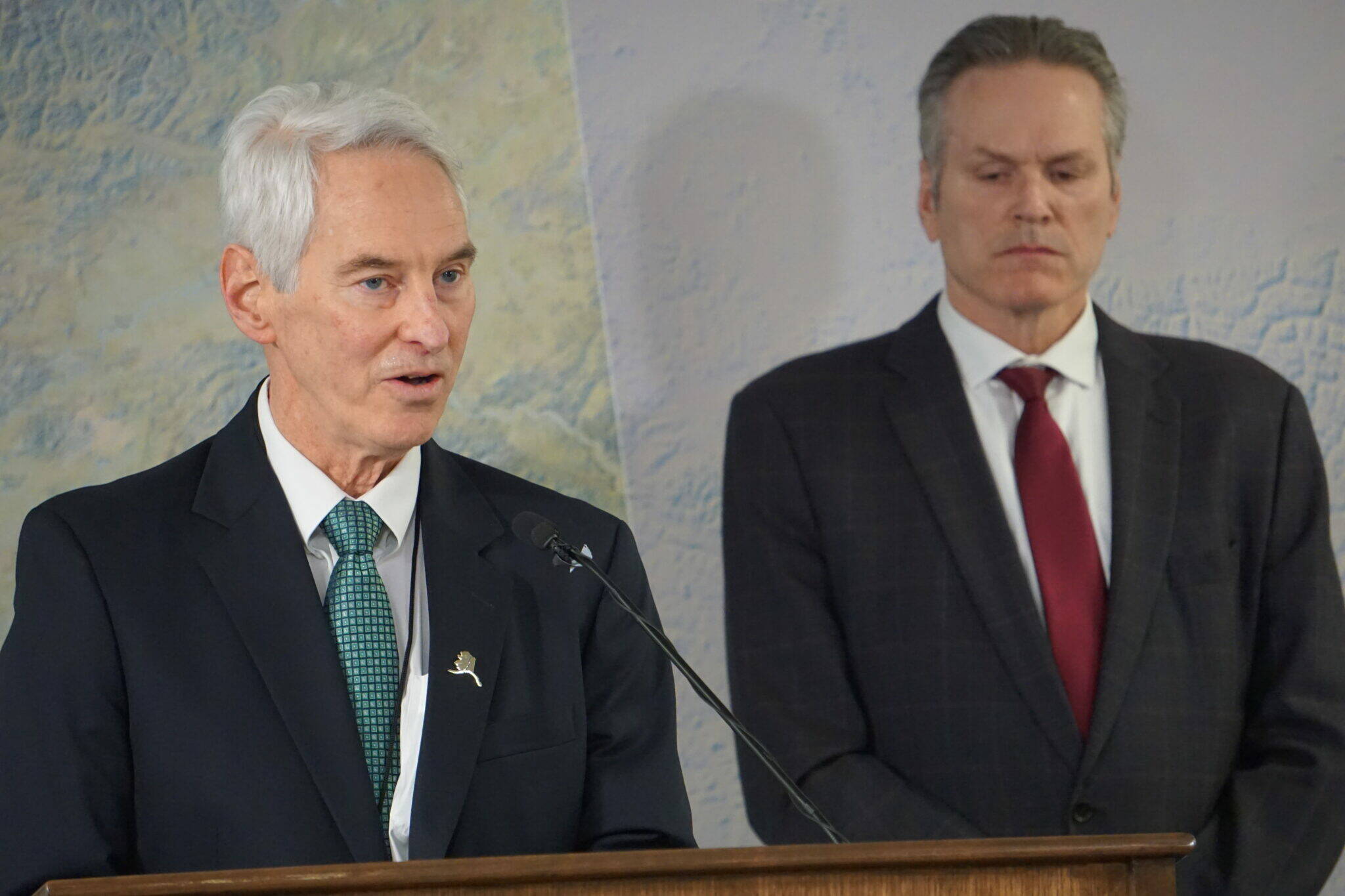
Frank Richards, president of the Alaska Gasline Development Corp., speaks at a Jan. 6, 2025, news conference held in Anchorage by Gov. Mike Dunleavy. Dunleavy is standing behind him. (Yereth Rosen/Alaska Beacon)

Frank Richards, president of the Alaska Gasline Development Corp., speaks at a Jan. 6, 2025, news conference held in Anchorage by Gov. Mike Dunleavy. Dunleavy is standing behind him. (Yereth Rosen/Alaska Beacon)

Unnamed energy company is negotiating takeover of proposed trans-Alaska gas pipeline

Top official for the Alaska Gasline Development Corp. said he expects a formal announcement soon.

The state-owned corporation in charge of developing a trans-Alaska natural gas pipeline said Monday that it is in secret negotiations with an energy company to lead and fund the project.

The pipeline and associated infrastructure is expected to cost at least $44 billion, and that cost has been an insurmountable hurdle for a project that has been discussed for more than 50 years.

Frank Richards, head of the Alaska Gasline Development Corp., declined on Monday to share any details of the potential agreement, including the name of the state’s partner.

“I’m announcing that AGDC has reached an exclusive framework agreement with a qualified energy company to privately lead and fund the development of the Alaska LNG project,” he said at a news conference.

“I expect a formal announcement of the definitive agreements in the next few months,” Richards said.

Gov. Mike Dunleavy, speaking at the conference, said he has previously been skeptical about the gas line but now believes actual progress is being made.

“A large gas line has been challenged for decades — the cost, the size, the engineering, you name it,” Dunleavy said. “But there has been significant movement in a positive direction, not just theoretical, but actual, significant movement.”

Last year, AGDC suggested that it could instead seek to build a smaller pipeline for in-state use, but on Monday, Richards said the proposed energy company deal includes an export facility, signaling that it involves the larger plan.

Dunleavy said the pipeline is a long-term solution for a looming energy crunch in Southcentral Alaska, and that the region will face a “bumpy” few years in the meantime.

In 2023, state legislators were warned that Southcentral Alaska may run short of available natural gas by the end of the decade.

Though the region has extensive natural gas deposits, development has been slow, and local utilities are considering plans to import gas, an act that would sharply increase heating and electricity prices for Alaskans in the region.

Dunleavy said he intends to introduce legislation this year that will incentivize gas production in Cook Inlet.

The state Legislature approved incentives during an almost identical gas-shortage crisis a decade ago, but lawmakers later repealed those incentives because of their billion-dollar cost.

That cost, coupled with the state’s worsening long-term finances, has made legislators reluctant to repeat their prior acts.

Last year, legislators considered but did not pass financial incentives for new drilling. They’ve also grown skeptical of AGDC itself, with some legislators proposing to eliminate a corporation that has failed to deliver on its core goal.

At Monday’s news conference, Dunleavy noted that because Alaska is so large, one energy source alone will not be sufficient to meet the state’s needs.

Hydroelectric, geothermal, wind, solar, coal and nuclear power are all options for the state, he said.

“Alaska has all of it, but we have got to agree that we’re done talking about the theoretical and now we have to make sure that we put things into reality,” Dunleavy said.

“I have no doubt … the large line will be disparaged or questioned. I questioned it for years, to be perfectly honest with you,” he said, “but there’s some real, concrete steps going forward and I think we’re entering a phase of reality for this pipeline.”

• James Brooks is a longtime Alaska reporter, having previously worked at the Anchorage Daily News, Juneau Empire, Kodiak Mirror and Fairbanks Daily News-Miner. This article originally appeared online at alaskabeacon.com. Alaska Beacon, an affiliate of States Newsroom, is an independent, nonpartisan news organization focused on connecting Alaskans to their state government.

More in News

The northern lights are seen from the North Douglas launch ramp late Monday, Jan. 19. A magnetic storm caused unusually bright northern lights Monday evening and into Tuesday morning. (Chloe Anderson/Juneau Empire)
Rare geomagnetic storm causes powerful aurora display in Juneau

The northern lights were on full display Monday evening.

teaser
Juneau activists ask Murkowski to take action against ICE

A small group of protesters attended a rally and discussion on Wednesday.

A female brown bear and her cub are pictured near Pack Creek on Admiralty Island on July 19, 2024. (Chloe Anderson for the Juneau Empire)
Pack Creek permits for bear viewing area available now

Visitors are welcome from April 1 to Sept. 30.

Cars pass down Egan Drive near the Fred Meyer intersection Thursday morning. (Clarise Larson / Juneau Empire file photo)
Safety changes planned for Fred Meyer intersection

DOTPF meeting set for Feb. 18 changes to Egan Drive and Yandukin intersection.

Herbert River and Herbert Glacier are pictured on Nov. 16, 2025. (Mari Kanagy / Juneau Empire)
Forest Service drops Herbert Glacier cabin plans, proposes trail reroute and scenic overlook instead

The Tongass National Forest has proposed shelving long-discussed plans to build a… Continue reading

A tsunami is not expected after a 4.4-magnitude earthquake northwest of Anchorage Wednesday, Feb. 4, 2026. (U.S. Geological Survey)
No tsunami expected after 4.4-magnitude earthquake in Alaska

U.S. Geological Survey says 179 people reported feeling the earthquake.

ORCA Adaptive Snowsports Program staff member Izzy Barnwell shows a man how to use the bi-ski. (SAIL courtesy photo)
Adaptive snow sports demo slides to Eaglecrest

Southeast Alaska Independent Living will be hosting Learn to Adapt Day on Feb. 21.

Cars drive aboard the Alaska Marine Highway System ferry Hubbard on June 25, 2023, in Haines. (Photo by James Brooks)
Alaska’s ferry system could run out of funding this summer due to ‘federal chaos problem’

A shift in state funding could help, but a big gap likely remains unless a key federal grant is issued.

Photo by James Brooks/Alaska Beacon
U.S. Sen. Dan Sullivan stands with acting Coast Guard Commandant Adm. Kevin Lunday during the after the commissioning ceremony for the Coast Guard icebreaker Storis on Sunday, Aug. 10, 2025, in Juneau, Alaska.
Coast Guard’s new Juneau base may not be complete until 2029, commandant says

Top Coast Guard officer says he is considering whether to base four new icebreakers in Alaska.

Most Read