
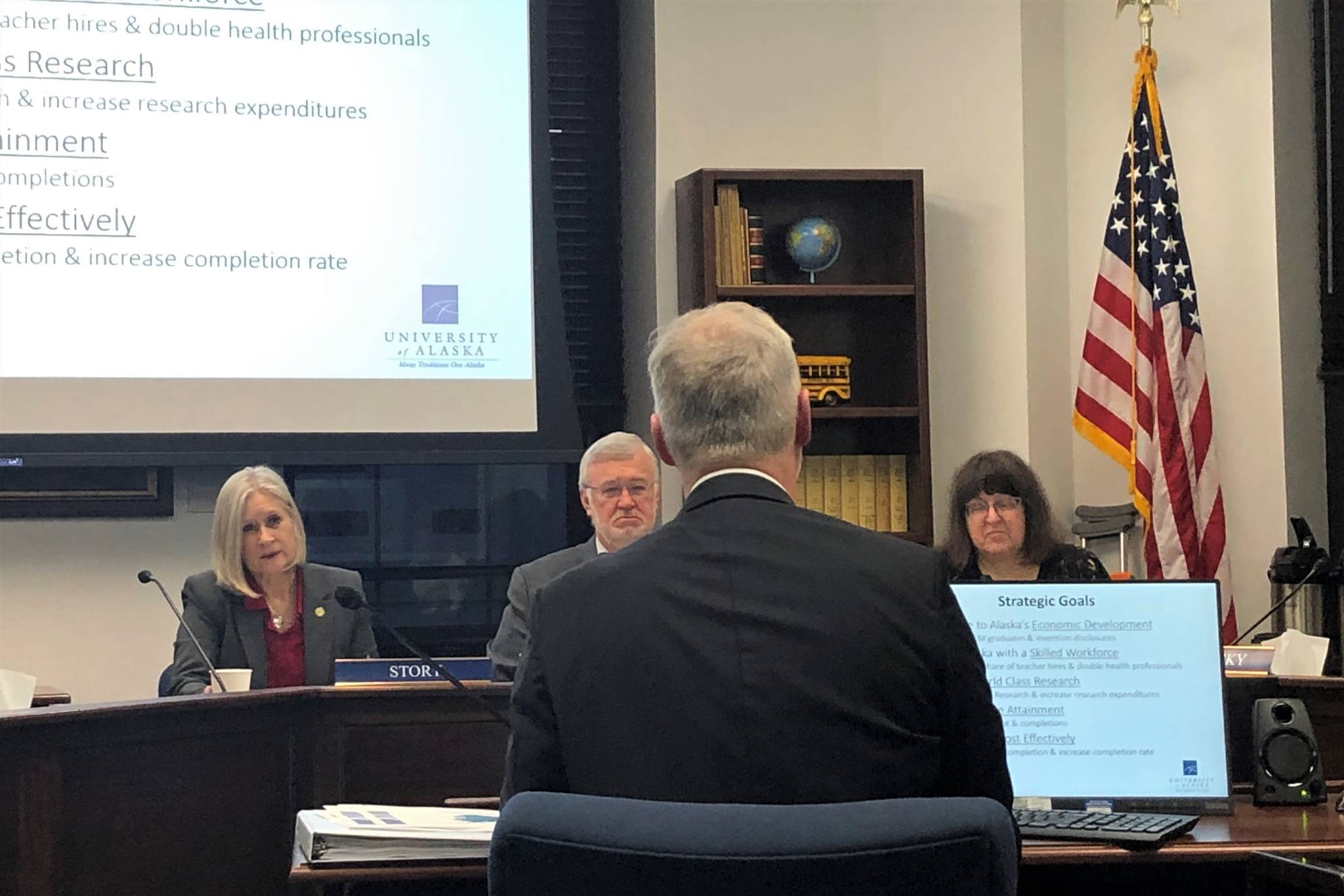
Sitting before a joint meeting of House and Senate Education Committees, University of Alaska President Jim Johnsen put a positive, if somber, view of the state’s university system.
“The effects of 2019 will be long lasting,” Johnsen said. “But we are pivoting.”
The university is still working through a three-year compact with Gov. Mike Dunleavy to reduce the system’s budget by $145 million. While that’s still a significant cut, Johnsen called the reductions manageable compared to the $405 million initially proposed by the governor in his vetoes.
But even with the compact, the university faces significant challenges, Johnsen said. Chief among them are declining enrollment and staff turnover.
When Sen. Mia Costello, R-Anchorage, asked if faculty were surveyed about their reasons for leaving and what the main driver of turnover was, Johnsen referred to a graph in his presentation showing a steadily declining budget.
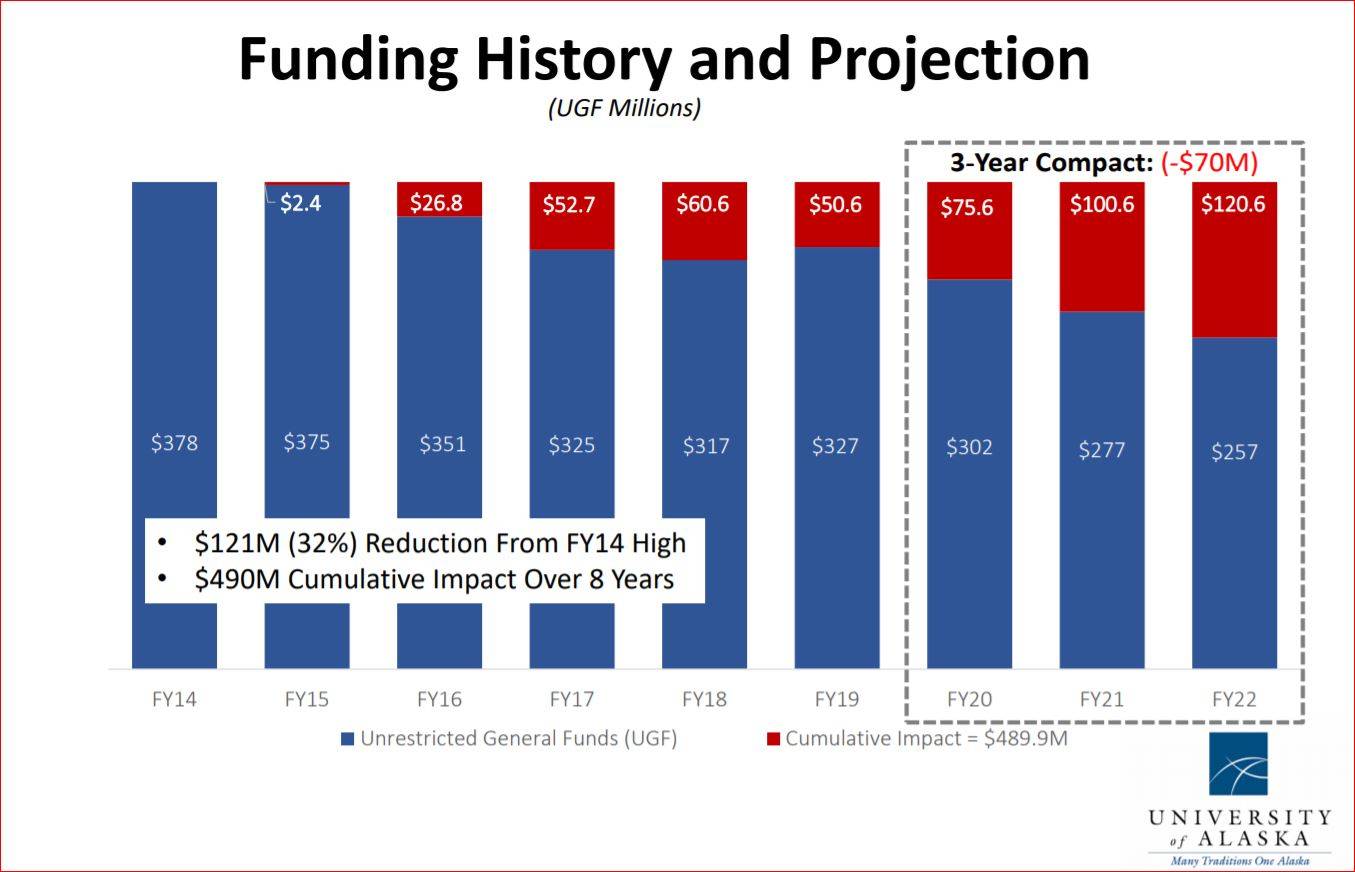
A slide from University of Alaska President Jim Johnsen’s presentation to a joint House and Senate Education Committee meeting on Wednesday. When Sen. Mia Costello, R-Anchorage, asked about the causes of high faculty turnover, Johnsen referred to this slide.
News of the cuts and uncertainty around the budget had negatively affected student enrollment and faculty morale, Johnsen said. But he added that enrollment had been declining ever since 2011 when the budget was increasing.
It’s more than just the university’s budget that affects enrollment, Johnsen said. Alaska has what he called a “high income, low education” economy. There are lots of high paying jobs in Alaska that don’t require a university degree, Johnsen said. Furthermore, the average age of a UA student is in the late 20s, and many students already have jobs or families which can disrupt studies.
Program completion was lower than average at UA, according to Johnsen, because many of its students have trouble fitting studies into their schedules.
Many of UA’s younger students are the first in their families to attend university, Johnsen said, which can mean financial struggles. General population loss and high unemployment across the state also negatively affect enrollment.
But UA’s tuition remains competitive, coming in at the third most affordable university in the country. It’s engineering, health and homeland security programs are in high demand, Johnsen said, and more resources are being put into those programs.
Sen. Shelley Hughes, R-Palmer, suggested expanding the university’s dual-enrollment programs it has with local high schools. High school students can enroll in certain programs while still in high school and earn credits toward a degree. Expanding that program could be a way to draw more students to the university, Hughes suggested.
Rep. Andi Story, D-Juneau, said that in her conversations with students, many of them were unfamiliar with federal grants and scholarships available to them. Highlighting and assisting prospective students with financial aid could bring more students in, she said.
While there are still cuts on the way as part of the university’s three-year compact with the governor, UA is looking at additional revenue sources as well.
The University of Alaska Board of Regents approved a 5% tuition increase for the fall 2020 semester, and several of the university’s buildings are being sold or demolished.
The university is also looking to sell some its land. UA is a land grant university, but has only received 25% of its federal land entitlement. According to Johnsen, UA is still owed about 360,000 acres of land.
Johnsen said Alaska’s congressional delegation has been working to get the federal government to allocate the remainder of the land but that process is ongoing.
• Contact reporter Peter Segall at 523-2228 or psegall@juneauempire.com.
