
Correction: One of the references to the year of the bombardment of Kake was incorrect in the original version of this article.
Two Tlingít villages in Southeast Alaska will receive apologies for wrongful military action from the U.S. Navy this fall.
The first of those apologies will take place in Kake this weekend, where U.S. Navy Rear Admiral Mark B. Sucato will acknowledge the harms of a bombardment in 1869. An apology in Angoon is scheduled for Oct. 26, the 142nd anniversary of the 1882 bombardment.
Navy Environmental Public Affairs Specialist Julianne Leinenveber said it was determined that the military actions were wrongful because they resulted in loss of life, loss of resources, and inflicted multigenerational trauma on the affected communities.
“The pain and suffering inflicted upon the Tlingit people warrants this long overdue apology,” she wrote in an email.
Tlingit people have asked the U.S. government to apologize for decades. Leinenveber said the U.S. responded in the last few years with planning discussions at the highest levels of military leadership and the federal government about how to issue a substantive, meaningful apology in a culturally appropriate manner. Lately, she wrote, military relationships with Alaska Native clans brought the matter to the attention of Navy leadership, who coordinated with the Office of the Secretary of Defense to formally apologize for the bombardments.
“The Navy will be issuing this apology because it is the right thing to do, regardless of how much time has passed since these tragic events transpired,” she wrote.
Joel Jackson, the president of the Organized Village of Kake, said the apologies are meaningful to the community even after a century.
“It’s a long time coming,” he said. “Hopefully, through this apology, we can start healing from the wrongs that were committed against us.”
Jackson said he is particularly concerned with the effects of intergenerational trauma, which he said he sees in his community today. The Navy apology will specifically acknowledge the U.S. government’s responsibility for that trauma.
Jackson said the military history of the event is not an accurate accounting of what happened. Many accounts refer to the bombardments as the Kake Wars.
“We never did go to war with them,” he said. “They attacked our communities.”
Military action in Kake
There are different accounts of the military events in Kake in 1869. Some refer to the events as a bombardment, while others refer to them as the Kake Wars
What goes without much dispute is that a U.S. Navy vessel, the USS Saginaw, totally destroyed three village sites and two forts in the area of Kake in the winter. Soldiers then burned the villages and destroyed food and canoes. By all accounts, the destruction led to “many deaths.”
Descriptions of the events that precipitated the bombardment differ. An account from William S Dodge, one of two mayors of Sitka under the provisional government, printed in the Annual Report of the Department of the Interior, recounts that two Alaska Native men were killed by a sentry in Sitka when they were unaware there was an order not to leave the village there. Afterward, men from Kake killed two colonizers in retaliation, which caused the war, Dodge wrote.
A forthcoming book from Zachary R. Jones, Ph.D., is similar to this account, with the detail that a Kake clan leader asked for trade blankets and goods as compensation for the deaths in accordance with Tlingit law, but the general refused, which is why a “party of Kake Tlingits” killed two trappers on Admiralty Island in retribution. The information was released in advance of the book’s publication in a news release from the Sealaska Heritage Institute.
New relationships
Angoon School Principal Emma Demmert was invited by the U.S. Navy to take part in planning meetings early this summer for its October apology. She said she is hopeful for the future after working with Navy officials and seeing their openness and willingness to embrace Angoon’s cultural traditions.
“This is a really good step to healing for our community, and it’s really been enlightening to be a part of the team and meeting with the Navy on this whole topic,” she said.
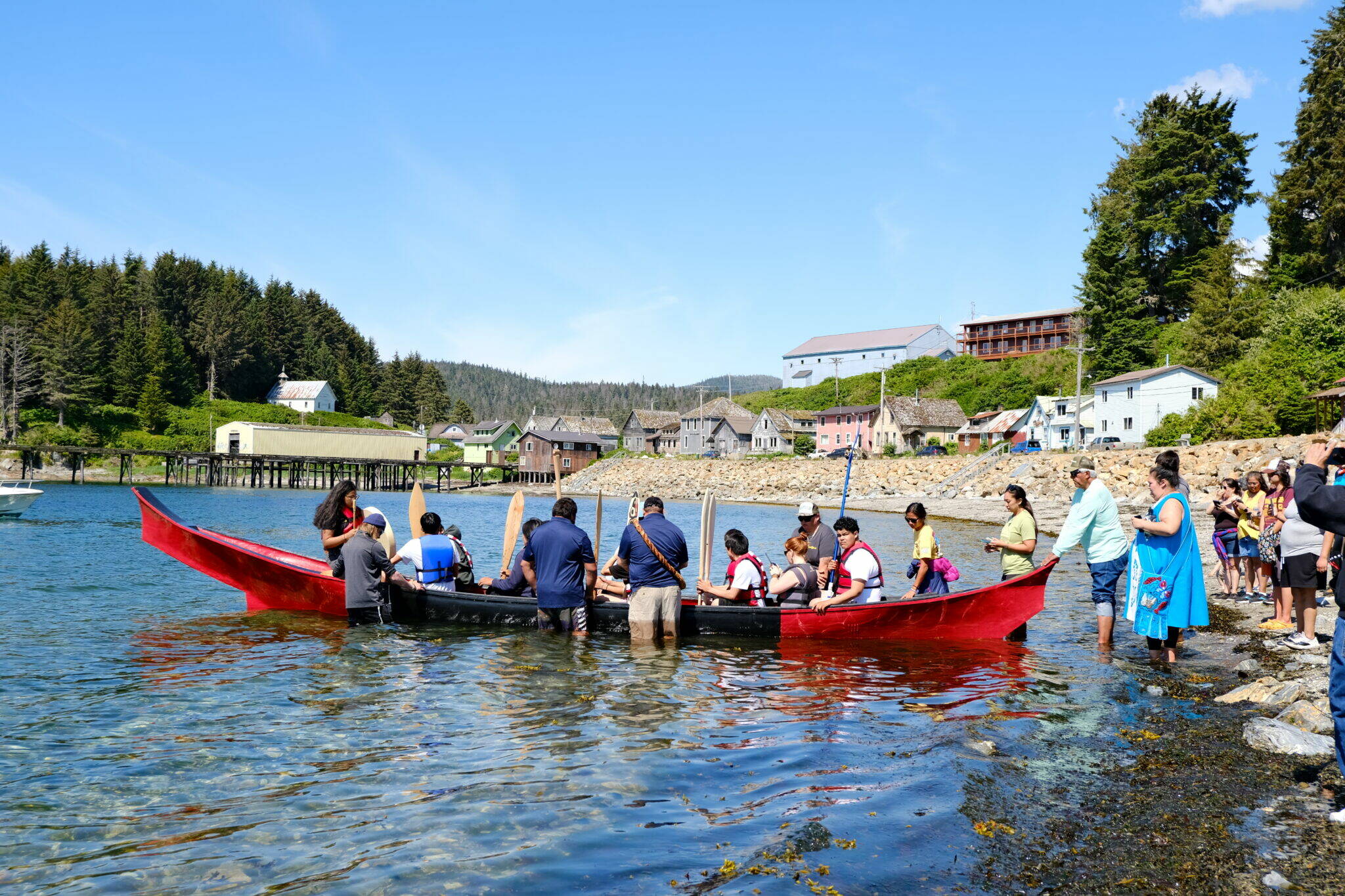
Demmert said the apology is a shift in relations with the U.S. government and she credits the Biden administration, in part, for that change. She also pointed to the work Angoon students did to build a dugout canoe and shine light on the history of the bombardment as a reason for renewed attention to the issue.
In Kake, Joel Jackson said he was also looking to the future and to right relations with the U.S. military.
“Giving an apology is by no means the end of it. Definitely we’ll be looking for them helping us even more,” he said. Jackson pointed to Kake’s high unemployment rate.
“Helping to set up infrastructure, you know, to get in some totem poles, stuff like that. Hopefully a museum to commemorate what happened.”
• Claire Stremple is a reporter based in Juneau who got her start in public radio at KHNS in Haines, and then on the health and environment beat at KTOO in Juneau. This article originally appeared online at alaskabeacon.com. Alaska Beacon, an affiliate of States Newsroom, is an independent, nonpartisan news organization focused on connecting Alaskans to their state government.
