
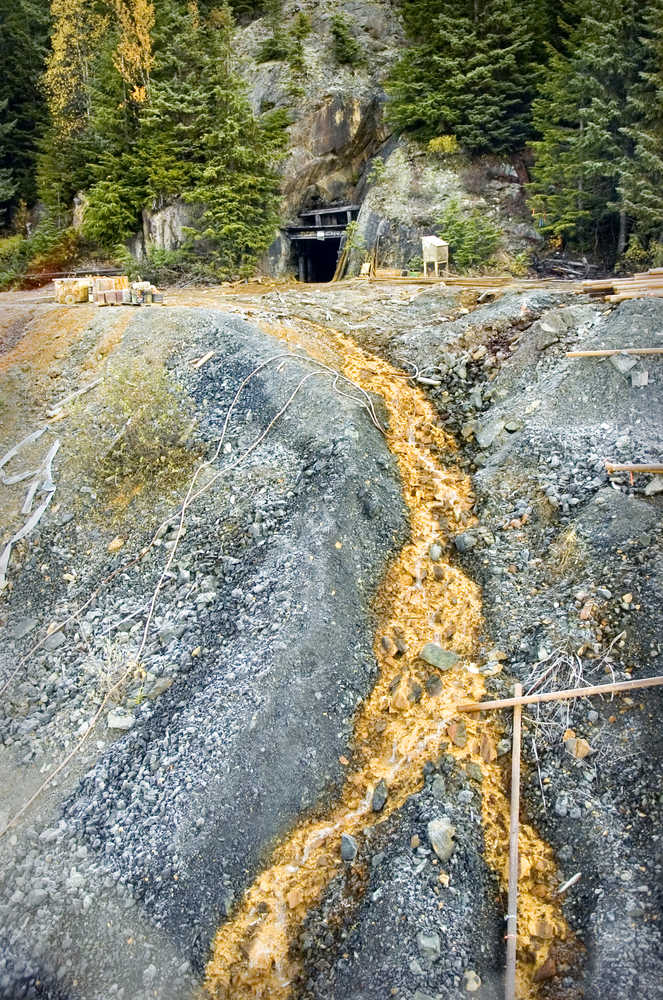
Tulsequah Chief Mine is still leaking polluted water into a tributary of the Taku River. The mine’s owner, which is tasked with cleaning it up, recently defaulted on a multi-million dollar loan payment.
“At this point you’re looking at blood from a stone. The company can’t even pay its own debts, how will it pay to clean it up?” said conservation advocacy organization Rivers Without Borders spokesman Chris Zimmer.
[Tulsequah Chief ordered to get clean in three months.]
Chieftain Metals was due to pay investment company West Face Capital about CAD $4 million March 31. Chieftain Metals didn’t make the payment, according to an April 6 press release on its website. The company’s total debt to West Face Capital is about $24.7 million.
West Face Capital “has not at this time demanded repayment of the amounts outstanding,” stated the press release. “Chieftain is engaged in constructive discussions with West Face regarding this matter and is working cooperatively with West Face to seek to resolve this matter and to move forward on a path that will stabilize (Chieftain) financially.”
The release also said the company is still in financial discussions with various groups to develop the Tulsequah Chief project. The mine has not been in operation since 1957.
Chieftain Metals representatives did not return repeated calls over multiple days requesting comment.
Acid mine drainage from the Tulsequah Chief Mine continues to flow into the Tulsequah River, a tributary of the Taku River near Juneau. This has been an ongoing issue, a problem Chieftain Mines inherited when it purchased the mine in 2010.
The Tulsequah Chief Mine is regulated by British Columbia government agencies Ministry of Energy and Mining, and the Ministry of Environment. Both were blasted Tuesday by the Auditor General of British Columbia Carol Bellringer.
“Almost all of our expectations for a robust compliance and enforcement program were not met. The compliance and enforcement activities of both the Ministry of Energy and Mines, and the Ministry of Environment are not set up to protect the province from environmental risks,” she said in a press release regarding British Columbia’s mining sector.
The British Columbia agencies inspected the Tulsequah Chief Mine last July and October and noted diesel fuel leaks, improperly constructed and unapproved ponds for toxic sludge, and inadequate reporting of incidents.
During a trip up the Taku River in August with Alaska Lt. Gov. Byron Mallott, British Columbia’s Minister of Energy and Mines Bill Bennett witnessed the mine’s pollution himself.
In November, British Columbia government officials with the Ministry of Energy and Mines, the Ministry of Environment, and the Environmental Assessment Office issued a letter stating Chieftain wasn’t in compliance with its environmental assessment certificate or under the Environmental Management Act.
One agency ordered the company to fix the issues related to fuel from diesel trucks leaking into the ground.
Andrew Milne, compliance and enforcement officer from British Columbia’s Environmental Assessment Office, said over the phone Tuesday that Chieftain Metals has submitted a plan to fix that issue and its deadline for getting into compliance is early May. Milne, who’s returning to work from annual leave Wednesday, said he has yet to confirm if the company is indeed in compliance.
The letter of noncompliance also stated that the mine wasn’t given approval to bypass a required acid water treatment plant. Chieftain Metals briefly operated a water treatment plant between 2011 and 2012, but suspended it due to high operating costs.
Milne said he couldn’t speak to the water treatment plant noncompliance issue as it wasn’t under his office.
The letter of noncompliance stated the action required to become compliant would be to commission the water treatment plant “once site development occurs.”
An email to the Empire from the Ministry of Environment stated, “The requirement for the treatment plant authorized in the permit was based on the company moving forward with development of the property.”
In other words, cleanup on the mine’s polluted water leaking into the Tulsequah River is tied to the mine’s future development.
“Options for ordering site cleanup may be considered in the future if there is no indication that the project is going to proceed,” the email stated.
“If BC continues to do nothing, Chieftain will continue to do nothing. Unless someone forces them to come up with the resources and focus more on the cleanup, I don’t think anything is going to happen,” Rivers Without Borders spokesman Chris Zimmer said.
Zimmer said the British Columbia government needs to stop relying on the mining companies to take responsibility for the cleanup.
“I think BC needs to step forward and say the companies have failed. It’s now the government’s responsibility to clean it up,” Zimmer said.
During the Central Council of the Tlingit and Haida Indian Tribes of Alaska’s tribal assembly held in Juneau in April, executive council member Rob Sanderson, Jr. said combating transboundary mines is about protecting a way of life.
“It’s not just the salmon we’re concerned about. It’s the hooligan and everything that lives out in these rivers. You take away these rivers through pollution, you take away our livelihood, our identity as tribes,” he said.
Sanderson is also part of the United Tribal Transboundary Work Group, a coalition of several Southeast Alaska tribes. He said Central Council has applied for funding to test the baseline quality of the Taku, Stikine and Unuk Rivers.
Zimmer said the focus should be on cleaning and closing the site, especially in light of Chieftain Metal’s financial troubles.
“At this point, the way to look at it is — how are we going to get this cleaned up, get rid of the festering sore up there, and move on,” he said.
• Contact reporter Lisa Phu at 523-2246 or lisa.phu@juneauempire.com.
Related links:
“An Audit of Compliance and Enforcement of the Mining Sector” by the Office of the Auditor General of British Columbia
http://www.bcauditor.com/pubs/2016/audit-compliance-and-enforcement-mining-sector
Chieftain Metals Corp. Provides Update on Corporate Debt
http://www.chieftainmetals.com/2016/04/06/chieftain-metals-corp-provides-update-on-corporate-debt/
Tulsequah Chief ordered to get clean in three months
http://juneauempire.com/outdoors/2015-11-20/tulsequah-chief-ordered-get-clean-three-months
